• Fri frakt över 249 kr
  • •
  • Snabba leveranser
  • •
  • Billiga böcker
Kundservice

Du är på sajten för privatpersoner.

Företag, bibliotek eller offentlig verksamhet?

Du handlar på classic.bokus.com, där alla dina funktioner finns intakta.
Till classic.bokus.com
Bokus logotyp. Gå till startsidan.
  • Erbjudanden
  • Nyheter
  • Student
  • Topplistor
  • Barn & ungdom
  • Bokus Play
  • E-böcker
  • Pocketböcker
  • Spel & pussel

10% rabatt på allt med kod: NYSTART10 →

Sidfot

Mina sidor

    Hjälp

    • Kundservice
    • Vanliga frågor och svar
    • Frakt och leverans
    • Retur vid ångerrätt
    • Reklamera vara
    • Betalning
    • Köpvillkor
    • Allmänna villkor
    • Information om webbplatsens tillgänglighet

    Om Bokus

    • Om oss
    • Pressrum
    • För studenter
    • För företag
    • För bibliotek och offentlig verksamhet
    • För leverantörer
    • Hållbarhet

    Populärt

    • Aktuella erbjudanden
    • Presentkort
    • Studentlitteratur
    • Nya böcker
    • Topplistor
    • Signerade böcker
    • Engelska böcker

    Inspiration

    • Boktips
    • BookTok
    • Populära bokserier
    • Barnbokskaraktärer
    • Populära författare
    Logotyp för Bokus
    Följ oss på Facebook (extern länk)Följ oss på Instagram (extern länk)Följ oss på YouTube (extern länk)Följ oss på TikTok (extern länk)
    bokus @ CookiesAnpassa cookiesIntegritetspolicyKöpvillkor
    Till Citymail hemsida (extern länk)Till Budbee hemsida (extern länk)Till Postnord hemsida (extern länk)Till Schenker hemsida (extern länk)Till Early Bird hemsida (extern länk)Till Walleys hemsida (extern länk)
    1. Naturvetenskap och teknik
    2. Geovetenskap
    3. Miljövetenskap och miljöpolitik

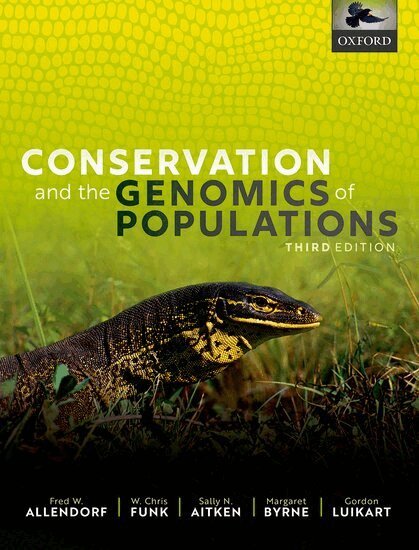
    Conservation and the Genomics of Populations

    AvFred W. Allendorf,W. Chris Funk

    Häftad, Engelska, 2022

    Del i serien Oxford University Press

    772 kr

    Beställningsvara. Skickas inom 5-8 vardagar. Fri frakt över 249 kr.

    Fler format och utgåvor

    Inbunden

    1 935 kr

    Beskrivning

    The relentless loss of biodiversity is among the greatest problems facing the world today. The third edition of this established textbook provides an updated and comprehensive overview of the essential background, concepts, and tools required to understand how genetics can be used to conserve species, reduce threat of extinction, and manage species of ecological or commercial importance. This edition is thoroughly revised to reflect the major contribution of genomics to conservation of populations and species. It includes two new chapters: "Genetic Monitoring" and a final "Conservation Genetics in Practice" chapter that addresses the role of science and policy in conservation genetics. New genomic techniques and statistical analyses are crucial tools for the conservation geneticist. This accessible and authoritative textbook provides an essential toolkit grounded in population genetics theory, coupled with basic and applied research examples from plants, animals, and microbes. The book examines genetic and phenotypic variation in natural populations, the principles and mechanisms of evolutionary change, evolutionary response to anthropogenic change, and applications in conservation and management.Conservation and the Genomics of Populations helps demystify genetics and genomics for conservation practitioners and early career scientists, so that population genetic theory and new genomic data can help raise the bar in conserving biodiversity in the most critical 20 year period in the history of life on Earth. It is aimed at a global market of applied population geneticists, conservation practitioners, and natural resource managers working for wildlife and habitat management agencies. It will be of particular relevance and use to upper undergraduate and graduate students taking courses in conservation biology, conservation genetics, and wildlife management.

    Produktinformation

    • Utgivningsdatum:2022-02-15
    • Mått:190 x 248 x 38 mm
    • Vikt:1 686 g
    • Format:Häftad
    • Språk:Engelska
    • Serie:Oxford University Press
    • Antal sidor:672
    • Upplaga:3
    • Förlag:OUP OXFORD
    • Illustratör:Agostinho Antunes
    • ISBN:9780198856573

    Utforska kategorier

    • Miljövetenskap och miljöpolitik inom Naturvetenskap och teknik
    • Biovetenskap inom Naturvetenskap och teknik

    Mer om författaren

    Fred W. Allendorf is a Regents Professor Emeritus at the University of Montana, USA. He was awarded the Molecular Ecology Prize in 2015, and he was elected to the American Academy of Arts and Science in 2019. He is a past President of the American Genetic Association, and former Director of the Population Biology Program of the US National Science Foundation. He has taught conservation genetics throughout the world, including the University of Western Australia, the Victoria University of Wellington, the University of Costa Rica, the Organization for Tropical Studies in Costa Rica, and the National Zoological Garden of South Africa.W. Chris Funk is a Professor in the Department of Biology and Director of the Global Biodiversity Center at Colorado State University, USA. He has published over 100 articles on the conservation genomics and evolutionary ecology of amphibians, fish, birds, mammals, and stream insects in North and South America. He is a Leopold Leadership Fellow and was a Fulbright Scholar at the Universidad del Los Andes, Bogotá, Colombia. He is actively involved in improving the incorporation of genetics into international conservation policy as a member of the IUCN Conservation Genetics Specialist Group, GEO BON Genetic Composition Working Group, and SCB Conservation Genetics Working Group.Sally N. Aitken is a Professor in the Department of Forest and Conservation Sciences in the Faculty of Forestry at the University of British Columbia, Canada. She leads the Centre for Forest Conservation Genetics. Her research integrates genomic, phenotypic, and climatic data to understand the processes driving local adaptation to climate, and how management can facilitate the adaptation of populations to new climates and other threats. She received the Canadian Forestry Scientific Achievement Award in 2009, the International Union of Forest Research Organization's Scientific Achievement Award in 2014, and was elected a Fellow of the Royal Society of Canada in 2017.Margaret Byrne is Executive Director of Biodiversity and Conservation Science in the Western Australian Department of Biodiversity, Conservation and Attractions, and is an Adjunct Professor at the University of Western Australia and Curtin University in Western Australia. She serves on the Australian Academy of Sciences National Committee for Ecology, Evolution and Conservation, and the Management Committee for the Genetics Society of Australasia. She undertakes conservation genetics research to inform biodiversity conservation strategies for rare and threatened species and for management of landscapes, including climate adaptation. She leads a strong science group providing an evidence-based approach to conservation management and policy in Western Australia.Gordon Luikart is a Professor at the University of Montana, USA. He has published numerous articles on the conservation and genetics of fish, mammals, and insects. He was a Fulbright Scholar at Latrobe University in Melbourne Australia, and won a Bronze medal as top scientist in France's CNRS. He was named one of the “Most Influential Scientific Minds” in 2014 by Thomson Reuters for publishing highly-cited papers. He taught conservation genetics in Portugal, South Africa, and globally on-line. He actively works to incorporate genetics into conservation as a member of the IUCN Conservation Genetics Specialist Group, and GEO BON Genetic Working Groups.

    Recensioner i media

    This textbook is foremost a great reference for upper level undergraduate or graduate courses, as well as a good go-to reference for conservation genetic professionals. As a teaching resource, the plentiful boxes and guest boxes that present recent literature and contextual examples provide great platforms for student discussion and improved comprehension.

    Innehållsförteckning

    • Preface PART I: INTRODUCTION 1: Introduction 2: Phenotypic Variation in Natural Populations 3: Genetic Variation in Natural Populations 4: Population Genomics PART II: MECHANISMS OF EVOLUTIONARY CHANGE 5: Random Mating Populations: Hardy-Weinberg Principle 6: Small Populations and Genetic Drift 7: Effective Population Size 8: Natural Selection 9: Population Subdivision 10: Beyond Individual Loci 11: Quantitative Genetics 12: Mutation PART III: EVOLUTIONARY RESPONSE TO ANTHROPOGENIC CHANGES 13: Hybridization 14: Invasive Species 15: Exploited Populations 16: Climate Change PART IV: CONSERVATION AND MANAGEMENT 17: Inbreeding Depression 18: Demography and Extinction 19: Population Connectivity 20: Units of Conservation 21: Conservation Breeding and Restoration 22: Genetic Identification 23: Genetic Monitoring 24: guest chapter author Helen R. Taylor: Conservation Genetics in Practice Glossary COMPANION WEBSITE MATERIALS (Available at www.oup.com/companion/AllendorfCGP3e ) Appendix: Probability, Statistics, and Coding References