• Fri frakt över 249 kr
  • •
  • Snabba leveranser
  • •
  • Billiga böcker
Kundservice

Du är på sajten för privatpersoner.

Företag, bibliotek eller offentlig verksamhet?

Du handlar på classic.bokus.com, där alla dina funktioner finns intakta.
Till classic.bokus.com
Bokus logotyp. Gå till startsidan.
  • Erbjudanden
  • Nyheter
  • Student
  • Topplistor
  • Barn & ungdom
  • Bokus Play
  • E-böcker
  • Pocketböcker
  • Spel & pussel

Må bättre, för mindre! Upp till 50% rabatt på hälsoböcker

Sidfot

Mina sidor

    Hjälp

    • Kundservice
    • Vanliga frågor och svar
    • Frakt och leverans
    • Retur vid ångerrätt
    • Reklamera vara
    • Betalning
    • Köpvillkor
    • Allmänna villkor
    • Information om webbplatsens tillgänglighet

    Om Bokus

    • Om oss
    • Pressrum
    • För studenter
    • För företag
    • För bibliotek och offentlig verksamhet
    • För leverantörer
    • Hållbarhet

    Populärt

    • Aktuella erbjudanden
    • Presentkort
    • Studentlitteratur
    • Nya böcker
    • Topplistor
    • Signerade böcker
    • Engelska böcker

    Inspiration

    • Boktips
    • BookTok
    • Populära bokserier
    • Barnbokskaraktärer
    • Populära författare
    Logotyp för Bokus
    Följ oss på Facebook (extern länk)Följ oss på Instagram (extern länk)Följ oss på YouTube (extern länk)Följ oss på TikTok (extern länk)
    bokus @ CookiesAnpassa cookiesIntegritetspolicyKöpvillkor
    Till Citymail hemsida (extern länk)Till Budbee hemsida (extern länk)Till Postnord hemsida (extern länk)Till Schenker hemsida (extern länk)Till Early Bird hemsida (extern länk)Till Walleys hemsida (extern länk)
    1. Data och IT
    2. Systemvetenskap och AI

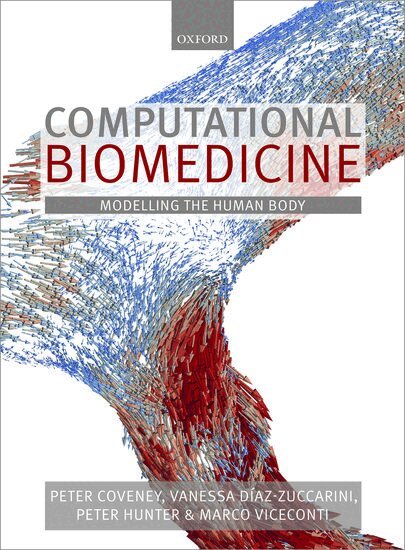
    Computational Biomedicine

    AvPeter Coveney,Vanessa Díaz-Zuccarini

    Häftad, Engelska, 2014

    967 kr

    Beställningsvara. Skickas inom 7-10 vardagar. Fri frakt över 249 kr.

    Beskrivning

    By the end of the twenty-first century, computer-based modelling and simulation will be integral to the way clinical decisions are taken. Drugs will be selected on the basis of an individual patient's "digital profile", while clinical treatments will be tailor-made for the individual in question. For this to come to pass, however, we must prepare for a future where we can simulate our own bodies with precision, drawing upon remarkable advances in information technology, computer, mathematical, physical and engineering science, data management, and high performance computing. Computational Biomedicine lays the foundations for a new approach to the subject - one that unifies the different strands of a broad-ranging subject, and demonstrates how computational biomedicine is a powerful tool with the potential to revolutionise our understanding of the human body, and the therapeutic strategies available to maintain and protect it.Written by a team of world-leading experts in the field, it explores the modelling of physiological systems at different scales - cells, tissues, organs - before considering the issues around biomedical computing, and data collection and analysis. It emphasises how a theoretical understanding of computational biomedicine translates into practice, with illustrative examples and case studies used throughout.Computational Biomedicine is the perfect introduction to the subject for anyone new to the field, from student to researcher. Online Resource CentreThe Online Resource Centre to accompany Computational Biomedicine features figures from the book in electronic format, for download by registered adopters.

    Produktinformation

    • Utgivningsdatum:2014-06-12
    • Mått:195 x 264 x 13 mm
    • Vikt:632 g
    • Format:Häftad
    • Språk:Engelska
    • Antal sidor:296
    • Förlag:OUP OXFORD
    • ISBN:9780199658183

    Utforska kategorier

    • Systemvetenskap och AI inom Data och IT
    • Medicinsk bildbehandling inom Medicin
    • Biologi inom Naturvetenskap och teknik

    Mer om författaren

    Professor Peter Coveney, Centre for Computational Science, University College LondonDr Vanessa Díaz-Zuccarini, Department of Mechanical Engineering, University College LondonProfessor Peter Hunter, Auckland Bioengineering Institute, New ZealandProfessor Marco Viceconti, Department of Mechanical Engineering , The University of Sheffield

    Innehållsförteckning

    • 1. Introduction ; 2. Molecular Foundations of Computational Bioscience ; 2.1 Introduction ; 2.2 Types of Omics Data ; 2.3 Databases and Data Sources ; 2.4 Management of Omics Data Types ; 2.5 Software Systems and Interoperability ; 2.6 Clinical Phenotypes, Security and Data Sharing ; 2.7 Conclusions ; 3. Understanding the Genotype-Phenotype Relationship ; 3.1 Introduction ; 3.2 Quantitative Genetics Theory ; 3.3 Systems Genetics ; 3.4 Implementing CGP Models ; 3.5 CGP Applications ; 3.6 Linking CGP Models to Data ; 3.7 Conclusions ; 4. Image Based Modelling ; 4.1 Introduction ; 4.2 Biomedical Imaging Techniques ; 4.3 Image Based Modelling ; 4.4 Medical Image Simulation ; 4.5 Statistical Atlases, Populational Imaging and Modelling ; 4.6 Open Source Image Modelling Tools ; 4.7 Conclusions ; 5. Modelling Cell Function ; 5.1 Introduction ; 5.2 General Cell Functions ; 5.3 Cell Fundamentals ; 5.4 Levels of Abstraction ; 5.5 Cell Simulation ; 5.6 Approaches to Modelling and Simulation ; 5.7 Simulation Tools ; 5.8 Example: An Agent Model in Skeletal Mechanobiology ; 5.9 Reproducible Modelling: Ordinary Differential Equations ; 5.10 Conclusions ; 6. Modelling Tissues and Organs ; 6.1 Introduction ; 6.2 Modelling Epithelia ; 6.3 Cardiac Modelling ; 6.4 Modelling the Gastro-Intestinal Tract ; 6.5 Modelling Kidney Function and Homeostasis ; 6.6 General Homeostasis and Blood Pressure Regulation ; 6.7 Conclusions ; 7. Multi-Scale Modelling ; 7.1 Introduction ; 7.2 Why Multi-Scale Modelling? ; 7.3 A Framework for Multi-Scale Modelling and Computing ; 7.4 Scale Bridging ; 7.5 Multi-Scale Computing ; 7.6 Example of a Multiscale Model: In-Stent Restenosis in Coronary Arteries ; 7.7 Conclusions ; 8. Workflows: Principles, Tools and Clinical Applications ; 8.1 Introduction: What is a Workflow? ; 8.2 Computational Workflows ; 8.3 Workflow Implementations ; 8.4 Provenance ; 8.5 Examples of Scientific Workflows ; 8.6 Key Considerations ; 8.7 Conclusions ; 9. Distributed Biomedical Computing ; 9.1 Introduction ; 9.2 Parallel Applications ; 9.3 The Computational Ecosystem ; 9.4 Computing Beyond the Desktop ; 9.5 Simulations in a High Performance Computing Environment ; 9.6 Case Study 1: Calculating Drug Binding Affinities ; 9.7 Computational Infrastructures ; 9.8 Distributed Applications ; 9.9 Orchestrated Workflows from Distributed Applications ; 9.10 Case Study 2: Computational Investigations of Cranial Haemodynamics ; 9.11 Conclusions ; 10. Managing Security and Privacy of Patient Data Sharing Platforms ; 10.1 Introduction ; 10.2 Legal Background ; 10.3 Brief Overview of Information Security Concepts ; 10.4 Common Data Sharing Requirements ; 10.5 The Data Sharing Lifecycle ; 10.6 Data Warehousing Architecture ; 10.7 Conclusions ; 11. Toward Clinical Deployment: Verification and Validation of Models ; 11.1 Introduction: Technology Assessment versus Health Assessment ; 11.2 Code and Model Verification ; 11.3 Sensitivity Analysis ; 11.4 Model Validation ; 11.5 Validation of Integrative Models ; 11.6 Clinical Accuracy ; 11.7 Efficacy, Risk and Cost-Benefit ; 11.8 Impact ; 11.9 Sustainability ; 11.10 Conclusions ; Appendix: Modelling Standards and Model Repositories ; A.1 Introduction ; A.2 Infrastructure for Computational Biomedicine ; A.3 Syntax, Semantics and Annotation of Models ; A.4 Markup Languages ; A.5 Model Repositories ; A.6 Conclusions