• Fri frakt över 249 kr
  • •
  • Snabba leveranser
  • •
  • Billiga böcker
Kundservice

Du är på sajten för privatpersoner.

Företag, bibliotek eller offentlig verksamhet?

Du handlar på classic.bokus.com, där alla dina funktioner finns intakta.
Till classic.bokus.com
Bokus logotyp. Gå till startsidan.
  • Erbjudanden
  • Student
  • Topplistor
  • Barn & ungdom
  • Bokus Play
  • E-böcker
  • Ljudböcker
  • Pocketböcker
  • Spel och pussel

5% studentrabatt – använd koden KURSBOK27 →

Sidfot

Mina sidor

    Hjälp

    • Kundservice
    • Vanliga frågor och svar
    • Frakt och leverans
    • Retur vid ångerrätt
    • Reklamera vara
    • Betalning
    • Köpvillkor
    • Allmänna villkor
    • Information om webbplatsens tillgänglighet

    Om Bokus

    • Om oss
    • Pressrum
    • För studenter
    • För företag
    • För bibliotek och offentlig verksamhet
    • För leverantörer
    • Hållbarhet

    Populärt

    • Aktuella erbjudanden
    • Presentkort
    • Studentlitteratur
    • Nya böcker
    • Topplistor
    • Signerade böcker
    • Engelska böcker

    Inspiration

    • Boktips
    • BookTok
    • Barnbokskaraktärer
    • Populära författare
    Logotyp för Bokus
    Följ oss på Facebook (extern länk)Följ oss på Instagram (extern länk)Följ oss på YouTube (extern länk)Följ oss på TikTok (extern länk)
    bokus @ CookiesAnpassa cookiesIntegritetspolicyKöpvillkor
    Till Citymail hemsida (extern länk)Till Budbee hemsida (extern länk)Till Postnord hemsida (extern länk)Till Schenker hemsida (extern länk)Till Early Bird hemsida (extern länk)Till Walleys hemsida (extern länk)
    1. Ekonomi och Ledarskap
    2. Nationalekonomi
    3. Ekonomisk politik

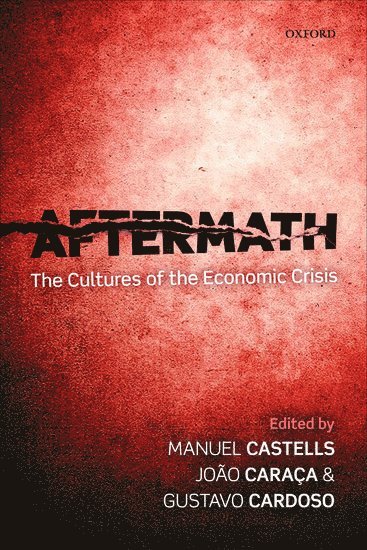
    Aftermath

    The Cultures of the Economic Crisis

    AvManuel Castells,Joao Caraca

    Inbunden, Engelska, 2012

    1 267 kr

    Beställningsvara. Skickas inom 3-6 vardagar. Fri frakt över 249 kr.

    Fler format och utgåvor

    Häftad

    460 kr

    Beskrivning

    The crisis of global capitalism that has unfolded since 2008 is more than an economic crisis. It is structural and multidimensional. The sequence of events that have taken place in its aftermath show that we are entering a world that is very different from the social and economic conditions that characterized the rise of global, informational capitalism in the preceding three decades. The policies and strategies that intended to manage the crisis-with mixed results depending on the country-may usher in a distinctly different economic and institutional system, as the New Deal, the construction of the European Welfare State, and the Bretton Woods global financial architecture all gave rise to a new form of capitalism in the aftermath of the 1930s Depression, and World War II.This volume examines the cultures and institutions at the root of the crisis, as well as the conflicts and debates that lead to a new social landscape, including the rise of alternative economic cultures expressed in the social movements occupying Wall Street. The book presents the results of a shared project of reflection by an interdisciplinary group of researchers from around the world. It contends that there is no quick fix to the current financial and political system. Life beyond the crisis requires a transformation of the mindset that led to bankruptcy and despair, and to economies and societies based on an unsustainable model of speculative finance and political irresponsibility. The book explains why and explores the contours of the world emerging in the aftermath of the crisis.

    Produktinformation

    • Utgivningsdatum:2012-07-26
    • Mått:164 x 243 x 23 mm
    • Vikt:634 g
    • Format:Inbunden
    • Språk:Engelska
    • Antal sidor:330
    • Förlag:OUP OXFORD
    • ISBN:9780199658411
    • Utmärkelser:Manuel Castells was awarded the Holberg International Memorial Prize in 2012

    Utforska kategorier

    • Ekonomisk politik inom Ekonomi och Ledarskap
    • Finanskriser inom Ekonomi och Ledarskap
    • Sociologi inom Samhälle och politik

    Mer om författaren

    Manuel Castells is University Professor and the Wallis Annenberg Chair of Communication Technology and Society at the University of Southern California. He is also Professor Emeritus of Sociology and Planning, University of California, Berkeley, where he taught for 24 years. He is a Fellow of the American Academy of Political and Social Science, of the Academia Europaea, of the Spanish Royal Academy of Economics, and of the British Academy. His main books include the trilogy The Information Age: Economy, Society, and Culture (Blackwell, 1996-2003) and Communication Power (OUP, 2009). He was a founding member of the board of the European Research Council and is a member of the Governing Board of the European Institute of Innovation and Technology. João Caraça obtained a D. Phil. in Nuclear Physics at the University of Oxford and the Agregação in Physics at the Lisbon Faculty of Sciences. He is Director of the Science Department of the Calouste Gulbenkian Foundation, Lisbon and also Full Professor of Science and Technology Policy at the Instituto Superior de Economia e Gestão of the Universidade Técnica de Lisboa. He is member of the Governing Board of the European Institute of Innovation and Technology - EIT. He also integrates the Steering Group of the European Forum on Philanthropy and Research Funding and is President of the Advisory Board of the Portuguese Business Association for Innovation - COTEC. He was Science Adviser of the President of the Portuguese Republic (1996-2006), has published over 150 scientific papers, and co-authored Limits to Competition (1995), co-edited O Futuro Tecnológico (1999) and collaborated in Le Printemps du Politique (2007).Gustavo Cardoso is Professor of Media and Society at IUL - Lisbon University Institute. His areas of interest are the cultures of the network society, the transformations of the notions of property, distribution and production of cultural goods, and the role of online social networking. Between 1996 and 2006 he was advisor on Information Society and telecommunications policies to the Presidency of the Portuguese Republic and in 2008 was chosen by the World Economic Forum as a Young Global Leader. His international cooperation in European research networks led him to work with IN3 (Internet Interdisciplinary Institute) in Barcelona, WIP (World Internet Project) at USC Annenberg, COST A20 "The Impact of the Internet in Mass Media" and COST 298 "Broadband Society." During the last five years he has been the Director of OberCom media observatory in Lisbon and is deputy chairman of the board of LUSA, the Portuguese global news agency.

    Recensioner i media

    The discussion of the crisis of global capitalism offered in this book marks a breakthrough. The work ranges far more widely than the usual crop of purely economic analyses and rightly so.

    Innehållsförteckning

    • PRELUDE; WHICH CRISIS? WHOSE CRISIS?; DEALING WITH THE CRISIS; BEYOND THE CRISIS; THE NON-GLOBAL GLOBAL CRISIS; AFTERMATH?