• Fri frakt över 249 kr
  • •
  • Snabba leveranser
  • •
  • Billiga böcker
Kundservice

Du är på sajten för privatpersoner.

Företag, bibliotek eller offentlig verksamhet?

Du handlar på classic.bokus.com, där alla dina funktioner finns intakta.
Till classic.bokus.com
Bokus logotyp. Gå till startsidan.
  • Erbjudanden
  • Nyheter
  • Student
  • Topplistor
  • Barn & ungdom
  • Bokus Play
  • E-böcker
  • Pocketböcker
  • Spel & pussel

10% rabatt på allt med kod: NYSTART10 →

Sidfot

Mina sidor

    Hjälp

    • Kundservice
    • Vanliga frågor och svar
    • Frakt och leverans
    • Retur vid ångerrätt
    • Reklamera vara
    • Betalning
    • Köpvillkor
    • Allmänna villkor
    • Information om webbplatsens tillgänglighet

    Om Bokus

    • Om oss
    • Pressrum
    • För studenter
    • För företag
    • För bibliotek och offentlig verksamhet
    • För leverantörer
    • Hållbarhet

    Populärt

    • Aktuella erbjudanden
    • Presentkort
    • Studentlitteratur
    • Nya böcker
    • Topplistor
    • Signerade böcker
    • Engelska böcker

    Inspiration

    • Boktips
    • BookTok
    • Populära bokserier
    • Barnbokskaraktärer
    • Populära författare
    Logotyp för Bokus
    Följ oss på Facebook (extern länk)Följ oss på Instagram (extern länk)Följ oss på YouTube (extern länk)Följ oss på TikTok (extern länk)
    bokus @ CookiesAnpassa cookiesIntegritetspolicyKöpvillkor
    Till Citymail hemsida (extern länk)Till Budbee hemsida (extern länk)Till Postnord hemsida (extern länk)Till Schenker hemsida (extern länk)Till Early Bird hemsida (extern länk)Till Walleys hemsida (extern länk)
    1. Samhälle och politik
    2. Samhälle och kultur
    3. Kultur och medier
    4. Referensverk och tvärvetenskap

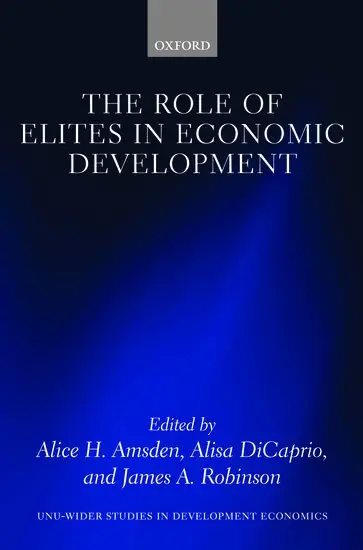
    The Role of Elites in Economic Development

    AvAlice H. Amsden,the late Alice H. Amsden

    Inbunden, Engelska, 2012

    Del i serien WIDER Studies in Development Economics

    2 381 kr

    Skickas . Fri frakt över 249 kr.

    Beskrivning

    Elites have a disproportionate impact on development outcomes. While a country's endowments constitute the deep determinates of growth, the trajectory they follow is shaped by the actions of elites. But what factors affect whether elites use their influence for individual gain or national welfare? To what extent do they see poverty as a problem? And are their actions today constrained by institutions and norms established in the past? This volume looks at case studies from South Africa to China to seek a better understanding of the dynamics behind how elites decide to engage with economic development. Approaches include economic modelling, social surveys, theoretical analysis, and program evaluation. These different methods explore the relationship between elites and development outcomes from five angles: the participation and reaction of elites to institutional creation and change, how economic changes affect elite formation and circulation, elite perceptions of national welfare, the extent to which state capacity is part of elite self-identity, and how elites interact with non-elites.

    Produktinformation

    • Utgivningsdatum:2012-09-27
    • Mått:162 x 240 x 27 mm
    • Vikt:734 g
    • Format:Inbunden
    • Språk:Engelska
    • Serie:WIDER Studies in Development Economics
    • Antal sidor:398
    • Förlag:OUP OXFORD
    • ISBN:9780199659036

    Utforska kategorier

    • Referensverk och tvärvetenskap inom Samhälle och politik
    • Internationell ekonomi inom Ekonomi och Ledarskap
    • Miljöekonomi inom Ekonomi och Ledarskap

    Mer om författaren

    Alice Amsden (now deceased) was Barton L. Weller Professor of Development Economics at the Massachusetts Institute of Technology. She authored Asia's Next Giant and the Rise of 'The Rest'. Most recently, she criticized the 'capabilities' approach to poverty alleviation, arguing that healthier and more educated job seekers cannot get jobs because there are none, and they cannot lower their subsistence wage any further. Some of her last work, alongside co-directing the UNU-WIDER research project and co-editing the resulting volume on the role of elites, was on a manuscript entitled 'The Rational Revolution: Learning from Role Models, Deserting Deductive Theory', which maintains that countries develop by studying what each other do, not from poring over Enlightenment propositions in their orthodox or modern manifestation.Alisa DiCaprio is a Research Fellow at United Nations University's World Institute for Development Economics Research. Prior to joining UNU-WIDER, she was a Post-Doctoral Fellow at New York University's Alexander Hamilton Center for Political Economy. In addition to her academic work, she has worked in the public and private sector supporting US trade policy, researching emerging market opportunities for exporters, and organizing unions in the healthcare sector.James Robinson is David Florence Professor of Government at Harvard University and a faculty associate at the Institute for Quantitative Social Science. Professor Robinson studied economics at the London School of Economics, the University of Warwick, and Yale University. He previously taught in the Department of Economics at the University of Melbourne and the University of Southern California. Before moving to Harvard he was a Professor in the Departments of Economics and Political Science at the University of California at Berkeley. His main research interest is the political economy of development with a particular interest in Latin America and Sub-Saharan Africa.

    Innehållsförteckning

    • PART I: THEORETICAL CONSIDERATIONS ; PART II: THE FORMATION AND CIRCULATION OF ELITES ; PART III: THE PREFERENCES OF ELITES ; PART IV: ELITES AND STATE CAPACTIY ; PART V: GRASSROOTS RESPONSES TO ELITES