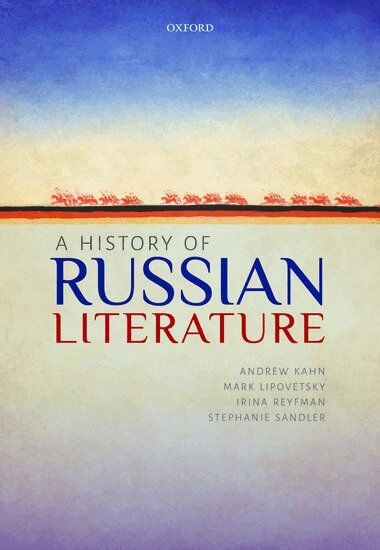
Inbunden, Engelska, 2018
A History of Russian Literature
Av Andrew Kahn, Mark Lipovetsky, Irina Reyfman, Stephanie Sandler
1976 kr
Beställningsvara. Skickas inom 7-10 vardagar. Fri frakt över 249 kr.
Fler format och utgåvor
Beskrivning
Produktinformation
- Utgivningsdatum: 2018-04-19
- Mått: 180 x 254 x 69 mm
- Vikt: 1 449 g
- Format: Inbunden
- Språk: Engelska
- Antal sidor: 960
- Förlag: OUP OXFORD
- ISBN: 9780199663941
- Utmärkelser: Finalist of the 2019 PROSE Award in Literature by the Association of American Publishers Honourable Mention from the MLA Aldo and Jeanne Scaglione Prize for Studies in Slavic Languages and Literatures
Utforska kategorier
Mer om författaren
Andrew Kahn is Professor of Russian Literature at the University of Oxford. He has published widely on Russian Enlightenment literature and on Russian poetry, including Pushkin's Lyric Intelligence (OUP, 2008, pbk. 2012). His studies often focus on the interplay between the history of ideas and how writers think with literature.Mark Lipovetsky is Professor of Russian Studies at the University of Colorado at Boulder (USA). He is the author of seven books on Russian literature and culture including Russian Postmodernist Fiction: Dialogue with Chaos (1999), Paralogies: Transformations of the (Post)Modernist Discourse in Russian Culture of the 1920s-2000s (2008), and Performing Violence: Literary and Theatrical Experiments of New Russian Drama (with Birgit Beumers). He has co-edited the volume of Dictionary of Literary Biography: Russian Writers Since 1980 (Gale Group in 2003), an anthology of Russian and Soviet wondertales, Politicizing Magic (2005), Veselye chelovechki: Cult Heroes of Soviet Childhood (2008) , and A Non-Canonical Classic: D. A. Prigov (2010), Charms of Cynical Reason: the Trickster's Transformations in Soviet and post-Soviet Culture (2011), and edited (with Evgeny Dobrenko) Russian Literature since 1991 (CUP, 2015).Irina Reyfman is professor of Russian Language and Literature at Columbia University. In her studies, Reyfman focuses on the interaction of literature and culture, examining both how literature reacts to cultural phenomena and how it contributes to the formation of cultural biases and forms of behavior. Reyfman is the author of How Russia Learned to Write: Literature and the Imperial Table of Rannks (Madison, Wisconsin, 2016), Vasilii Trediakovsky: The Fool of the `New' Russian Literature (Stanford, 1990), and Ritualized Violence Russian Style: The Duel in Russian Culture and Literature (Stanford, 1999); the latter book also appeared in Russian (Moscow: Novoe Literaturnoe obozrenie, 2002). She is also a co-editor (with Catherine T. Nepomnyashchy and Hilde Hoogenboom) of Mapping the Feminine: Russian Women and Cultural Difference (Bloomington, IN: Slavica, 2008).Stephanie Sandler is the Ernest E. Monrad Professor of Slavic Languages and Literatures at Harvard University. She has written on Pushkin and later myths about him, including Distant Pleasures: Alexander Pushkin and the Writing of Exile (1989) and Commemorating Pushkin: Russia's Myth of a National Poet (2004). Other interests include ideas of selfhood and identity in Russian literature and film, which led to a co-edited volume, Self and Story in Russian History (2000, with Laura Engelstein); and questions of sex and gender, subject of another edited volume, Sexuality and the Body in Russian Culture (1993, 1998, with Jane Costlow and Judith Vowles). She has co-edited a pioneering collection of essays on the contemporary poet Olga Sedakova, published in Russia in 2017 and due out in English with University of Wisconsin Press.
Recensioner i media
This exhaustive volume represents a very significant contribution to the bibliography of Russian literary history from the medieval to the modern period. In its scope, conception and engagement with scholarship, this is the kind of account which comes along only once every generation, a work informed by the lifelong study of four preeminent scholars of Russian literature from both sides of the Atlantic. ...The authors have been extraordinarily thorough throughout in their generous engagement with the scholarship and secondary literature in both Russian and English. ...It will inevitably feature in the comprehensive exam lists of all graduate students of Russian literature.
Betyg & recensioner
0 recensioner
Inga recensioner tillgängliga.