• Fri frakt över 249 kr
  • •
  • Snabba leveranser
  • •
  • Billiga böcker
Kundservice

Du är på sajten för privatpersoner.

Företag, bibliotek eller offentlig verksamhet?

Du handlar på classic.bokus.com, där alla dina funktioner finns intakta.
Till classic.bokus.com
Bokus logotyp. Gå till startsidan.
  • Erbjudanden
  • Nyheter
  • Student
  • Topplistor
  • Barn & ungdom
  • Bokus Play
  • E-böcker
  • Pocketböcker
  • Spel & pussel

10% rabatt på allt med kod: NYSTART10 →

Sidfot

Mina sidor

    Hjälp

    • Kundservice
    • Vanliga frågor och svar
    • Frakt och leverans
    • Retur vid ångerrätt
    • Reklamera vara
    • Betalning
    • Köpvillkor
    • Allmänna villkor
    • Information om webbplatsens tillgänglighet

    Om Bokus

    • Om oss
    • Pressrum
    • För studenter
    • För företag
    • För bibliotek och offentlig verksamhet
    • För leverantörer
    • Hållbarhet

    Populärt

    • Aktuella erbjudanden
    • Presentkort
    • Studentlitteratur
    • Nya böcker
    • Topplistor
    • Signerade böcker
    • Engelska böcker

    Inspiration

    • Boktips
    • BookTok
    • Populära bokserier
    • Barnbokskaraktärer
    • Populära författare
    Logotyp för Bokus
    Följ oss på Facebook (extern länk)Följ oss på Instagram (extern länk)Följ oss på YouTube (extern länk)Följ oss på TikTok (extern länk)
    bokus @ CookiesAnpassa cookiesIntegritetspolicyKöpvillkor
    Till Citymail hemsida (extern länk)Till Budbee hemsida (extern länk)Till Postnord hemsida (extern länk)Till Schenker hemsida (extern länk)Till Early Bird hemsida (extern länk)Till Walleys hemsida (extern länk)
    1. Samhälle och politik
    2. Samhälle och kultur
    3. Kultur och medier
    4. Kulturvetenskap

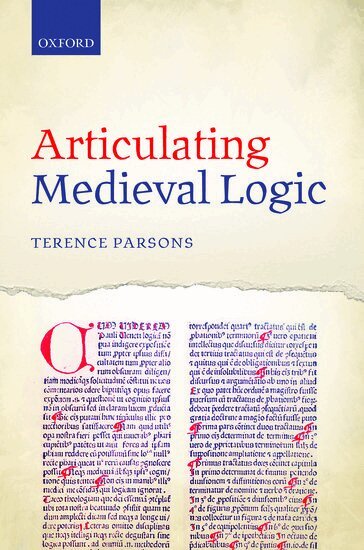
    Articulating Medieval Logic

    AvTerence Parsons

    Inbunden, Engelska, 2014

    1 967 kr

    Beställningsvara. Skickas inom 5-8 vardagar. Fri frakt över 249 kr.

    Fler format och utgåvor

    E-bok

    1 367 kr

    Beskrivning

    Terence Parsons presents a new study of the development and logical complexity of medieval logic. Basic principles of logic were used by Aristotle to prove conversion principles and reduce syllogisms. Medieval logicians expanded Aristotle's notation in several ways, such as quantifying predicate terms, as in 'No donkey is every animal', and allowing singular terms to appear in predicate position, as in 'Not every donkey is Brownie'; with the enlarged notation come additional logical principles. The resulting system of logic is able to deal with relational expressions, as in De Morgan's puzzles about heads of horses. A crucial issue is a mechanism for dealing with anaphoric pronouns, as in 'Every woman loves her mother'. Parsons illuminates the ways in which medieval logic is as rich as contemporary first-order symbolic logic, though its full potential was not envisaged at the time. Along the way, he provides a detailed exposition and examination of the theory of modes of common personal supposition, and the useful principles of logic included with it. An appendix discusses the artificial signs introduced in the fifteenth century to alter quantifier scope.

    Produktinformation

    • Utgivningsdatum:2014-02-27
    • Mått:162 x 240 x 30 mm
    • Vikt:676 g
    • Format:Inbunden
    • Språk:Engelska
    • Antal sidor:346
    • Förlag:OUP OXFORD
    • ISBN:9780199688845

    Utforska kategorier

    • Kulturvetenskap inom Samhälle och politik
    • Filosofiska discipliner inom Filosofi och religion

    Mer om författaren

    Terence Parsons was born and raised in Endicott, New York. He attended the University of Rochester as a physics major, receiving a BA degree. He received a PhD in Philosophy from Stanford University. He was a full time faculty member at the University of Illinois at Chicago from 1965 to 1972, at the University of Massachusetts at Amherst from 1972 to 1979, at the University of California at Irvine from 1979 to 2000, and at the University of California at Los Angeles from 2000 to 2012. He also visited briefly at the University of California at Berkeley and the University of Pittsburgh.

    Recensioner i media

    It's a book that I found admirable for the scope of its accomplishment, and a book I came away from reading with a deeper understanding of the complexities and sophistication of certain aspects of medieval logic.

    Innehållsförteckning

    • Preface ; Introduction ; 1. An Overview of Aristotelian Logic as seen by Medieval Logicians ; 2. Aristotle's Proofs of Conversions and Syllogisms ; 3. Quantifying Predicates, Singular Term Predicates, Negative Terms ; 4. Linguish ; 5. Expanding the Notation ; 6. Some Illustrative Topics ; 7. Modes of Personal Supposition ; 8. Relatives (Anaphoric Words) ; 9. Comparison of Medieval Logic with Contemporary Logic ; 10. Ampliation and Restriction ; Appendix: Artificial Quantifiers in Early 16th Century Logic ; Bibliography ; Index