• Fri frakt över 249 kr
  • •
  • Snabba leveranser
  • •
  • Billiga böcker
Kundservice

Du är på sajten för privatpersoner.

Företag, bibliotek eller offentlig verksamhet?

Du handlar på classic.bokus.com, där alla dina funktioner finns intakta.
Till classic.bokus.com
Bokus logotyp. Gå till startsidan.
  • Erbjudanden
  • Nyheter
  • Student
  • Topplistor
  • Barn & ungdom
  • Bokus Play
  • E-böcker
  • Pocketböcker
  • Spel & pussel

10% rabatt på allt med kod: NYSTART10 →

Sidfot

Mina sidor

    Hjälp

    • Kundservice
    • Vanliga frågor och svar
    • Frakt och leverans
    • Retur vid ångerrätt
    • Reklamera vara
    • Betalning
    • Köpvillkor
    • Allmänna villkor
    • Information om webbplatsens tillgänglighet

    Om Bokus

    • Om oss
    • Pressrum
    • För studenter
    • För företag
    • För bibliotek och offentlig verksamhet
    • För leverantörer
    • Hållbarhet

    Populärt

    • Aktuella erbjudanden
    • Presentkort
    • Studentlitteratur
    • Nya böcker
    • Topplistor
    • Signerade böcker
    • Engelska böcker

    Inspiration

    • Boktips
    • BookTok
    • Populära bokserier
    • Barnbokskaraktärer
    • Populära författare
    Logotyp för Bokus
    Följ oss på Facebook (extern länk)Följ oss på Instagram (extern länk)Följ oss på YouTube (extern länk)Följ oss på TikTok (extern länk)
    bokus @ CookiesAnpassa cookiesIntegritetspolicyKöpvillkor
    Till Citymail hemsida (extern länk)Till Budbee hemsida (extern länk)Till Postnord hemsida (extern länk)Till Schenker hemsida (extern länk)Till Early Bird hemsida (extern länk)Till Walleys hemsida (extern länk)
    1. Naturvetenskap och teknik
    2. Teknik och industri
    3. Biokemisk teknik

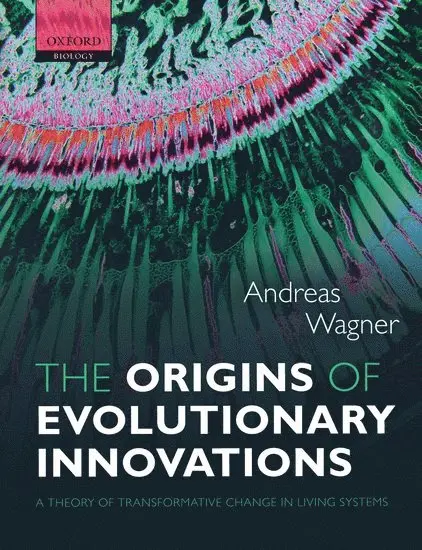
    The Origins of Evolutionary Innovations

    A Theory of Transformative Change in Living Systems

    AvAndreas Wagner

    Häftad, Engelska, 2011

    1 032 kr

    Beställningsvara. Skickas inom 7-10 vardagar. Fri frakt över 249 kr.

    Fler format och utgåvor

    Inbunden

    2 766 kr

    Beskrivning

    The history of life is a nearly four billion year old story of transformative change. This change ranges from dramatic macroscopic innovations such as the evolution of wings or eyes, to a myriad of molecular changes that form the basis of macroscopic innovations. We are familiar with many examples of innovations (qualitatively new phenotypes that provide a critical benefit) but have no systematic understanding of the principles that allow organisms to innovate. This book proposes several such principles as the basis of a theory of innovation, integrating recent knowledge about complex molecular phenotypes with more traditional Darwinian thinking. Central to the book are genotype networks: vast sets of connected genotypes that exist in metabolism and regulatory circuitry, as well as in protein and RNA molecules. The theory can successfully unify innovations that occur at different levels of organization. It captures known features of biological innovation, including the fact that many innovations occur multiple times independently, and that they combine existing parts of a system to new purposes. It also argues that environmental change is important to create biological systems that are both complex and robust, and shows how such robustness can facilitate innovation. Beyond that, the theory can reconcile neutralism and selectionism, as well as explain the role of phenotypic plasticity, gene duplication, recombination, and cryptic variation in innovation. Finally, its principles can be applied to technological innovation, and thus open to human engineering endeavours the powerful principles that have allowed life's spectacular success.

    Produktinformation

    • Utgivningsdatum:2011-07-14
    • Mått:188 x 247 x 16 mm
    • Vikt:592 g
    • Format:Häftad
    • Språk:Engelska
    • Antal sidor:264
    • Förlag:OUP OXFORD
    • ISBN:9780199692606

    Utforska kategorier

    • Biokemisk teknik inom Naturvetenskap och teknik
    • Biovetenskap inom Naturvetenskap och teknik
    • Biologi inom Naturvetenskap och teknik

    Mer om författaren

    Andreas Wagner is professor in the Institute of Evolutionary Biology and Environmental Sciences at the University of Zurich in Switzerland, and External Professor at the Santa Fe Institute for the study of Complex Systems. His main research interest is the evolution of biological systems, from genes to complex biological networks with thousands of components. He received his Ph.D in 1995 at Yale University, and has since held research fellowships at several institutions, such as the Institute for Advanced Studies in Berlin, Germany, and the Institut des Hautes Etudes in Bures-sur-Yvette, France. Author of more than 100 scientific publications and two books, he has lectured widely worldwide. He is a member of the Faculty of 1000 Biology, as well as of the editorial boards of several scientific journals, including Bioessays, BMC Evolutionary biology, Molecular Genetics and Genomics, and Molecular and Developmental Evolution.

    Recensioner i media

    This book will surely be influential with the next generation of evolutionary biologists, who will be able to digest and then apply the significance of a network-centric view of adaptation. Such a perspective will be essential for interpreting the increasing number of empirical studies that recapitulate evolutionary innovations in laboratory experiments. But even those molecular and evolutionary biologists who do not actively work on problems of innovation will benefit from the clarity of Wagner's theoretical arguments, and the inspiring wealth of empirical examples that demonstrate a new way to think of the dynamics of adaptation.

    Innehållsförteckning

    • 1. Introduction ; 2. Metabolic innovation ; 3. Innovation through regulation ; 4. Novel molecules ; 5. The origins of evolutionary innovation ; 6. Genotype networks, self-organization, and natural selection ; 7. A synthesis of neutralism and selectionism ; 8. The role of robustness for innovation ; 9. Gene duplications and innovation ; 10. The role of recombination ; 11. Environmental change in adaptation and innovation ; 12. Evolutionary constraints and genotype spaces ; 13. Phenotypic plasticity and innovation ; 14. Towards continuous genotype spaces ; 15. Evolvable technology and innovation ; 16. Summary and outlook ; Bibliography ; Index