• Fri frakt över 249 kr
  • •
  • Snabba leveranser
  • •
  • Billiga böcker
Kundservice

Du är på sajten för privatpersoner.

Företag, bibliotek eller offentlig verksamhet?

Du handlar på classic.bokus.com, där alla dina funktioner finns intakta.
Till classic.bokus.com
Bokus logotyp. Gå till startsidan.
  • Erbjudanden
  • Nyheter
  • Student
  • Topplistor
  • Barn & ungdom
  • Bokus Play
  • E-böcker
  • Pocketböcker
  • Spel & pussel

10% rabatt på allt med kod: NYSTART10 →

Sidfot

Mina sidor

    Hjälp

    • Kundservice
    • Vanliga frågor och svar
    • Frakt och leverans
    • Retur vid ångerrätt
    • Reklamera vara
    • Betalning
    • Köpvillkor
    • Allmänna villkor
    • Information om webbplatsens tillgänglighet

    Om Bokus

    • Om oss
    • Pressrum
    • För studenter
    • För företag
    • För bibliotek och offentlig verksamhet
    • För leverantörer
    • Hållbarhet

    Populärt

    • Aktuella erbjudanden
    • Presentkort
    • Studentlitteratur
    • Nya böcker
    • Topplistor
    • Signerade böcker
    • Engelska böcker

    Inspiration

    • Boktips
    • BookTok
    • Populära bokserier
    • Barnbokskaraktärer
    • Populära författare
    Logotyp för Bokus
    Följ oss på Facebook (extern länk)Följ oss på Instagram (extern länk)Följ oss på YouTube (extern länk)Följ oss på TikTok (extern länk)
    bokus @ CookiesAnpassa cookiesIntegritetspolicyKöpvillkor
    Till Citymail hemsida (extern länk)Till Budbee hemsida (extern länk)Till Postnord hemsida (extern länk)Till Schenker hemsida (extern länk)Till Early Bird hemsida (extern länk)Till Walleys hemsida (extern länk)
    1. Ekonomi och Ledarskap
    2. Nationalekonomi
    3. Mikroekonomi

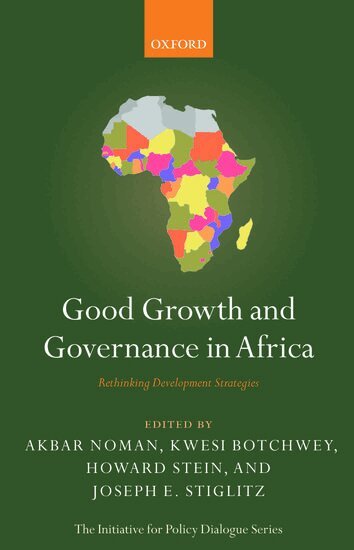
    Good Growth and Governance in Africa

    Rethinking Development Strategies

    AvAkbar Noman,Kwesi Botchwey

    Häftad, Engelska, 2011

    Del i serien Initiative for Policy Dialogue

    1 104 kr

    Beställningsvara. Skickas inom 5-8 vardagar. Fri frakt över 249 kr.

    Fler format och utgåvor

    Inbunden

    2 855 kr

    Beskrivning

    Why has the economic growth performance of Sub-Saharan Africa been disappointing on balance over the past 50 years? More importantly, what can be done to reverse that trend and to sustain and improve upon the accelerated growth experienced in recent years? What are the possibilities and policies for Africa to reduce poverty and achieve sustained, rapid economic growth? What are the lessons of success in both Africa and elsewhere? Could some of the policies that proved so successful in East Asia help reverse the deindustrialization of Africa in the past three decades and be the basis of its structural transformation? These were the questions posed to a diverse group of experts on development convened by the Initiative for Policy Dialogue (IPD). This volume reflects the highlights of their deliberations. It broadens the policy debate, expands the policy options, and proposes alternative development strategies. This book captures the lively, and sometimes contentious, debate, and provides a note of optimism for the future. Though success is not assured, this volume argues that there is good reason to believe that policies based on lessons of successes, notably in East Asia, can be adapted successfully in African contexts.

    Produktinformation

    • Utgivningsdatum:2011-12-22
    • Mått:154 x 234 x 31 mm
    • Vikt:902 g
    • Format:Häftad
    • Språk:Engelska
    • Serie:Initiative for Policy Dialogue
    • Antal sidor:610
    • Förlag:OUP OXFORD
    • ISBN:9780199698578

    Utforska kategorier

    • Mikroekonomi inom Ekonomi och Ledarskap
    • Centralt styre och förvaltning inom Samhälle och politik
    • Internationell ekonomi inom Ekonomi och Ledarskap

    Mer om författaren

    Akbar Noman is an economist with wide-ranging experience of policy analysis and formulation in a variety of developing and transition economies, having worked extensively for the World Bank where he was Senior Economist for Ethiopia and an influential adviser to the government. He combines teaching at SIPA with being a Senior Fellow at the Initiative for Policy Dialogue. His other academic appointments have been at Oxford University (where he was also a student) and the Institute of Development Studies at the University of Sussex.Kwesi Botchwey was Ghana's Ministers of Finance from 1983-1995 and he was key to stabilizing the country's collapsed economy. He is a member of the President's Economic Advisory Council (Ghana) and member of the UN Committee on Development Policy (CDP). His past positions include: Professor of Practice in Development Economics at the Fletcher School, Tufts University and Director of African Research and Programs at the Center for International Development at Harvard University. Howard Stein also teaches in the Department of Epidemiology. He is a development economist educated in Canada, the US, and the UK who has taught in both Asia and Africa. His research has focused on foreign aid, finance and development, structural adjustment, health and development, rural property right transformation, and industrial policy. His most recent monograph is Beyond the World Bank Agenda: An Institutional Approach to Development (University of Chicago Press, 2008). Joseph E. Stiglitz is the winner of the 2001 Nobel Memorial Prize in Economics, and a lead author of the 1995 report of the IPCC, which shared the 2007 Nobel Peace Prize. He was chairman of the U.S. Council of Economic Advisors under President Clinton and chief economist and senior vice president of the World Bank for 1997-2000. Prior to Columbia he held the Drummond Professorship at All Souls College, Oxford, and professorships at Yale, Stanford, and Princeton. He is the author of the best-selling Globalization and Its Discontents, Making Globalization Work, Fair Trade For All, and most recently of Freefall: America, Free Markets, and the Sinking of the Global Economy. His engagement with Africa began more than 40 years ago, at the Institute of Development Studies in Nairobi.

    Innehållsförteckning

    • PART I: INTRODUCTION AND OVERVIEW ; 1. Strategies for African Development ; PART II: GOVERNANCE, INSTITUTIONS AND THE STATE ; 2. Governance and Growth: History, Ideology and Methods of Proof ; 3. Institutional Monocroping and Monotasking in Africa ; 4. Governance and Growth Challenges for Africa ; 5. States and Markets: Neoliberal Limitations and the Case for a Developmental State ; 6. The African Economic Growth Record, and the Roles of Policy Syndromes and Governance ; PART III: TECHNOLOGY, INDUSTRIAL AND TRADE POLICIES ; 7. Dynamic Capacity Development: What Africa Can Learn from Industrial Policy Formulation in East Asia ; 8. How can Low-Income Countries Accelerate their Catch-up with High-Income Countries? The Case for Open-Economy Industrial Policy ; 9. Institutional Capacity and Policy Choices for Latecomer Technology Development ; 10. State-Business Relations, Investment Climate Reform and Economic Growth in Sub-Saharan Africa ; 11. Africa, Industrial Policy and Export Processing Zones: Lessons from Asia ; 12. South African Post-Apartheid Policies Towards Industrialization: Tentative Implications for Other African Countries ; 13. Issues in Africa's Industrial Policy Process ; 14. Tiger, Tiger Burning Bright? Industrial Policy Lessons from Ireland for Small African Economies ; PART IV: EMPLOYMENT AND HUMAN CAPITAL ; 15. Employment in Sub-Saharan Africa: Lessons to be Learnt from the East Asian Experience ; 16. Skills Development for Economic Growth in Sub-Saharan Africa: A Pragmatic Perspective ; PART V: INTERNATIONAL CONTEXT ; 17. Economic Liberalization and Constraints to Development in Sub-Saharan Africa ; 18. The Emerging Asian Giants and Economic Development in Africa