• Fri frakt över 249 kr
  • •
  • Snabba leveranser
  • •
  • Billiga böcker
Kundservice

Du är på sajten för privatpersoner.

Företag, bibliotek eller offentlig verksamhet?

Du handlar på classic.bokus.com, där alla dina funktioner finns intakta.
Till classic.bokus.com
Bokus logotyp. Gå till startsidan.
  • Erbjudanden
  • Student
  • Topplistor
  • Barn & ungdom
  • Bokus Play
  • E-böcker
  • Ljudböcker
  • Pocketböcker
  • Spel & pussel

Upp till 25% på utvalda nyheter →

Sidfot

Mina sidor

    Hjälp

    • Kundservice
    • Vanliga frågor och svar
    • Frakt och leverans
    • Retur vid ångerrätt
    • Reklamera vara
    • Betalning
    • Köpvillkor
    • Allmänna villkor
    • Information om webbplatsens tillgänglighet

    Om Bokus

    • Om oss
    • Pressrum
    • För studenter
    • För företag
    • För bibliotek och offentlig verksamhet
    • För leverantörer
    • Hållbarhet

    Populärt

    • Aktuella erbjudanden
    • Presentkort
    • Studentlitteratur
    • Nya böcker
    • Topplistor
    • Signerade böcker
    • Engelska böcker

    Inspiration

    • Boktips
    • BookTok
    • Populära bokserier
    • Barnbokskaraktärer
    • Populära författare
    Logotyp för Bokus
    Följ oss på Facebook (extern länk)Följ oss på Instagram (extern länk)Följ oss på YouTube (extern länk)Följ oss på TikTok (extern länk)
    bokus @ CookiesAnpassa cookiesIntegritetspolicyKöpvillkor
    Till Citymail hemsida (extern länk)Till Budbee hemsida (extern länk)Till Postnord hemsida (extern länk)Till Schenker hemsida (extern länk)Till Early Bird hemsida (extern länk)Till Walleys hemsida (extern länk)
    1. Samhälle och politik
    2. Samhälle och kultur
    3. Kultur och medier
    4. Kulturvetenskap

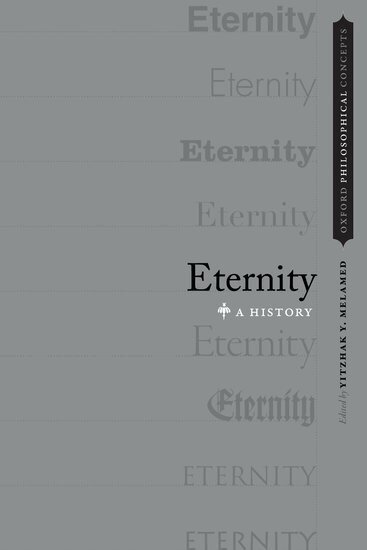
    Eternity

    A History

    AvYitzhak Y. Melamed

    Häftad, Engelska, 2016

    Del i serien Oxford Philosophical Concepts

    615 kr

    Beställningsvara. Skickas inom 5-8 vardagar. Fri frakt över 249 kr.

    Beskrivning

    Eternity is a unique kind of existence that is supposed to belong to the most real being or beings. It is an existence that is not shaken by the common wear and tear of time. Over the two and half millennia history of Western philosophy we find various conceptions of eternity, yet one sharp distinction between two notions of eternity seems to run throughout this long history: eternity as timeless existence, as opposed to eternity as existence in all times. Both kinds of existence stand in sharp contrast to the coming in and out of existence of ordinary beings, like hippos, humans, and toothbrushes: were these eternally-timeless, for example, a hippo could not eat, a human could not think or laugh, and a toothbrush would be of no use. Were a hippo an eternal-everlasting creature, it would not have to bother itself with nutrition in order to extend its existence. Everlasting human beings might appear similar to us, but their mental life and patterns of behavior would most likely be very different from ours.The distinction between eternity as timelessness and eternity as everlastingness goes back to ancient philosophy, to the works of Plato and Aristotle, and even to the fragments of Parmenides' philosophical poem. In the twentieth century, it seemed to go out of favor, though one could consider as eternalists those proponents of realism in philosophy of mathematics, and those of timeless propositions in philosophy of language (i.e., propositions that are said to exist independently of the uttered sentences that convey their thought-content). However, recent developments in contemporary physics and its philosophy have provided an impetus to revive notions of eternity due to the view that time and duration might have no place in the most fundamental ontology.The importance of eternity is not limited to strictly philosophical discussions. It is a notion that also has an important role in traditional Biblical interpretation. The Tetragrammaton, the Hebrew name of God considered to be most sacred, is derived from the Hebrew verb for being, and as a result has been traditionally interpreted as denoting eternal existence (in either one of the two senses of eternity). Hence, Calvin translates the Tetragrammaton as 'l'Eternel', and Mendelssohn as 'das ewige Wesen' or 'der Ewige'. Eternity also plays a central role in contemporary South American fiction, especially in the works of J.L. Borges. The representation of eternity poses a major challenge to both literature and arts (just think about the difficulty of representing eternity in music, a thoroughly temporal art). The current volume aims at providing a history of the philosophy of eternity surrounded by a series of short essays, or reflections, on the role of eternity and its representation in literature, religion, language, liturgy, science, and music. Thus, our aim is to provide a history of philosophy as a discipline that is in constant commerce with various other domains of human inquisition and exploration.

    Produktinformation

    • Utgivningsdatum:2016-08-04
    • Mått:137 x 208 x 22 mm
    • Vikt:363 g
    • Format:Häftad
    • Språk:Engelska
    • Serie:Oxford Philosophical Concepts
    • Antal sidor:352
    • Förlag:OUP USA
    • ISBN:9780199781867

    Utforska kategorier

    • Kulturvetenskap inom Samhälle och politik
    • Filosofiska discipliner inom Filosofi och religion

    Mer om författaren

    Yitzhak Y. Melamed is a Professor of Philosophy at Johns Hopkins University. He is the author of Spinoza's Metaphysics (OUP, 2013), and editor/co-editor of Spinoza's Theological Political Treatise: A Critical Guide (2011), Spinoza and German Idealism (2012), and The Young Spinoza (OUP, 2015).

    Recensioner i media

    "The five essays Melamed (Johns Hopkins) has gathered trace concepts of, and controversies about, eternity as conceived in Platonic, medieval, modern, Kantian, and analytic philosophy. The collection is distinguished by its interdisciplinary approach. Each scholarly essay is followed by enticing "reflections" that extract philosophical claims from broader themes. Highlights include insights into divine love that emerge in Dante's portrayal of God's relation totime; arguments from ancient India that the language of the Vedas conveys timeless meaning; and descriptions of eternity in the verse of Palestinian poet Mahmoud Darwish...Narrower than anintroduction, decidedly philosophical in its interdisciplinary forays, yet historical in substance, this careful, usefully synoptic book...warrants a look, particularly by specialists." -- CHOICE

    Innehållsförteckning

    • ContributorsSeries Editor's Forward Introduction Yitzhak Y. Melamed 1. Eternity in Ancient Philosophy James WilberdingReflection: Eternity in the Astrology of Vettius Valens Dorian Gieseler GreenbaumReflection: Eternity and World Cycles Godefroid De CallatayReflection: The Eternality of Language in India Andrew Ollett 2. Eternity in Medieval Philosophy Peter AdamsonReflection: The Daharia Hinrich BisterfeldtReflection: Eternity and the Trinity Christophe Erismann 3. Eternity in Early Modern Philosophy Yitzhak Y. MelamedReflection: Dante and Eternity Akash KumarReflection: Perpetuum mobile Marius Stan 4. Eternity in Kant and Post-Kantian European Thought Alistair WelchmanReflection: Eternity in the Fruehromantiker Judith NormanReflection: Eternity in Hassidism Ariel Evan MayseReflection:"White Eternity" in the Poetry of Mahmud Darwish Abed Azzam 5. Eternity In Twentieth Century Analytic Philosophy Kris McDanielReflection: Borges on Eternity William EggintonReflection: Eternity in music Walter Frisch Reflection: The Kaddish, Mourning, and Eternity Abraham P. Socher GlossaryBibliographyIndex of NamesIndex of Concepts