• Fri frakt över 249 kr
  • •
  • Snabba leveranser
  • •
  • Billiga böcker
Kundservice

Du är på sajten för privatpersoner.

Företag, bibliotek eller offentlig verksamhet?

Du handlar på classic.bokus.com, där alla dina funktioner finns intakta.
Till classic.bokus.com
Bokus logotyp. Gå till startsidan.
  • Erbjudanden
  • Student
  • Topplistor
  • Barn & ungdom
  • Bokus Play
  • E-böcker
  • Ljudböcker
  • Pocketböcker
  • Spel och pussel

Pocketfynda! Hundratals böcker för 49 kr/st →

Sidfot

Mina sidor

    Hjälp

    • Kundservice
    • Vanliga frågor och svar
    • Frakt och leverans
    • Retur vid ångerrätt
    • Reklamera vara
    • Betalning
    • Köpvillkor
    • Allmänna villkor
    • Information om webbplatsens tillgänglighet

    Om Bokus

    • Om oss
    • Pressrum
    • För studenter
    • För företag
    • För bibliotek och offentlig verksamhet
    • För leverantörer
    • Hållbarhet

    Populärt

    • Aktuella erbjudanden
    • Presentkort
    • Studentlitteratur
    • Nya böcker
    • Topplistor
    • Signerade böcker
    • Engelska böcker

    Inspiration

    • Boktips
    • BookTok
    • Barnbokskaraktärer
    • Populära författare
    Logotyp för Bokus
    Följ oss på Facebook (extern länk)Följ oss på Instagram (extern länk)Följ oss på YouTube (extern länk)Följ oss på TikTok (extern länk)
    bokus @ CookiesAnpassa cookiesIntegritetspolicyKöpvillkor
    Till Citymail hemsida (extern länk)Till Budbee hemsida (extern länk)Till Postnord hemsida (extern länk)Till Schenker hemsida (extern länk)Till Early Bird hemsida (extern länk)Till Walleys hemsida (extern länk)
    1. Naturvetenskap och teknik
    2. Geovetenskap
    3. Miljövetenskap och miljöpolitik

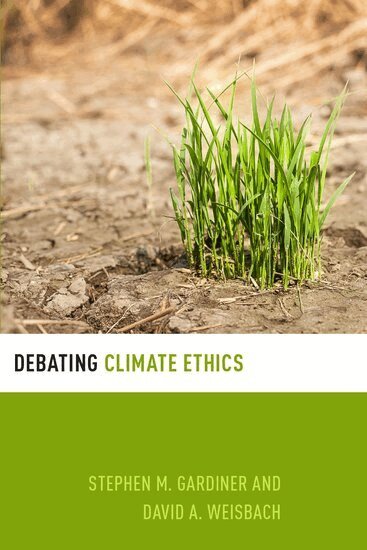
    Debating Climate Ethics

    AvStephen M. Gardiner,David A. Weisbach

    Häftad, Engelska, 2016

    Del i serien Debating Ethics

    532 kr

    Beställningsvara. Skickas inom 5-8 vardagar. Fri frakt över 249 kr.

    Beskrivning

    In this volume, Stephen M. Gardiner and David A. Weisbach present arguments for and against the relevance of ethics to global climate policy. Gardiner argues that climate change is fundamentally an ethical issue, since it is an early instance of a distinctive challenge to ethical action (the perfect moral storm), and ethical concerns (such as with justice, rights, political legitimacy, community and humanity's relationship to nature) are at the heart of many of the decisions that need to be made. Consequently, climate policy that ignores ethics is at risk of "solving " the wrong problem, perhaps even to the extreme of endorsing forms of climate extortion. This is especially true of policy based on narrow forms of economic self-interest. By contrast, Weisbach argues that existing ethical theories are not well suited to addressing climate change. As applied to climate change, existing ethical theories suffer from internal logical problems and suggest infeasible strategies. Rather than following failed theories or waiting indefinitely for new and better ones, Weisbach argues that central motivation for climate policy is straightforward: it is in their common interest for people and nations to agree to policies that dramatically reduce emissions to prevent terrible harms.

    Produktinformation

    • Utgivningsdatum:2016-08-11
    • Mått:137 x 208 x 17 mm
    • Vikt:318 g
    • Format:Häftad
    • Språk:Engelska
    • Serie:Debating Ethics
    • Antal sidor:280
    • Förlag:OUP USA
    • ISBN:9780199996483

    Utforska kategorier

    • Miljövetenskap och miljöpolitik inom Naturvetenskap och teknik
    • Filosofiska discipliner inom Filosofi och religion
    • Etiska frågor och debatter inom Samhälle och politik

    Mer om författaren

    Stephen M. Gardiner is Professor of Philosophy and Ben Rabinowitz Endowed Professor of the Human Dimensions of the Environment at the University of Washington, Seattle. He is the author of A Perfect Moral Storm (Oxford, 2011), editor of Virtue Ethics, Old and New (Cornell, 2005), and co-editor of the Oxford Handbook of Environmental Ethics (Oxford, in press) and Climate Ethics: Essential Readings (Oxford, 2010). His research focuses on global environmental problems, future generations and virtue ethics.David A. Weisbach is the Walter J Blum Professor at the University of Chicago Law School and Senior Fellow at the University of Chicago Computation Institute and Argonne National Laboratories. Weisbach's research primarily focuses on issues related to taxation and on policy aspects of climate change.Weisbach received his BS in Mathematics from the University of Michigan in 1985; a Masters in Advance Study (Mathematics) from Wolfson College, Cambridge in 1986; and a JD from Harvard Law School in 1989. After graduating from law school, Weisbach clerked for Judge Joel M. Flaum of the U.S. Court of Appeals for the Seventh Circuit and worked as an associate in the law firm of Miller & Chevalier. In 1992, Weisbach joined the Department of Treasury where he worked as an attorney-advisor in the Office of the Tax Legislative Counsel and, subsequently, as associate tax legislative counsel. In 1996, Weisbach was appointed Associate Professor of Law at Georgetown Law Center and joined the Chicago faculty in 1998.

    Recensioner i media

    One of the most refreshing aspects of Gardiner and Weisbach's contribution to this debate is that both of them--Gardiner a philosopher, Weisbach an economist--think that rapid decarbonization must be the paramount aim of climate policythis is an extremely valuable book and I recommend it warmly. Both authors display an admirable tenacity, courage, forbearance, and intelligence. Their debate marks a significant advance in our attempts to grapple with this most serious of issues.

    Innehållsförteckning

    • Part I By Stephen M. Gardiner1. How Will We be Remembered?2. Betraying the Future3. Who Are We and What Do We Want?4. Justice vs. Extortion Part II By David A. Weisbach5. Introduction to Part II6. Climate Policy and Self-Interest7. The Role of Claims of Justice in Climate Change Policy8. Summing Up Part III Responses9. 'The Feasible is Political'10. Weisbach Responds to Gardiner