• Fri frakt över 249 kr
  • •
  • Snabba leveranser
  • •
  • Billiga böcker
Kundservice

Du är på sajten för privatpersoner.

Företag, bibliotek eller offentlig verksamhet?

Du handlar på classic.bokus.com, där alla dina funktioner finns intakta.
Till classic.bokus.com
Bokus logotyp. Gå till startsidan.
  • Erbjudanden
  • Student
  • Topplistor
  • Barn & ungdom
  • Bokus Play
  • E-böcker
  • Ljudböcker
  • Pocketböcker
  • Spel & pussel

Upp till 25% på utvalda nyheter →

Sidfot

Mina sidor

    Hjälp

    • Kundservice
    • Vanliga frågor och svar
    • Frakt och leverans
    • Retur vid ångerrätt
    • Reklamera vara
    • Betalning
    • Köpvillkor
    • Allmänna villkor
    • Information om webbplatsens tillgänglighet

    Om Bokus

    • Om oss
    • Pressrum
    • För studenter
    • För företag
    • För bibliotek och offentlig verksamhet
    • För leverantörer
    • Hållbarhet

    Populärt

    • Aktuella erbjudanden
    • Presentkort
    • Studentlitteratur
    • Nya böcker
    • Topplistor
    • Signerade böcker
    • Engelska böcker

    Inspiration

    • Boktips
    • BookTok
    • Populära bokserier
    • Barnbokskaraktärer
    • Populära författare
    Logotyp för Bokus
    Följ oss på Facebook (extern länk)Följ oss på Instagram (extern länk)Följ oss på YouTube (extern länk)Följ oss på TikTok (extern länk)
    bokus @ CookiesAnpassa cookiesIntegritetspolicyKöpvillkor
    Till Citymail hemsida (extern länk)Till Budbee hemsida (extern länk)Till Postnord hemsida (extern länk)Till Schenker hemsida (extern länk)Till Early Bird hemsida (extern länk)Till Walleys hemsida (extern länk)
    1. Data och IT
    2. Programmeringsböcker

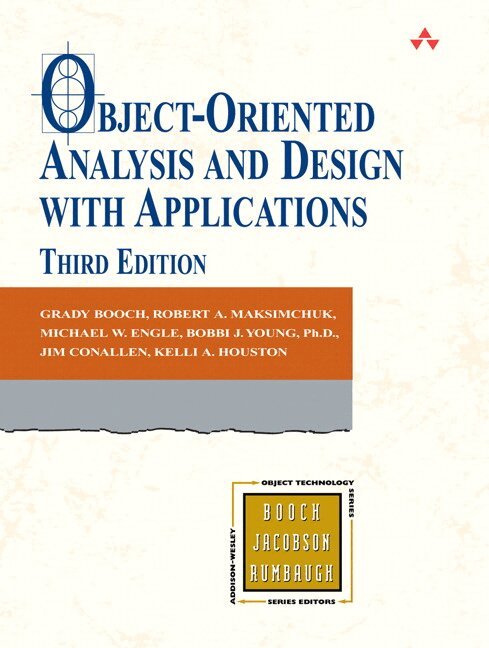
    Object-Oriented Analysis and Design with Applications

    AvGrady Booch,Robert Maksimchuk

    Inbunden, Engelska, 2007

    Del i serien Addison-Wesley Object Technology Series

    1 112 kr

    Beställningsvara. Skickas inom 3-6 vardagar. Fri frakt över 249 kr.

    Beskrivning

    Object-Oriented Design with Applications has long been the essential reference to object-oriented technology, which, in turn, has evolved to join the mainstream of industrial-strength software development. In this third edition--the first revision in 13 years--readers can learn to apply object-oriented methods using new paradigms such as Java, the Unified Modeling Language (UML) 2.0, and .NET.

    The authors draw upon their rich and varied experience to offer improved methods for object development and numerous examples that tackle the complex problems faced by software engineers, including systems architecture, data acquisition, cryptoanalysis, control systems, and Web development. They illustrate essential concepts, explain the method, and show successful applications in a variety of fields. You'll also find pragmatic advice on a host of issues, including classification, implementation strategies, and cost-effective project management.

    New to this new edition are

    • An introduction to the new UML 2.0, from the notation's most fundamental and advanced elements with an emphasis on key changes
    • New domains and contexts
    • A greatly enhanced focus on modeling--as eagerly requested by readers--with five chapters that each delve into one phase of the overall development lifecycle.
    • Fresh approaches to reasoning about complex systems
    • An examination of the conceptual foundation of the widely misunderstood fundamental elements of the object model, such as abstraction, encapsulation, modularity, and hierarchy
    • How to allocate the resources of a team of developers and mange the risks associated with developing complex software systems
    • An appendix on object-oriented programming languages

    This is the seminal text for anyone who wishes to use object-oriented technology to manage the complexity inherent in many kinds of systems.


    Sidebars  
    Preface 
    Acknowledgments   
    About the Authors   

    Section I: Concepts  
    Chapter 1: Complexity   
    Chapter 2: The Object Model   
    Chapter 3: Classes and Objects   
    Chapter 4: Classification   
    Section II: Method  
    Chapter 5: Notation   
    Chapter 6: Process
    Chapter 7: Pragmatics   
    Chapter 8: System Architecture: Satellite-Based Navigation   
    Chapter 9: Control System: Traffic Management   
    Chapter 10: Artificial Intelligence: Cryptanalysis   
    Chapter 11: Data Acquisition: Weather Monitoring Station  
    Chapter 12: Web Application: Vacation Tracking System    
    Appendix A: Object-Oriented Programming Languages 
    Appendix B: Further Reading   
    Notes   
    Glossary   
    Classified Bibliography   
    Index   

    Produktinformation

    • Utgivningsdatum:2007-05-16
    • Mått:184 x 237 x 42 mm
    • Vikt:1 240 g
    • Format:Inbunden
    • Språk:Engelska
    • Serie:Addison-Wesley Object Technology Series
    • Antal sidor:720
    • Upplaga:3
    • Förlag:Pearson Education
    • ISBN:9780201895513

    Utforska kategorier

    • Programmeringsböcker inom Data och IT

    Mer om författaren

    Grady Booch is an IBM fellow and author of six best-selling books on object-oriented programming. He is world-reknowned as an originator of OO and founder of UML. Robert A. Maksimchuk, as Research Director in the Unisys CTO Office, focuses on emerging modeling technologies to advance the strategic direction of the Unisys 3D-Visual Enterprise modeling framework. Bob brings an abundance of systems engineering, modeling, and object-oriented analysis and design expertise, in numerous industries, to this mission. He is the coauthor of the books UML for Mere Mortals and UML for Database Design, has written various articles, has traveled worldwide as a featured speaker in numerous technology forums, and led workshops and seminars on UML and object-oriented development. Michael W. Engle is a principal member of the engineering staff with the Lockheed Martin Corporation. He has extensive technical and management experience across the complete system development lifecycle, from project initiation through deployment and support in a variety of application domains. As a systems architect, Mike employs object-oriented analysis nad design techniques in complex systems development. Dr. Bobbi Young is a Director of Research for the Unisys Chief Technology Office. She has many years of experience in the IT industry working with commercial companies and Department of Defense contractors. Dr. Young has been a consultant mentoring in program management, enterprise architecture, systems engineering, and object-oriented analysis and design. Throughout her career, she has focused on system lifecycle processes and methodologies, and enterprise architecture. Jim Conallen is a software engineer in IBM Rational's Model Driven Development Strategy team, where he is actively involved in applying the Object Management Group's (OMG) Model Driven Architecture (MDA) initiative to IBM Rational's model tooling. Kelli A. Houston is a Consulting IT Specialist at IBM Rational. She is the method architect for IBM's internal method authoring method and is part of the team responsible for integrating IBM's methods.

    Innehållsförteckning

    • Sidebars   xiPreface    xiiiAcknowledgments    xixAbout the Authors    xxi Section I: Concepts   1 Chapter 1: Complexity   3 1.1      The Structure of Complex Systems    41.2      The Inherent Complexity of Software    71.3      The Five Attributes of a Complex System    121.4      Organized and Disorganized Complexity    141.5      Bringing Order to Chaos    181.6      On Designing Complex Systems    24Chapter 2: The Object Model    29 2.1      The Evolution of the Object Model    292.2      Foundations of the Object Model    372.3      Elements of the Object Model    432.4      Applying the Object Model    71Chapter 3: Classes and Objects    75 3.1      The Nature of an Object    753.2      Relationships among Objects    883.3      The Nature of a Class    923.4      Relationships among Classes    963.5      The Interplay of Classes and Objects    1113.6      On Building Quality Classes and Objects    112Chapter 4: Classification    121 4.1      The Importance of Proper Classification    1214.2      Identifying Classes and Objects    1264.3      Key Abstractions and Mechanisms    138Section II: Method    145 Chapter 5: Notation    147 5.1      The Unified Modeling Language    1475.2      Package Diagrams    1555.3      Component Diagrams    1635.4      Deployment Diagrams    1715.5      Use Case Diagrams    1755.6      Activity Diagrams    1855.7      Class Diagrams    1925.8      Sequence Diagrams    2065.9      Interaction Overview Diagrams    2135.10    Composite Structure Diagrams    2155.11    State Machine Diagrams    2185.12    Timing Diagrams    2315.13    Object Diagrams    2355.14    Communication Diagrams    238Chapter 6: Process 247 6.1        First Principles    2486.2        The Macro Process: The Software Development Lifecycle    2566.3        The Micro Process: The Analysis and Design Process    272Chapter 7: Pragmatics    303 7.1      Management and Planning    3047.2      Staffing    3087.3      Release Management    3127.4      Reuse    3147.5      Quality Assurance and Metrics    3167.6      Documentation    3207.7      Tools    3227.8      Special Topics    3247.9      The Benefits and Risks of Object-Oriented Development    326Section III: Applications    331 Chapter 8: System Architecture: Satellite-Based Navigation    333 8.1      Inception    3348.2      Elaboration    3478.3      Construction    3708.4      Post-Transition 371Chapter 9: Control System: Traffic Management    375 9.1      Inception    3769.2      Elaboration    3859.3      Construction    3969.4      Post-Transition 411Chapter 10: Artificial Intelligence: Cryptanalysis    413 10.1      Inception    41410.2      Elaboration    42110.3      Construction    42710.4      Post-Transition 446Chapter 11: Data Acquisition: Weather Monitoring Station    449 11.1      Inception    45011.2      Elaboration    46311.3      Construction    47411.4      Post-Transition    487Chapter 12: Web Application: Vacation Tracking System    489 12.1      Inception    49012.2      Elaboration    49412.3      Construction    50612.4      Transition and Post-Transition    534Appendix A: Object-Oriented Programming Languages    537 A.1      Language Evolution    537A.2      Smalltalk    541A.3      C++    546A.4      Java    551Appendix B: Further Reading    557 Notes    567Glossary    591Classified Bibliography    603Index    677

    Betyg & recensioner

    1.5/5