• Fri frakt över 249 kr
  • •
  • Snabba leveranser
  • •
  • Billiga böcker
Kundservice

Du är på sajten för privatpersoner.

Företag, bibliotek eller offentlig verksamhet?

Du handlar på classic.bokus.com, där alla dina funktioner finns intakta.
Till classic.bokus.com
Bokus logotyp. Gå till startsidan.
  • Erbjudanden
  • Nyheter
  • Student
  • Topplistor
  • Barn & ungdom
  • Bokus Play
  • E-böcker
  • Pocketböcker
  • Spel & pussel

10% rabatt på allt med kod: NYSTART10 →

Sidfot

Mina sidor

    Hjälp

    • Kundservice
    • Vanliga frågor och svar
    • Frakt och leverans
    • Retur vid ångerrätt
    • Reklamera vara
    • Betalning
    • Köpvillkor
    • Allmänna villkor
    • Information om webbplatsens tillgänglighet

    Om Bokus

    • Om oss
    • Pressrum
    • För studenter
    • För företag
    • För bibliotek och offentlig verksamhet
    • För leverantörer
    • Hållbarhet

    Populärt

    • Aktuella erbjudanden
    • Presentkort
    • Studentlitteratur
    • Nya böcker
    • Topplistor
    • Signerade böcker
    • Engelska böcker

    Inspiration

    • Boktips
    • BookTok
    • Populära bokserier
    • Barnbokskaraktärer
    • Populära författare
    Logotyp för Bokus
    Följ oss på Facebook (extern länk)Följ oss på Instagram (extern länk)Följ oss på YouTube (extern länk)Följ oss på TikTok (extern länk)
    bokus @ CookiesAnpassa cookiesIntegritetspolicyKöpvillkor
    Till Citymail hemsida (extern länk)Till Budbee hemsida (extern länk)Till Postnord hemsida (extern länk)Till Schenker hemsida (extern länk)Till Early Bird hemsida (extern länk)Till Walleys hemsida (extern länk)
    1. Historia och arkeologi
    2. Historia
    3. Historia: särskilda händelser och ämnen
    4. Socialhistoria och kulturhistoria

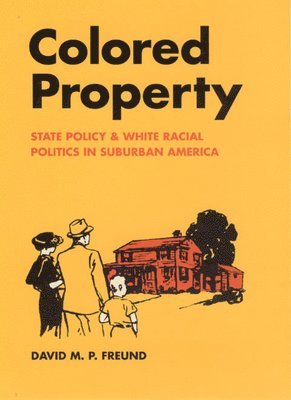
    Colored Property

    State Policy and White Racial Politics in Suburban America

    AvDavid M. P. Freund

    Inbunden, Engelska, 2007

    Del i serien Historical Studies of Urban America

    1 226 kr

    Skickas . Fri frakt över 249 kr.

    Fler format och utgåvor

    Häftad

    293 kr

    E-bok

    643 kr

    Beskrivning

    In "Colored Property", David M. P. Freund shows how federal intervention spurred a dramatic shift in the language and logic of racial integration in residential neighborhoods after World War II - away from invocations of a mythical racial hierarchy and toward talk of markets, property, and citizenship. Freund traces the emergence of a powerful public-private alliance that facilitated postwar suburban growth across the nation with federal programs that significantly favored whites. Then, showing how this national story played out in metropolitan Detroit, he demonstrates how whites learned to view discrimination not as an act of racism but as a legitimate response to the needs of the market. Illuminating government's powerful yet still-hidden role in the segregation of U.S. cities, "Colored Property" presents a dramatic new vision of metropolitan growth, segregation, and white identity in modern America.

    Produktinformation

    • Utgivningsdatum:2007-08-01
    • Mått:17 x 23 x 3 mm
    • Vikt:822 g
    • Format:Inbunden
    • Språk:Engelska
    • Serie:Historical Studies of Urban America
    • Antal sidor:496
    • Förlag:The University of Chicago Press
    • ISBN:9780226262758

    Utforska kategorier

    • Socialhistoria och kulturhistoria inom Historia och arkeologi
    • Socialt arbete och välfärd inom Samhälle och politik
    • Etnicitet inom Samhälle och politik

    Mer om författaren

    David M. P. Freund is associate professor of history at the University of Maryland, College Park.

    Recensioner i media

    "A creative, vital entry point to explore the tangle of federal mortgage financing, housing reform, and deep-seated racism.... This well-written, much-needed study brings together the realms of urban history, race relations, and economic opportunity." - Choice "Freund's book unravels the ties that bound (and bind) race and property, and, in the process, shows how that linkage altered white racial ideals and politics in postwar America." - Andrew Wiese, Journal of American History"