• Fri frakt över 249 kr
  • •
  • Snabba leveranser
  • •
  • Billiga böcker
Kundservice

Du är på sajten för privatpersoner.

Företag, bibliotek eller offentlig verksamhet?

Du handlar på classic.bokus.com, där alla dina funktioner finns intakta.
Till classic.bokus.com
Bokus logotyp. Gå till startsidan.
  • Erbjudanden
  • Nyheter
  • Student
  • Topplistor
  • Barn & ungdom
  • Bokus Play
  • E-böcker
  • Pocketböcker
  • Spel & pussel

10% rabatt på allt med kod: NYSTART10 →

Sidfot

Mina sidor

    Hjälp

    • Kundservice
    • Vanliga frågor och svar
    • Frakt och leverans
    • Retur vid ångerrätt
    • Reklamera vara
    • Betalning
    • Köpvillkor
    • Allmänna villkor
    • Information om webbplatsens tillgänglighet

    Om Bokus

    • Om oss
    • Pressrum
    • För studenter
    • För företag
    • För bibliotek och offentlig verksamhet
    • För leverantörer
    • Hållbarhet

    Populärt

    • Aktuella erbjudanden
    • Presentkort
    • Studentlitteratur
    • Nya böcker
    • Topplistor
    • Signerade böcker
    • Engelska böcker

    Inspiration

    • Boktips
    • BookTok
    • Populära bokserier
    • Barnbokskaraktärer
    • Populära författare
    Logotyp för Bokus
    Följ oss på Facebook (extern länk)Följ oss på Instagram (extern länk)Följ oss på YouTube (extern länk)Följ oss på TikTok (extern länk)
    bokus @ CookiesAnpassa cookiesIntegritetspolicyKöpvillkor
    Till Citymail hemsida (extern länk)Till Budbee hemsida (extern länk)Till Postnord hemsida (extern länk)Till Schenker hemsida (extern länk)Till Early Bird hemsida (extern länk)Till Walleys hemsida (extern länk)
    1. Samhälle och politik
    2. Politik och statsskick
    3. Statsskick och politiska processer

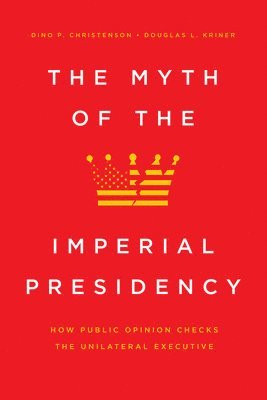
    Myth of the Imperial Presidency

    How Public Opinion Checks the Unilateral Executive

    AvDino P Christenson,Douglas L Kriner

    Inbunden, Engelska, 2020

    823 kr

    Beställningsvara. Skickas inom 5-8 vardagar. Fri frakt över 249 kr.

    Fler format och utgåvor

    Häftad

    276 kr

    Beskrivning

    Throughout the history of the United States, the nation's presidents have shown a startling power to act independently of Congress and the courts. Using such tools as executive orders and memoranda, presidents have taken the country to war, abolished slavery, authorized widespread electronic surveillance, shielded undocumented immigrants from deportation, and more. As a result, executive authority has at times been accused of verging on the imperial. In this book, Dino P. Christenson and Douglas L. Kriner consider an oft-overlooked question: Given the strength of unilateral executive action and the steep barriers for Congress and the courts to successfully check it, what stops presidents from asserting control even more broadly than they already do? The answer, Christenson and Kriner argue, lies in the reactions of everyday Americans.With robust empirical data and compelling case studies, the authors reveal the extent to which domestic public opinion limits executive might. Presidents are emboldened to pursue their own agendas when they enjoy high levels of public support, and constrained when they are down in the polls, as unilateral action could jeopardize future initiatives and render presidents even more politically vulnerable. Although they find little evidence that the public instinctively recoils against the use of unilateral action, Congress and the courts can sway the public's view via their criticism of unilateral policies. Thus, other branches can still check the executive branch through political means. On the whole, as long as presidents are concerned with public opinion, Christenson and Kriner contend that fears of an imperial presidency are overblown. However, a president who responds only to the narrow base and ignores the mass public could pose a unique threat to checks and balances.

    Produktinformation

    • Utgivningsdatum:2020-11-23
    • Mått:152 x 229 x undefined mm
    • Format:Inbunden
    • Språk:Engelska
    • Antal sidor:240
    • Förlag:The University of Chicago Press
    • ISBN:9780226704227

    Utforska kategorier

    • Statsskick och politiska processer inom Samhälle och politik
    • Amerikas historia inom Historia och arkeologi

    Mer om författaren

    Dino P. Christenson is associate professor in the Department of Political Science at Boston University and an institute fellow at the Hariri Institute for Computational Science and Engineering. He is a coauthor of Applied Social Science Methodology. Douglas L. Kriner is the Clinton Rossiter Professor in American Institutions in the Department of Government at Cornell University. He is the author of multiple books, including After the Rubicon, also published by the University of Chicago Press.

    Recensioner i media

    "If unilateralism is so tempting and so effective, Christenson and Kriner ask, why is it so rare? The key dynamics, they show, are less in other branches of government but in politics and public opinion. Christenson and Kriner unify strands of presidency research that have been treated by too many as competitors and even as opposites, and the book will make a crucial contribution."--Andrew Rudalevige, Bowdoin College "American democracy only works if the populace controls those who they elect. There is no more fundamental question then whether citizens can in fact exert such control. Yet, for more than one hundred years, scholars and pundits have worried about an imperial presidency that evades institutional and popular checks. This seminal book offers remarkable evidence that the public--with the help of the Congress and the courts--do in fact hold the president accountable. In that sense, democracy can work and has worked. Alas, the book also points to concerns of responsiveness to a narrow base. In so doing, Christenson and Kriner not only resolve a hundred-year-old puzzle but also set an agenda for the next generation of scholarship on American democracy."--James N. Druckman, Northwestern University

    Innehållsförteckning

    • Chapter 1: An Imperial Presidency?Chapter 2: How Americans Think about Unilateral Action Appendix to Chapter 2Chapter 3: Congressional Pushback in the Public Sphere Appendix to Chapter 3Chapter 4: Rethinking the Role of the Courts Appendix to Chapter 4Chapter 5: A Popular Check on Unilateralism Appendix to Chapter 5Chapter 6: Pathways of Political ConstraintChapter 7: Democratic Decline?NotesReferencesIndex