• Fri frakt över 249 kr
  • •
  • Snabba leveranser
  • •
  • Billiga böcker
Kundservice

Du är på sajten för privatpersoner.

Företag, bibliotek eller offentlig verksamhet?

Du handlar på classic.bokus.com, där alla dina funktioner finns intakta.
Till classic.bokus.com
Bokus logotyp. Gå till startsidan.
  • Erbjudanden
  • Student
  • Topplistor
  • Barn & ungdom
  • Bokus Play
  • E-böcker
  • Ljudböcker
  • Pocketböcker
  • Spel & pussel

Upp till 25% på utvalda nyheter →

Sidfot

Mina sidor

    Hjälp

    • Kundservice
    • Vanliga frågor och svar
    • Frakt och leverans
    • Retur vid ångerrätt
    • Reklamera vara
    • Betalning
    • Köpvillkor
    • Allmänna villkor
    • Information om webbplatsens tillgänglighet

    Om Bokus

    • Om oss
    • Pressrum
    • För studenter
    • För företag
    • För bibliotek och offentlig verksamhet
    • För leverantörer
    • Hållbarhet

    Populärt

    • Aktuella erbjudanden
    • Presentkort
    • Studentlitteratur
    • Nya böcker
    • Topplistor
    • Signerade böcker
    • Engelska böcker

    Inspiration

    • Boktips
    • BookTok
    • Populära bokserier
    • Barnbokskaraktärer
    • Populära författare
    Logotyp för Bokus
    Följ oss på Facebook (extern länk)Följ oss på Instagram (extern länk)Följ oss på YouTube (extern länk)Följ oss på TikTok (extern länk)
    bokus @ CookiesAnpassa cookiesIntegritetspolicyKöpvillkor
    Till Citymail hemsida (extern länk)Till Budbee hemsida (extern länk)Till Postnord hemsida (extern länk)Till Schenker hemsida (extern länk)Till Early Bird hemsida (extern länk)Till Walleys hemsida (extern länk)
    1. Naturvetenskap och teknik
    2. Geovetenskap
    3. Miljövetenskap och miljöpolitik

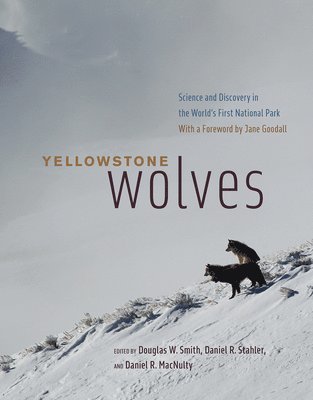
    Yellowstone Wolves

    Science and Discovery in the World's First National Park

    AvDouglas W Smith,Daniel Stahler

    Inbunden, Engelska, 2020

    333 kr

    Beställningsvara. Skickas inom 5-8 vardagar. Fri frakt över 249 kr.

    Beskrivning

    In 2020, it will have been twenty-five years since one of the greatest wildlife conservation and restoration achievements of the twentieth century took place: the reintroduction of wolves to the world's first national park, Yellowstone. Eradicated after the park was established, then absent for seventy years, these iconic carnivores returned to Yellowstone in 1995 when the US government reversed its century-old policy of extermination and--despite some political and cultural opposition--began the reintroduction of forty-one wild wolves from Canada and northwest Montana. In the intervening decades, scientists have studied their myriad behaviors, from predation to mating to wolf-pup play, building a one-of-a-kind field study that has both allowed us to witness how the arrival of top predators can change an entire ecosystem and provided a critical window into impacts on prey, pack composition, and much else. Here, for the first time in a single book, is the incredible story of the wolves' return to Yellowstone National Park as told by the very people responsible for their reintroduction, study, and management. Anchored in what we have learned from Yellowstone, highlighting the unique blend of research techniques that have given us this knowledge, and addressing the major issues that wolves still face today, this book is as wide-ranging and awe-inspiring as the Yellowstone restoration effort itself. We learn about individual wolves, population dynamics, wolf-prey relationships, genetics, disease, management and policy, newly studied behaviors and interactions with other species, and the rippling ecosystem effects wolves have had on Yellowstone's wild and rare landscape. Perhaps most importantly of all, the book also offers solutions to ongoing controversies and debates. Featuring a foreword by Jane Goodall, beautiful images, a companion online documentary by celebrated filmmaker Bob Landis, and contributions from more than seventy wolf and wildlife conservation luminaries from Yellowstone and around the world, Yellowstone Wolves is a gripping, accessible celebration of the extraordinary Yellowstone Wolf Project--and of the park through which these majestic and important creatures once again roam.

    Produktinformation

    • Utgivningsdatum:2020-12-07
    • Mått:216 x 279 x 31 mm
    • Vikt:1 598 g
    • Format:Inbunden
    • Språk:Engelska
    • Antal sidor:344
    • Förlag:The University of Chicago Press
    • Medarbetare:Jane Goodall
    • ISBN:9780226728346

    Utforska kategorier

    • Miljövetenskap och miljöpolitik inom Naturvetenskap och teknik
    • Däggdjur inom Naturvetenskap och teknik
    • Däggdjur inom Djur och Natur

    Mer om författaren

    Douglas W. Smith has studied wolves for more than forty years. In 1994 he was hired by the National Park Service in Yellowstone National Park as the project biologist to reintroduce wolves, and in 1997 he became the project leader, a position he still holds today. Besides wolves in Yellowstone, he is also responsible for supervising the park's bird, elk, and beaver programs. He is coauthor, most recently, of Wolves on the Hunt: The Behavior of Wolves Hunting Wild Prey, also published by the University of Chicago Press. Daniel R. Stahler is the Yellowstone Wolf Project's lead biologist and the project leader of the Yellowstone Cougar Project. In addition, he helps manage the elk program and is Yellowstone National Park's threatened and endangered species coordinator, working with species like lynx, wolverine, and grizzly bears. Daniel R. MacNulty is associate professor of wildlife ecology in the Department of Wildland Resources at Utah State University and was one of the first volunteers hired by the Yellowstone Wolf Project. He is also coauthor of Wolves on the Hunt.

    Recensioner i media

    "Yellowstone Wolves summarizes over two decades of hard work, involving dozens of dedicated scientists and advocates, to bring these wolves back to Yellowstone. . . . Their voices are skillfully combined to tell the many-faceted narratives in this marvelous book. . . . The overall success of this long-term effort provides information that will be of inestimable value to other restoration projects, sharing methods that can help wolves and humans coexist in a changing world and an example of what can happen if people unite to give Mother Nature a chance."--Jane Goodall, from the foreword

    Innehållsförteckning

    • Study Area MapA Note on Accompanying VideoRobert K. LandisForewordJane GoodallPrefaceDouglas W. Smith, Daniel R. Stahler, and Daniel R. MacNultyPart 1 History and Reintroduction1 Historical and Ecological Context for Wolf RecoveryDouglas W. Smith, Daniel R. Stahler, Daniel R. MacNulty, and Lee H. WhittleseyBox 1.1 Wolf History and Surveys in Yellowstone National Park John Weaver2 How Wolves Returned to Yellowstone Steven H. Fritts, Rebecca J. Watters, Edward E. Bangs, Douglas W. Smith, and Michael K. PhillipsBox 2.1 To Reintroduce or Not to Reintroduce, That Is the QuestionDiane BoydGuest Essay: Why Are Yellowstone Wolves Important? L. David MechPart 2 Behavioral and Population Ecology3 Essential Biology of the Wolf: Foundations and AdvancesDaniel R. MacNulty, Daniel R. Stahler, Tim Coulson, and Douglas W. Smith4 Ecology of Family Dynamics in Yellowstone Wolf Packs Daniel R. Stahler, Douglas W. Smith, Kira A. Cassidy, Erin E. Stahler, Matthew C. Metz, Rick McIntyre, and Daniel R. MacNultyBox 4.1 Naming Wolf Packs Daniel R. Stahler5 Territoriality and Competition between Wolf Packs Kira A. Cassidy, Douglas W. Smith, Daniel R. Stahler, Daniel R. MacNulty, Erin E. Stahler, and Matthew C. MetzBox 5.1 Auditory Profile: The Howl of the Wolf John B. Theberge and Mary T. Theberge6 Population Dynamics and Demography Douglas W. Smith, Kira A. Cassidy, Daniel R. Stahler, Daniel R. MacNulty, Quinn Harrison, Ben Balmford, Erin E. Stahler, Ellen E. Brandell, and Tim CoulsonGuest Essay: Yellowstone Wolves Are Important Because They Changed Science Rolf O. Peterson and Trevor S. PetersonPart 3 Genetics and Disease7 Yellowstone Wolves at the Frontiers of Genetic Research Daniel R. Stahler, Bridgett M. vonHoldt, Elizabeth Heppenheimer, and Robert K. Wayne8 The K Locus: Rise of the Black Wolf Rena M. Schweizer, Daniel R. Stahler, Daniel R. MacNulty, Tim Coulson, Phil Hedrick, Rachel Johnston, Kira A. Cassidy, Bridgett M. vonHoldt, and Robert K. Wayne9 Infectious Diseases in Yellowstone’s Wolves Ellen E. Brandell, Emily S. Almberg, Paul C. Cross, Andrew P. Dobson, Douglas W. Smith, and Peter J. HudsonGuest Essay: Why Are Yellowstone Wolves Important? A European Perspective Olof LibergPart 4 Wolf-Prey Relationships10 How We Study Wolf-Prey Relationships Douglas W. Smith, Matthew C. Metz, Daniel R. Stahler, and Daniel R. MacNultyBox 10.1 Nine-Three-AlphaDouglas W. SmithBox 10.2 The Bone CollectorsKy Koitzsch and Lisa Koitzsch11 Limits to Wolf Predatory Performance  Daniel R. MacNulty, Daniel R. Stahler, and Douglas W. SmithBox 11.1 Tougher Times for Yellowstone Wolves Reflected in Tooth Wear and FractureBlaire Van Valkenburgh12 What Wolves Eat and Why Matthew C. Metz, Mark Hebblewhite, Douglas W. Smith, Daniel R. Stahler, Daniel R. MacNulty, Aimee Tallian, and John A. VucetichBox 12.1 Bison in Wood Buffalo National ParkL. N. Carbyn13 Wolf Predation on Elk in a Multi-Prey Environment Matthew C. Metz, Douglas W. Smith, Daniel R. Stahler, Daniel R. MacNulty, and Mark HebblewhiteBox 13.1 Generalizing Wolf-Prey Dynamics across Systems: Yellowstone, Banff, and Isle RoyaleMark HebblewhiteBox 13.2 The Predator’s Perspective: Biomass of PreyMatthew C. MetzBox 13.3 Lessons from Denali National Park: Stability in Predator-Prey Dynamics Is a Pause on the Way to Somewhere ElseLayne Adams14 Population Dynamics of Northern Yellowstone Elk after Wolf Reintroduction Daniel R. MacNulty, Daniel R. Stahler, Travis Wyman, Joel Ruprecht, Lacy M. Smith, Michel T. Kohl, and Douglas W. SmithBox 14.1 Wolves and Elk in the Madison HeadwatersRobert A. Garrott, P. J. White, Claire Gower, Matthew S. Becker, Shana Drimal, Ken L. Hamlin, and Fred G. R. WatsonBox 14.2 Ecology of FearDaniel R. Stahler and Daniel R. MacNultyGuest Essay: The Value of Yellowstone’s Wolves? The Power of Choice Michael K. PhillipsPart 5 Ecosystem Effects and Species Interactions15 Indirect Effects of Carnivore Restoration on Vegetation Rolf O. Peterson, Robert L. Beschta, David J. Cooper, N. Thompson Hobbs, Danielle Bilyeu Johnston, Eric J. Larsen, Kristin N. Marshall, Luke E. Painter, William J. Ripple, Joshua R. Rose, Douglas W. Smith, and Evan C. WolfBox 15.1 Long-Term Trends in Beaver, Moose, and Willow Status in the Southern Portion of the Absaroka-Beartooth WildernessDaniel B. Tyers16 Competition and Coexistence among Yellowstone’s Meat Eaters Daniel R. Stahler, Christopher C. Wilmers, Aimee Tallian, Colby B. Anton, Matthew C. Metz, Toni K. Ruth, Douglas W. Smith, Kerry A. Gunther, and Daniel R. MacNultyGuest Essay: Old Dogs Taught Old Lessons Paul C. PaquetPart 6 Conservation, Management, and the Human Experience17 Wolves and Humans in Yellowstone Douglas W. Smith, Daniel R. Stahler, Rick McIntyre, Erin E. Stahler, and Kira A. Cassidy18 The Wolf Watchers Nathan Varley, Rick McIntyre, and James HalfpennyBox 18.1 Bob Landis’s Yellowstone Wolves Documentaries 000Box 18.2 Seeing WolvesRobert Hayes19 Conservation and Management: A Way Forward Douglas W. Smith, P. J. White, Daniel R. Stahler, Rebecca J. Watters, Kira A. Cassidy, Adrian Wydeven, Jim Hammill, and David E. HallacGuest Essay: Making Better Sense of Wolves Susan G. Clark   AfterwordRebecca J. Watters, Douglas W. Smith, Daniel R. Stahler, and Daniel R. MacNultyAcknowledgmentsAppendix: Species Names Used in the TextLiterature CitedList of ContributorsAuthor IndexSubject Index