• Fri frakt över 249 kr
  • •
  • Snabba leveranser
  • •
  • Billiga böcker
Kundservice

Du är på sajten för privatpersoner.

Företag, bibliotek eller offentlig verksamhet?

Du handlar på classic.bokus.com, där alla dina funktioner finns intakta.
Till classic.bokus.com
Bokus logotyp. Gå till startsidan.
  • Erbjudanden
  • Nyheter
  • Student
  • Topplistor
  • Barn & ungdom
  • Bokus Play
  • E-böcker
  • Pocketböcker
  • Spel & pussel

10% rabatt på allt med kod: NYSTART10 →

Sidfot

Mina sidor

    Hjälp

    • Kundservice
    • Vanliga frågor och svar
    • Frakt och leverans
    • Retur vid ångerrätt
    • Reklamera vara
    • Betalning
    • Köpvillkor
    • Allmänna villkor
    • Information om webbplatsens tillgänglighet

    Om Bokus

    • Om oss
    • Pressrum
    • För studenter
    • För företag
    • För bibliotek och offentlig verksamhet
    • För leverantörer
    • Hållbarhet

    Populärt

    • Aktuella erbjudanden
    • Presentkort
    • Studentlitteratur
    • Nya böcker
    • Topplistor
    • Signerade böcker
    • Engelska böcker

    Inspiration

    • Boktips
    • BookTok
    • Populära bokserier
    • Barnbokskaraktärer
    • Populära författare
    Logotyp för Bokus
    Följ oss på Facebook (extern länk)Följ oss på Instagram (extern länk)Följ oss på YouTube (extern länk)Följ oss på TikTok (extern länk)
    bokus @ CookiesAnpassa cookiesIntegritetspolicyKöpvillkor
    Till Citymail hemsida (extern länk)Till Budbee hemsida (extern länk)Till Postnord hemsida (extern länk)Till Schenker hemsida (extern länk)Till Early Bird hemsida (extern länk)Till Walleys hemsida (extern länk)
    1. Historia och arkeologi
    2. Historia
    3. Amerikas historia

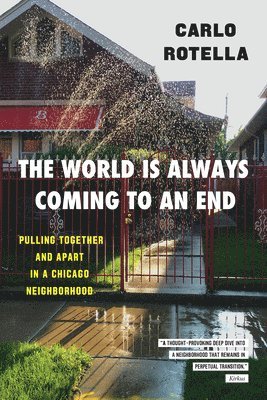
    World Is Always Coming to an End

    Pulling Together and Apart in a Chicago Neighborhood

    AvCarlo Rotella

    Häftad, Engelska, 2020

    Del i serien Chicago Visions and Revisions

    167 kr

    Beställningsvara. Skickas inom 5-8 vardagar. Fri frakt över 249 kr.

    Fler format och utgåvor

    Inbunden

    251 kr

    Beskrivning

    An urban neighborhood remakes itself every day--and unmakes itself, too. Houses and stores and streets define it in one way. But it's also people--the people who make it their home, some eagerly, others grudgingly. A neighborhood can thrive or it can decline, and neighbors move in and move out. Sometimes they stay but withdraw behind fences and burglar alarms. If a neighborhood becomes no longer a place of sociability and street life, but of privacy indoors and fearful distrust outdoors, is it still a neighborhood? In the late 1960s and 1970s Carlo Rotella grew up in Chicago's South Shore neighborhood--a place of neat bungalow blocks and desolate commercial strips, and sharp, sometimes painful social contrasts. In the decades since, the hollowing out of the middle class has left residents confronting--or avoiding--each other across an expanding gap that makes it ever harder for them to recognize each other as neighbors. Rotella tells the stories that reveal how that happened--stories of deindustrialization and street life; stories of gorgeous apartments with vistas onto Lake Michigan and of Section 8 housing vouchers held by the poor. At every turn, South Shore is a study in contrasts, shaped and reshaped over the past half-century by individual stories and larger waves of change that make it an exemplar of many American urban neighborhoods. Talking with current and former residents and looking carefully at the interactions of race and class, persistence and change, Rotella explores the tension between residents' deep investment of feeling and resources in the physical landscape of South Shore and their hesitation to make a similar commitment to the community of neighbors living there. Blending journalism, memoir, and archival research, The World Is Always Coming to an End uses the story of one American neighborhood to challenge our assumptions about what neighborhoods are, and to think anew about what they might be if we can bridge gaps and commit anew to the people who share them with us. Tomorrow is another ending.

    Produktinformation

    • Utgivningsdatum:2020-09-18
    • Mått:152 x 229 x 28 mm
    • Vikt:399 g
    • Format:Häftad
    • Språk:Engelska
    • Serie:Chicago Visions and Revisions
    • Antal sidor:320
    • Förlag:The University of Chicago Press
    • ISBN:9780226759616

    Utforska kategorier

    • Amerikas historia inom Historia och arkeologi
    • Sociala grupper och identitet inom Samhälle och politik

    Mer om författaren

    Carlo Rotella is director of the American studies program at Boston College. He writes for the New York Times Magazine, and he has been a regular op-ed columnist for the Boston Globe and radio commentator for WGBH. His work has appeared in the New Yorker, Harper's, the Believer, Washington Post Magazine, and Best American Essays.

    Recensioner i media

    "An ambitious analysis of a singular neighborhood that in some ways serves as a microcosm for all urban neighborhoods. . . . The author offers a nuanced narrative, partly personal and partly sociological, that keeps circling back to the same important truths about race, class, community, poverty, and crime. A thought-provoking deep dive into a neighborhood that remains in perpetual transition."--Eric Klinenberg "Kirkus" "An evocative and engaging mix of the minutely personal, the more broadly ethnographic, and the sociological in its description and analysis of a complex and interesting slice of Chicago. Rotella, who also works in long-form journalism, brings his gifts as a writer to bear on his experience of place and the terms of place itself."--Eric Klinenberg "Los Angeles Review of Books" "It's fair to call Rotella a poet of urban life, alive to the freedom that cities offer us to pursue lives of our own devising, and of masculinity and the ways men lose and find themselves in their passions."--Wendy Griswold, Northwestern University "National, on Playing in Time" "Some books take a while to draw you in. But when I'd finished the first paragraph of Carlo Rotella's The World Is Always Coming to an End: Pulling Together and Pulling Apart in a Chicago Neighborhood, I knew that I was going to love it." --John Wilson "Forma Review" "The World Is Always Coming to an End is unlike any work of contemporary urban studies that I know. It combines elements of journalism, archival research, ethnography, and memoir in a study of South Shore--the South Side, Chicago, neighborhood in which Carlo grew up, in the 1970s. It's at times lyrical, at times analytic, and always engaging."--Eric Klinenberg "Public Books"