• Fri frakt över 249 kr
  • •
  • Snabba leveranser
  • •
  • Billiga böcker
Kundservice

Du är på sajten för privatpersoner.

Företag, bibliotek eller offentlig verksamhet?

Du handlar på classic.bokus.com, där alla dina funktioner finns intakta.
Till classic.bokus.com
Bokus logotyp. Gå till startsidan.
  • Erbjudanden
  • Nyheter
  • Student
  • Topplistor
  • Barn & ungdom
  • Bokus Play
  • E-böcker
  • Pocketböcker
  • Spel & pussel

10% rabatt på allt med kod: NYSTART10 →

Sidfot

Mina sidor

    Hjälp

    • Kundservice
    • Vanliga frågor och svar
    • Frakt och leverans
    • Retur vid ångerrätt
    • Reklamera vara
    • Betalning
    • Köpvillkor
    • Allmänna villkor
    • Information om webbplatsens tillgänglighet

    Om Bokus

    • Om oss
    • Pressrum
    • För studenter
    • För företag
    • För bibliotek och offentlig verksamhet
    • För leverantörer
    • Hållbarhet

    Populärt

    • Aktuella erbjudanden
    • Presentkort
    • Studentlitteratur
    • Nya böcker
    • Topplistor
    • Signerade böcker
    • Engelska böcker

    Inspiration

    • Boktips
    • BookTok
    • Populära bokserier
    • Barnbokskaraktärer
    • Populära författare
    Logotyp för Bokus
    Följ oss på Facebook (extern länk)Följ oss på Instagram (extern länk)Följ oss på YouTube (extern länk)Följ oss på TikTok (extern länk)
    bokus @ CookiesAnpassa cookiesIntegritetspolicyKöpvillkor
    Till Citymail hemsida (extern länk)Till Budbee hemsida (extern länk)Till Postnord hemsida (extern länk)Till Schenker hemsida (extern länk)Till Early Bird hemsida (extern länk)Till Walleys hemsida (extern länk)
    1. Filosofi och religion
    2. Filosofi

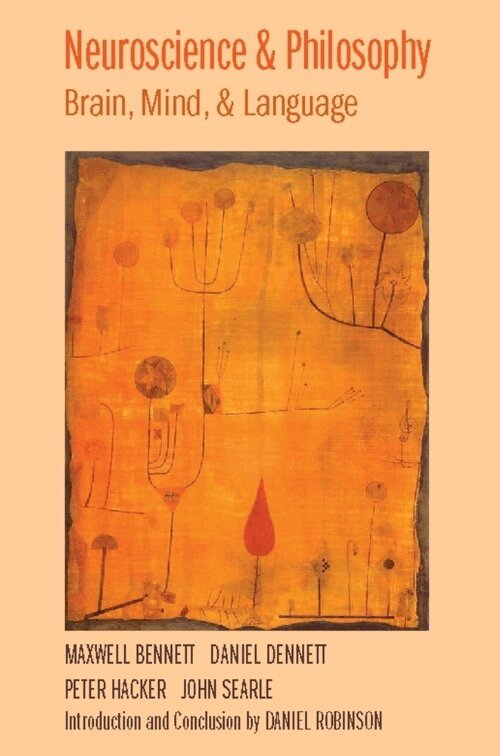
    Neuroscience and Philosophy

    Brain, Mind, and Language

    AvMaxwell Bennett,Daniel Dennett

    Inbunden, Engelska, 2007

    986 kr

    Beställningsvara. Skickas inom 5-8 vardagar. Fri frakt över 249 kr.

    Fler format och utgåvor

    Häftad

    252 kr

    E-bok

    385 kr

    Beskrivning

    In Neuroscience and Philosophy three prominent philosophers and a leading neuroscientist clash over the conceptual presuppositions of cognitive neuroscience. The book begins with an excerpt from Maxwell Bennett and Peter Hacker's Philosophical Foundations of Neuroscience (Blackwell, 2003), which questions the conceptual commitments of cognitive neuroscientists. Their position is then criticized by Daniel Dennett and John Searle, two philosophers who have written extensively on the subject, and Bennett and Hacker in turn respond. Their impassioned debate encompasses a wide range of central themes: the nature of consciousness, the bearer and location of psychological attributes, the intelligibility of so-called brain maps and representations, the notion of qualia, the coherence of the notion of an intentional stance, and the relationships between mind, brain, and body.Clearly argued and thoroughly engaging, the authors present fundamentally different conceptions of philosophical method, cognitive-neuroscientific explanation, and human nature, and their exchange will appeal to anyone interested in the relation of mind to brain, of psychology to neuroscience, of causal to rational explanation, and of consciousness to self-consciousness. In his conclusion Daniel Robinson (member of the philosophy faculty at Oxford University and Distinguished Professor Emeritus at Georgetown University) explains why this confrontation is so crucial to the understanding of neuroscientific research. The project of cognitive neuroscience, he asserts, depends on the incorporation of human nature into the framework of science itself. In Robinson's estimation, Dennett and Searle fail to support this undertaking; Bennett and Hacker suggest that the project itself might be based on a conceptual mistake. Exciting and challenging, Neuroscience and Philosophy is an exceptional introduction to the philosophical problems raised by cognitive neuroscience.

    Produktinformation

    • Utgivningsdatum:2007-04-10
    • Mått:140 x 210 x undefined mm
    • Format:Inbunden
    • Språk:Engelska
    • Antal sidor:232
    • Förlag:Columbia University Press
    • ISBN:9780231140447

    Utforska kategorier

    • Filosofi inom Filosofi och religion
    • Biovetenskap inom Naturvetenskap och teknik

    Mer om författaren

    Maxwell Bennett is professor of neuroscience and university chair at the University of Sydney and scientific director of the Brain and Mind Research Institute. His most recent books are History of the Synapse, The Idea of Consciousness, and Philosophical Foundations of Neuroscience, which he coauthored with Peter Hacker.Daniel Dennett is Austin B. Fletcher Professor of Philosophy and director of the Center for Cognitive Studies at Tufts University. He is the author of numerous books including Freedom Evolves, Breaking the Spell: Religion as a Natural Phenomenon, and Darwin's Dangerous Idea: Evolution and the Meanings of Life.Peter Hacker is a fellow of St. John's College, Oxford. The leading authority on the philosophy of Wittgenstein, his seventeen books include, most recently, Human Nature: The Categorical Framework, Philosophical Foundations of Neuroscience, which he coauthored with Maxwell Bennett, and Wittgenstein: Connections and Controversies.John Searle is Slusser Professor of Philosophy at the University of California, Berkeley. He is the author of sixteen books, including Freedom and Neurobiology: Reflections on Free Will, Language, and Political Power, Speech Acts: An Essay in the Philosophy of Language, and Mind: A Brief Introduction. His works have been translated into twenty-one languages, and in 2004 he was awarded the National Humanities Medal.

    Recensioner i media

    If you can get two sworn and unrestrained philosophical enemies such as Daniel Dennett and John Searle to join forces against you, you must at the very least be described as the controversialists of our time. -- Akeel Bilgrami, Johnsonian Professor of Philosophy and director, Heyman Centre for the Humanities, Columbia University Neurophysiology has made astonishing progress in recent decades and has learnt many hitherto unknown facts about the brain and its functioning. But what do these discoveries tell us about the mind? Peter Hacker and Maswell Bennett adopt an avowedly Aristotelian stance. Many cognitive scientists, they maintain, covertly endorse the dualism of Plato and Descartes, merely substituting brain-body dualism for mind-body dualism. If Daniel Dennett and John Searle are right, philosophical psychology is about to be superannuated by a scientific breakthrough in the study of the mind. If Bennett and Hacker are right, then much of cognitive neuroscience is not sound science but muddled philosophy. The resulting four-cornered discussion must rank as one of the great philosophical debates of our generation. The points at issue between these four sophisticated and articulate thinkers concern not only neurophysiology and philosophy of mind but the whole nature of philosophy itself and its relationship to science. The debates here give the reader an unparalleled chance to reach a personal decision on issues of fundamental intellectual importance. -- Anthony Kenny, Fellow Emeritus, St. John's College, Oxford University A useful introduction. -- Barry Dainton Science Readable and accessible. -- James Sage Metapsychology A good introduction to this dynamic subfield. Library Journal [A] rare opportunity to appreciate an encapsulated philosophical debate... Recommended. CHOICE

    Innehållsförteckning

    • Introduction, by Daniel Robinson The Argument Selections from Philosophical Foundations of Neuroscience Neuroscience and Philosophy, by Maxwell R. Bennett The Rebuttals Philosophy as Naive Anthropology: Comment on Bennett and Hacker, by Daniel Dennett Putting Consciousness Back in the Brain: Reply to Bennett and Hacker, Philosophical Foundations of Neuroscience, by John Searle Reply to the Rebuttals The Conceptual Presuppositions of Cognitive Neuroscience: A Reply to Critics, by Maxwell R. Bennett and Peter M. S. Hacker Epilogue, by Maxwell R. Bennett Still Looking: Science and Philosophy in Pursuit of Prince Reason, by Daniel Robinson Notes