• Fri frakt över 249 kr
  • •
  • Snabba leveranser
  • •
  • Billiga böcker
Kundservice

Du är på sajten för privatpersoner.

Företag, bibliotek eller offentlig verksamhet?

Du handlar på classic.bokus.com, där alla dina funktioner finns intakta.
Till classic.bokus.com
Bokus logotyp. Gå till startsidan.
  • Erbjudanden
  • Student
  • Topplistor
  • Barn & ungdom
  • Bokus Play
  • E-böcker
  • Ljudböcker
  • Pocketböcker
  • Spel och pussel

5% studentrabatt – använd koden KURSBOK27 →

Sidfot

Mina sidor

    Hjälp

    • Kundservice
    • Vanliga frågor och svar
    • Frakt och leverans
    • Retur vid ångerrätt
    • Reklamera vara
    • Betalning
    • Köpvillkor
    • Allmänna villkor
    • Information om webbplatsens tillgänglighet

    Om Bokus

    • Om oss
    • Pressrum
    • För studenter
    • För företag
    • För bibliotek och offentlig verksamhet
    • För leverantörer
    • Hållbarhet

    Populärt

    • Aktuella erbjudanden
    • Presentkort
    • Studentlitteratur
    • Nya böcker
    • Topplistor
    • Signerade böcker
    • Engelska böcker

    Inspiration

    • Boktips
    • BookTok
    • Barnbokskaraktärer
    • Populära författare
    Logotyp för Bokus
    Följ oss på Facebook (extern länk)Följ oss på Instagram (extern länk)Följ oss på YouTube (extern länk)Följ oss på TikTok (extern länk)
    bokus @ CookiesAnpassa cookiesIntegritetspolicyKöpvillkor
    Till Citymail hemsida (extern länk)Till Budbee hemsida (extern länk)Till Postnord hemsida (extern länk)Till Schenker hemsida (extern länk)Till Early Bird hemsida (extern länk)Till Walleys hemsida (extern länk)
    1. Samhälle och politik
    2. Politik och statsskick
    3. Statsvetenskap och politisk teori

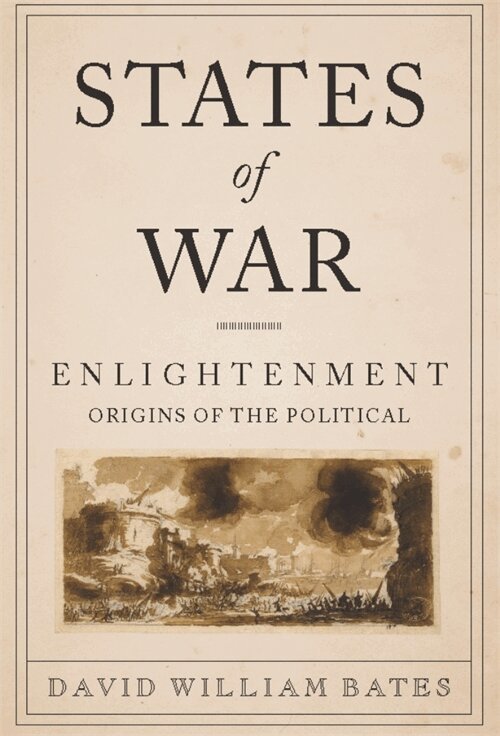
    States of War

    Enlightenment Origins of the Political

    AvDavid Bates

    Häftad, Engelska, 2011

    Del i serien Columbia Studies in Political Thought / Political History

    639 kr

    Beställningsvara. Skickas inom 3-6 vardagar. Fri frakt över 249 kr.

    Fler format och utgåvor

    Inbunden

    1 146 kr

    Beskrivning

    We fear that the growing threat of violent attack has upset the balance between existential concepts of political power, which emphasize security, and traditional notions of constitutional limits meant to protect civil liberties. We worry that constitutional states cannot, during a time of war, terror, and extreme crisis, maintain legality and preserve civil rights and freedoms. David Williams Bates allays these concerns by revisiting the theoretical origins of the modern constitutional state, which, he argues, recognized and made room for tensions among law, war, and the social order. We traditionally associate the Enlightenment with the taming of absolutist sovereign power through the establishment of a legal state based on the rights of individuals. In his critical rereading, Bates shows instead that Enlightenment thinkers conceived of political autonomy in a systematic, theoretical way. Focusing on the nature of foundational violence, war, and existential crises, eighteenth-century thinkers understood law and constitutional order not as constraints on political power but as the logical implication of that primordial force.Returning to the origin stories that informed the beginnings of political community, Bates reclaims the idea of law, warfare, and the social order as intertwining elements subject to complex historical development. Following an analysis of seminal works by seventeenth-century natural-law theorists, Bates reviews the major canonical thinkers of constitutional theory (Locke, Montesquieu, and Rousseau) from the perspective of existential security and sovereign power. Countering Carl Schmitt's influential notion of the autonomy of the political, Bates demonstrates that Enlightenment thinkers understood the autonomous political sphere as a space of law protecting individuals according to their political status, not as mere members of a historically contingent social order.

    Produktinformation

    • Utgivningsdatum:2011-11-01
    • Mått:152 x 229 x 15 mm
    • Vikt:392 g
    • Format:Häftad
    • Språk:Engelska
    • Serie:Columbia Studies in Political Thought / Political History
    • Antal sidor:280
    • Förlag:Columbia University Press
    • ISBN:9780231158053

    Utforska kategorier

    • Statsvetenskap och politisk teori inom Samhälle och politik
    • Filosofiska discipliner inom Filosofi och religion
    • Politiskt förtryck inom Samhälle och politik

    Mer om författaren

    David William Bates is professor of rhetoric at the University of California, Berkeley, and director of the Berkeley Center for New Media. He is the author of Enlightenment Aberrations: Error and Revolution in France, and, alongside his work on the history of political and legal thought, his research focuses on the intersections between technology and cognition since the Scientific Revolution.

    Recensioner i media

    Bates's own position is supremely original and perfectly and clearly articulated. He shows that the political does not have to lead to fascism and violence and exclusion (clearly it has not prevented these things from taking place) but can have a more progressive, individualist, and anti-exclusionary form. -- James Martel, San Francisco State University In this breakthrough rereading of early-modern thought, David William Bates discovers the origins of liberal norms in and through the creation of a fully autonomous political domain. As Bates shows, it was no accident that construction of internal constitutionalist restraints on the state occurred just as the modern state emerged to its full external potential for global violence. Bates's argument is at the cutting edge in the history of political thought, and his interpretations of Thomas Hobbes, John Locke, and Jean-Jacques Rousseau renovate the study of each author. -- Samuel Moyn, Columbia University [A] masterful study. -- David Tkach The Review of Politics

    Innehållsförteckning

    • Foreword by Dick Howard Preface Introduction: Constitutional Violence and Enlightenment Thought 1. The Autonomous State and the Origin of the Political 2. States of Reasoning: Modern Natural-Law Theory 3. Locke's Natural History of the Political 4. Systems of Sovereignty in Montesquieu 5. Rousseau's Cybernetic Political Body Conclusion: From the Concept of the Political to the Rule of Law Notes Index