• Fri frakt över 249 kr
  • •
  • Snabba leveranser
  • •
  • Billiga böcker
Kundservice

Du är på sajten för privatpersoner.

Företag, bibliotek eller offentlig verksamhet?

Du handlar på classic.bokus.com, där alla dina funktioner finns intakta.
Till classic.bokus.com
Bokus logotyp. Gå till startsidan.
  • Erbjudanden
  • Nyheter
  • Student
  • Topplistor
  • Barn & ungdom
  • Bokus Play
  • E-böcker
  • Pocketböcker
  • Spel & pussel

10% rabatt på allt med kod NYSTART10 →

Sidfot

Mina sidor

    Hjälp

    • Kundservice
    • Vanliga frågor och svar
    • Frakt och leverans
    • Retur vid ångerrätt
    • Reklamera vara
    • Betalning
    • Köpvillkor
    • Allmänna villkor
    • Information om webbplatsens tillgänglighet

    Om Bokus

    • Om oss
    • Pressrum
    • För studenter
    • För företag
    • För bibliotek och offentlig verksamhet
    • För leverantörer
    • Hållbarhet

    Populärt

    • Aktuella erbjudanden
    • Presentkort
    • Studentlitteratur
    • Nya böcker
    • Topplistor
    • Signerade böcker
    • Engelska böcker

    Inspiration

    • Boktips
    • BookTok
    • Populära bokserier
    • Barnbokskaraktärer
    • Populära författare
    Logotyp för Bokus
    Följ oss på Facebook (extern länk)Följ oss på Instagram (extern länk)Följ oss på YouTube (extern länk)Följ oss på TikTok (extern länk)
    bokus @ CookiesAnpassa cookiesIntegritetspolicyKöpvillkor
    Till Citymail hemsida (extern länk)Till Budbee hemsida (extern länk)Till Postnord hemsida (extern länk)Till Schenker hemsida (extern länk)Till Early Bird hemsida (extern länk)Till Walleys hemsida (extern länk)
    1. Naturvetenskap och teknik
    2. Matematik och naturvetenskap
    3. Matematik
    4. Matematikens grunder

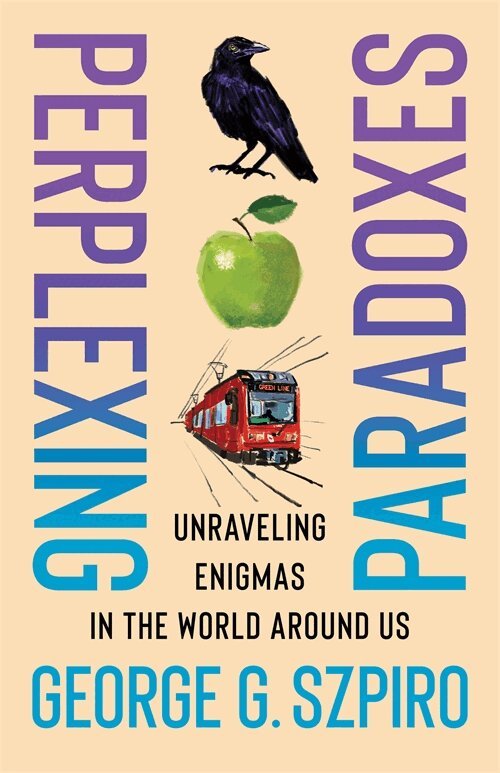
    Perplexing Paradoxes

    Unraveling Enigmas in the World Around Us

    AvGeorge G. Szpiro

    Inbunden, Engelska, 2024

    292 kr

    Beställningsvara. Skickas inom 5-8 vardagar. Fri frakt över 249 kr.

    Beskrivning

    Why does it always seem like the elevator is going down when you need to go up? Is it really true that 0.99999 . . . with an infinite number of 9s after the decimal point, is equal to 1? What do tea leaves and river erosion have in common, per Albert Einstein? Does seeing a bed of red flowers help prove that all ravens are black? Can we make sense of a phrase like “this statement is unprovable”?Exploring these questions and many more, George G. Szpiro guides readers through the puzzling world of paradoxes, from Socratic dialogues to the Monty Hall problem. Perplexing Paradoxes presents sixty counterintuitive conundrums drawn from diverse areas of thought—not only mathematics, statistics, logic, and philosophy but also social science, physics, politics, and religion. Szpiro offers a brisk history of each paradox, unpacks its inner workings, and considers where one might encounter it in daily life. Ultimately, he argues, paradoxes are not simple brain teasers or abstruse word games—they challenge us to hone our reasoning and become more alert to the flaws in received wisdom and common habits of thought.Lighthearted, witty, and conversational, Perplexing Paradoxes presents sophisticated material in an accessible way for all readers interested in the world’s boundless possibilities—and impossibilities.

    Produktinformation

    • Utgivningsdatum:2024-03-26
    • Mått:140 x 216 x 32 mm
    • Vikt:614 g
    • Format:Inbunden
    • Språk:Engelska
    • Antal sidor:360
    • Förlag:Columbia University Press
    • ISBN:9780231213769

    Utforska kategorier

    • Matematikens grunder inom Naturvetenskap och teknik
    • Matematikens filosofi inom Naturvetenskap och teknik
    • Matematikens historia inom Naturvetenskap och teknik

    Mer om författaren

    George G. Szpiro is an author and journalist who was a longtime correspondent for the Swiss daily Neue Zürcher Zeitung. His many books include Numbers Rule: The Vexing Mathematics of Democracy, from Plato to the Present (2010) and Risk, Choice, and Uncertainty: Three Centuries of Economic Decision-Making (Columbia, 2020). Szpiro was on the faculty at the Wharton School, University of Pennsylvania, and the Hebrew University in Jerusalem.

    Recensioner i media

    Think you’ve got a fine, analytical mind? Read this book. I can’t tell you how many times I paused and thought, "OK, wait a sec . . . gotta read that again." The paradoxes arising out of simple-sounding conditions were, well, mind-boggling. A must-read!

    Innehållsförteckning

    • IntroductionPart I. Quotidian Riddles: Making Sense of the Silly and Surprising1. My Friends Are More Popular Than I Am: The Friendship Paradox2. Waiting for Godot: The Elevator Paradox3. The Pursuit of Happiness: The Paradox of Hedonism4. Tip Now or Tip Later? The Good Service Paradox5. Don’t Work Out to Lose Weight: The Exercise ParadoxPart II. Language Is Tricky: It’s Not What You Say, It’s What They Hear6. Can’t Get No Satisfaction: Morgenbesser’s Double Negatives7. Don’t Trust Friends: False Friends8. Janus Words: The Antagonym Paradox9. Pentasyllabic Has Five Syllables: The Grelling-Nelson Paradox10. A Rose Is a Rose Is a Rose: The Langford-Moore ParadoxPart III. Unbelievable but True: There’s More Than Happy Endings11. Whodunit? He Done It! The Paradox of Suspense12. To Wallow in Sorrow: The Paradox of Tragedy13. Moved to Tears: The Paradox of Fiction14. Hidden by Quotation Marks: The Quinification Paradox15. All Remaining Errors Are My Own: The Preface ParadoxPart IV. You Do the Math: Numbers Don’t Lie—Go Figure!16. Chocolates from the Trays: The Axiom of Choice17. Rounding Crooked Numbers: 0.999 . . .18. On or Off? Thomson’s Lamp19. Randomness Is Not Random: The Random Numbers Paradox20. Zero or One? That Is the Question: Grandi’s ParadoxPart V. Let’s Get Physical21. Why Is It Dark at Night? Olbers’s Paradox22. Gathering in the Middle: The Tea Leaves Paradox23. Shaken, Not Stirred! The Brazil Nut Effect24. Cold and Colder: The Mpemba Paradox25. Suck or Spout? The Sprinkler ParadoxPart VI. The Possibility of Probability . . . and Then There’s Statistics26. A Cadillac or a Goat? The Monty Hall Paradox27. To Treat or Not to Treat? Simpson’s Paradox28. A Holistic Approach: The Two Envelopes Problem29. Silver and Gold? Bertrand’s Probability Paradox30. Are More Than Half the Babies Boys? Lindley’s ParadoxPart VII. Footloose Philosophy: Give It Some Thought31. To Shave or Not to Shave . . . Oneself: Russell’s Barber Paradox32. I Don’t Believe It: Moore’s Paradox33. Known Knowns, Known Unknowns: Fitch’s Paradox34. No ATM in the Desert: Parfit’s Hitchhiker35. Plus, or Quus? The Kripkenstein ParadoxPart VIII. Loopy Logic: Making Sense of Seeming Nonsense36. God Exists and the Moon Is Made of Cheese: Curry’s Paradox37. To Know Nothing: Socrates’s Paradox38. Is There a Point in Asking the Question? Meno’s Paradox39. The Whole Truth and Nothing but the Truth: Gödel’s Incompleteness Theorem40. Are All Ravens Black? Hempel’s ParadoxPart IX. Questions of Faith: The Small Print of Holy Texts41. In the Name of the Lord, Your God: The Third Commandment42. A Stone So Heavy . . . : The Omnipotence Paradox43. Accumulate Wealth . . . but Don’t Spend It: The Paradox of Asceticism44. Thou Mayest Steal: The Sermon on the Mount45. All Is Perfect: The Smarandache ParadoxPart X. Legal Liabilities: Terms and Conditions Apply46. When Two Rights Make a Wrong: The Blackmail Paradox47. Guilty Until Proven Innocent: The Prosecutor’s Fallacy48. The Right to Remain Silent: The Fifth Amendment49. When in Doubt, Acquit: The Unspecified Offense Paradox50. Can Two Wrongs Make a Right? The Holistic Trial ParadoxPart XI. The Economics of the Unexpected: It Stacks Up . . . but Does It Balance?51. Sell a Lot and Make No Profits: Bertrand’s Economics Paradox52. Doing More with Less: Jevons’s Paradox53. Optimal Liberalism: Sen’s Paradox54. Private Vices, Publick Benefits: Mandeville’s Paradox55. Tightening One’s Belt: The Paradox of ThriftPart XII. Puzzling Politics: The Vexing Mathematics of Democracy56. Who Should Win? Condorcet Cycles57. More Seats or Fewer? The Alabama Paradox58. To Abstain from Elections: The Nonvoting Paradox59. Packing and Cracking: Gerrymandering60. How Can One Be a Democrat? Wollheim’s ParadoxEpiloguePostscriptBibliographic NotesIndex