• Fri frakt över 249 kr
  • •
  • Snabba leveranser
  • •
  • Billiga böcker
Kundservice

Du är på sajten för privatpersoner.

Företag, bibliotek eller offentlig verksamhet?

Du handlar på classic.bokus.com, där alla dina funktioner finns intakta.
Till classic.bokus.com
Bokus logotyp. Gå till startsidan.
  • Erbjudanden
  • Nyheter
  • Student
  • Topplistor
  • Barn & ungdom
  • Bokus Play
  • E-böcker
  • Pocketböcker
  • Spel & pussel

10% rabatt på allt med kod NYSTART10 →

Sidfot

Mina sidor

    Hjälp

    • Kundservice
    • Vanliga frågor och svar
    • Frakt och leverans
    • Retur vid ångerrätt
    • Reklamera vara
    • Betalning
    • Köpvillkor
    • Allmänna villkor
    • Information om webbplatsens tillgänglighet

    Om Bokus

    • Om oss
    • Pressrum
    • För studenter
    • För företag
    • För bibliotek och offentlig verksamhet
    • För leverantörer
    • Hållbarhet

    Populärt

    • Aktuella erbjudanden
    • Presentkort
    • Studentlitteratur
    • Nya böcker
    • Topplistor
    • Signerade böcker
    • Engelska böcker

    Inspiration

    • Boktips
    • BookTok
    • Populära bokserier
    • Barnbokskaraktärer
    • Populära författare
    Logotyp för Bokus
    Följ oss på Facebook (extern länk)Följ oss på Instagram (extern länk)Följ oss på YouTube (extern länk)Följ oss på TikTok (extern länk)
    bokus @ CookiesAnpassa cookiesIntegritetspolicyKöpvillkor
    Till Citymail hemsida (extern länk)Till Budbee hemsida (extern länk)Till Postnord hemsida (extern länk)Till Schenker hemsida (extern länk)Till Early Bird hemsida (extern länk)Till Walleys hemsida (extern länk)
    1. Naturvetenskap och teknik
    2. Matematik och naturvetenskap
    3. Matematik
    4. Matematikens grunder

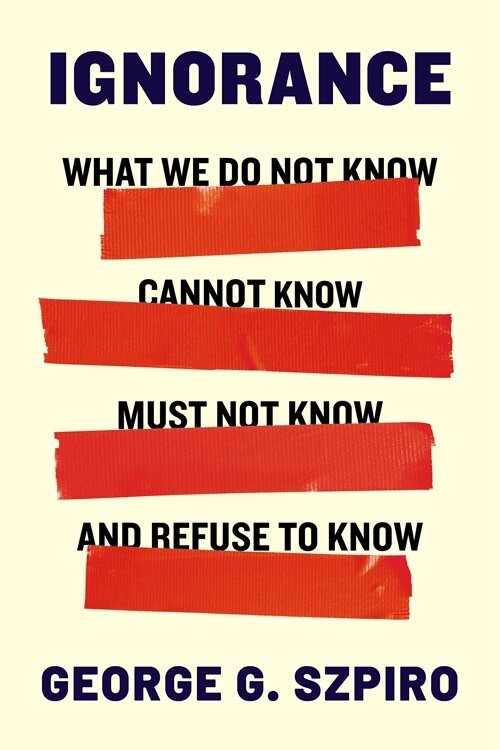
    Ignorance

    What We Do Not Know, Cannot Know, Must Not Know, and Refuse to Know

    AvGeorge G. Szpiro

    Inbunden, Engelska, 2026

    492 kr

    Beställningsvara. Skickas inom 3-6 vardagar. Fri frakt över 249 kr.

    Beskrivning

    Does the lack of evidence mean that aliens don’t exist? Why does an unproven mathematical hypothesis have profound consequences? Are humans capable of grasping the nature of divinity? Is it ethical to give a patient a placebo? Why do people persist in demonstrably false beliefs like flat earth theory? Should someone want to know when they will die?George G. Szpiro examines these questions and many others, offering an engaging and witty tour of what we can learn from ignorance. In a series of fast-paced chapters, he unravels problems ranging across science, mathematics, law, economics, politics, religion, psychology, and philosophy—some esoteric, others drawn from everyday life. Ignorance comes in many forms, Szpiro shows. Some questions are only temporarily unsolved; others are inherently unanswerable. Sometimes authorities keep answers from us, for good or ill. Often our assumptions and biases keep us from overcoming our ignorance, and occasionally we choose to remain ignorant—for surprisingly rational reasons.Ultimately, Szpiro argues, ignorance is not purely negative. It can motivate the pursuit of learning and wisdom—as long as we acknowledge it. Presenting sophisticated topics in an accessible way, this book shows how ignorance sheds light on the nature of knowledge.

    Produktinformation

    • Utgivningsdatum:2026-04-07
    • Mått:140 x 216 x 29 mm
    • Vikt:604 g
    • Format:Inbunden
    • Språk:Engelska
    • Antal sidor:344
    • Förlag:Columbia University Press
    • ISBN:9780231221658

    Utforska kategorier

    • Matematikens grunder inom Naturvetenskap och teknik
    • Naturvetenskap:allmänt inom Naturvetenskap och teknik
    • Filosofiska discipliner inom Filosofi och religion

    Mer om författaren

    George G. Szpiro is an author and journalist who was a longtime correspondent for the Swiss daily Neue Zürcher Zeitung. His previous Columbia University Press books are Risk, Choice, and Uncertainty: Three Centuries of Economic Decision-Making (2020) and Perplexing Paradoxes: Unraveling Enigmas in the World Around Us (2024). Szpiro was on the faculty at the Wharton School, University of Pennsylvania, and the Hebrew University in Jerusalem.

    Recensioner i media

    Ignorance has become a hip topic in academia and beyond. George G. Szpiro's book masterfully weaves together different aspects of this trend by considering the flip side of knowledge from everyday perspectives, that is, the normalcy of nonknowledge, intentionally or not, in basically all areas of life. By so doing, Szpiro detects sixty "normal" instances of ignorance, no less. If you truly want to know about not knowing, then this is the book to read.

    Innehållsförteckning

    • AcknowledgmentsIntroductionPart I. Do Not Know1. Do Aliens Visit Us? Flying Saucers and Other UFOs2. Knowledge Under Seal: Les Plis Cachetés3. A Mathematical Riddle: The Riemann Hypothesis4. Restricted Access: Top Secret vs. Freedom of Information5. Ignoramus et Ignorabimus: A Controversy in Germany6. Will the Universe Expand Forever? Big Crunch, Big Bounce, Big Rip, or Big Chill7. Ignorantia Legis Non Excusat: Presumed to Know8. What Is Nothing? Horror vacui9. Is Justified True Belief Knowledge? Gettier’s Problem10. Hard but Easy: P vs. NP11. Ignoring One’s Own Assessment: Ellsberg’s Paradox12. It’s There but Can’t Be Seen: Dark Matter13. Unskilled and Unaware of It: The Dunning-Kruger Effect14. The Hard Problem and the Easy Problem: Understanding Consciousness15. Uncharted Depths: Aqua IncognitaPart II. Cannot Know16. On Learned Ignorance: Cardinal Nicolas de Cusa17. Where and How Fast? The Uncertainty Principle18. Half Zeros, Half Ones: Random Numbers19. Satisfice, Don’t Optimize: Bounded Rationality20. Don’t Even Ask: Meno’s Paradox21. Engaging in Risky Behavior: Moral Hazard22. Nonlinearities Have Consequences: Chaos Theory23. The Sixth Sense in a Post-Truth World: Alternative Facts and Fake News24. How Long Is the Coast of Britain? Fractal Dimensions25. Is the Solar System Stable? KAM Theory26. Entering Infinite Loops: The Turing Halting Problem27. True but Not Provable: Gödel’s Incompleteness Theorems28. Storing Music, Photos, Video, and Text: Algorithmic Complexity29. Too Far Away: The Light Cone30. Is Your Red My Blue? QualiaPart III. Must Not Know31. Preventing Last Rites: Professor Bernhardi32. The Veil of Ignorance: John Rawls’s Theory of Justice33. Show and (Don’t) Tell: Zero Knowledge Proofs34. Limited Liability: The Corporate Veil35. Move to Strike: Unringing the Bell36. Hot Stock Tips: Insider Trading37. Carnal Knowledge: Adam and Eve38. Ignore Irrelevant Alternatives: The Theory of Games39. Blind and Double Blind: The Placebo Effect40. Polls Are Like Perfume: The Bandwagon Effect41. Don’t Talk About Money: Compensation Secrecy42. Cursed Be He: Spinoza’s Theses43. Apply for a Patent or Keep a Secret? Intellectual Property44. Don’t Throw Good Money After Bad: The Sunk Cost Fallacy45. Kabbalah: Only Men Over FortyPart IV. Refuse to Know46. Murder, Suicide, or the Gods’ Wrath? The Square Root of 247. “Eppur si muove!” The Trial of Galileo48. Diamonds Are a Girl’s Best Friend: A Mineral Consisting of Pure Carbon49. The Silent Epidemic of Misunderstandings: Pluralistic Ignorance50. “Non, je ne regrette rien”: Anticipated Regret51. Ill-Informed but Harmless? Flat-Earthers52. Don’t Even Talk About It: Critical Race Theory53. Oldies Prefer Ignorance: Twenty-Somethings vs. Over-Eighties54. Protecting the Second Amendment: The Dickey and Tiahart Amendments55. Ignoring High-Risk Events: Disaster Insurance56. Legislating Mathematical Truth: π = 3.2?57. To Test or Not to Test? Prostate-Specific Antigens58. Beware: Violence Ahead! Trigger Warning59. Don’t Tell Me You Did It: Plausible Deniability60. Experts, Shmexperts: Denial of Expertise, Dismissal of ElitesEpilogueNotesIndex of Names