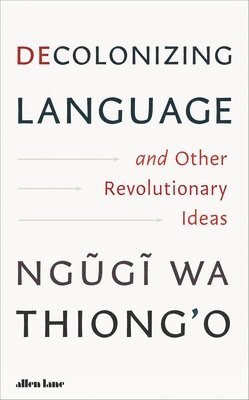
Inbunden, Engelska, 2025
Decolonizing Language and Other Revolutionary Ideas
251 kr
Skickas tisdag 10/11. Fri frakt över 249 kr.
Fler format och utgåvor
Beskrivning
Produktinformation
- Utgivningsdatum: 2025-08-21
- Mått: 222 x 25 x 138 mm
- Vikt: 400 g
- Format: Inbunden
- Språk: Engelska
- Antal sidor: 224
- Förlag: Penguin Books Ltd
- ISBN: 9780241780978
Utforska kategorier
Mer om författaren
Ngugi wa Thiong’o (1938-2025) was born in Limuru, Kenya, and went on to become one of the leading writers and scholars of our times. He authored numerous works of fiction, memoir and essay, including A Grain of Wheat, Devil on the Cross and Decolonizing the Mind. Ngugi was the Distinguished Professor of English and Comparative Literature at the University of California, Irvine; he held fourteen honorary doctorates, among other awards, and was nominated for the Man Booker International Prize.
Recensioner i media
One of the greatest writers of our time
Betyg & recensioner
1 recensioner, genomsnitt 5/5
- 5/5 Robert P
Ngugi wa Thiong'o was shortlisted for the Nobel Prize in Literature several times. The book summarises a lifetime devoted to writing fiction, non-fiction, and autobiography, all dealing with life in Kenya in colonial and post-colonial times. He wrote successful novels in English but decided to switch to using his mother tongue, Gikuyu, because he wanted to reach a different readership, and he wished to demonstrate that a West African language could equally well be used in plays and novels. He was a pioneer.