• Fri frakt över 249 kr
  • •
  • Snabba leveranser
  • •
  • Billiga böcker
Kundservice

Du är på sajten för privatpersoner.

Företag, bibliotek eller offentlig verksamhet?

Du handlar på classic.bokus.com, där alla dina funktioner finns intakta.
Till classic.bokus.com
Bokus logotyp. Gå till startsidan.
  • Erbjudanden
  • Student
  • Topplistor
  • Barn & ungdom
  • Bokus Play
  • E-böcker
  • Ljudböcker
  • Pocketböcker
  • Spel & pussel

Upp till 25% på utvalda nyheter →

Sidfot

Mina sidor

    Hjälp

    • Kundservice
    • Vanliga frågor och svar
    • Frakt och leverans
    • Retur vid ångerrätt
    • Reklamera vara
    • Betalning
    • Köpvillkor
    • Allmänna villkor
    • Information om webbplatsens tillgänglighet

    Om Bokus

    • Om oss
    • Pressrum
    • För studenter
    • För företag
    • För bibliotek och offentlig verksamhet
    • För leverantörer
    • Hållbarhet

    Populärt

    • Aktuella erbjudanden
    • Presentkort
    • Studentlitteratur
    • Nya böcker
    • Topplistor
    • Signerade böcker
    • Engelska böcker

    Inspiration

    • Boktips
    • BookTok
    • Populära bokserier
    • Barnbokskaraktärer
    • Populära författare
    Logotyp för Bokus
    Följ oss på Facebook (extern länk)Följ oss på Instagram (extern länk)Följ oss på YouTube (extern länk)Följ oss på TikTok (extern länk)
    bokus @ CookiesAnpassa cookiesIntegritetspolicyKöpvillkor
    Till Citymail hemsida (extern länk)Till Budbee hemsida (extern länk)Till Postnord hemsida (extern länk)Till Schenker hemsida (extern länk)Till Early Bird hemsida (extern länk)Till Walleys hemsida (extern länk)
    1. Data och IT
    2. Grafik och bildbehandling
    3. Datorspelsdesign

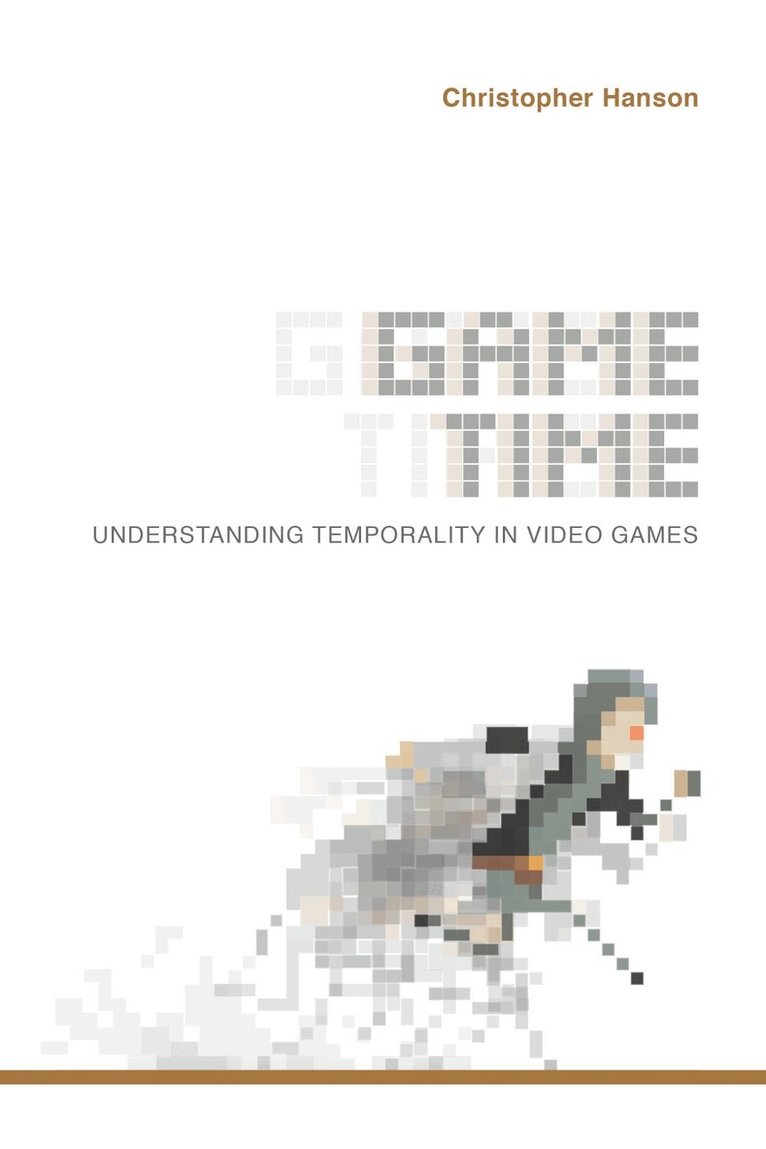
    Game Time

    Understanding Temporality in Video Games

    AvChristopher Hanson

    Häftad, Engelska, 2018

    Del i serien Digital Game Studies

    378 kr

    Beställningsvara. Skickas inom 5-8 vardagar. Fri frakt över 249 kr.

    Fler format och utgåvor

    Inbunden

    979 kr

    E-bok

    100 kr

    E-bok

    100 kr

    Beskrivning

    Preserving, pausing, slowing, rewinding, replaying, reactivating, reanimating Has the ability to manipulate video game timelines altered our cultural conceptions of time? Video game scholar Christopher Hanson argues that the mechanics of time in digital games have presented a new model for understanding time in contemporary culture, a concept he calls "game time." Multivalent in nature, game time is characterized by apparent malleability, navigability, and possibility while simultaneously being highly restrictive and requiring replay and repetition. When compared to analog tabletop games, sports, film, television, and other forms of media, Hanson demonstrates that the temporal structures of digital games provide unique opportunities to engage players with liveness, causality, potentiality, and lived experience that create new ways of experiencing time Featuring comparative analysis of key video games titles—including Braid, Quantum Break, Battle of the Bulge, Prince of Persia: The Sands of Time, Passage, The Legend of Zelda: The Ocarina of Time, Lifeline, and A Dark Room.

    Produktinformation

    • Utgivningsdatum:2018-03-08
    • Mått:152 x 229 x 13 mm
    • Vikt:336 g
    • Format:Häftad
    • Språk:Engelska
    • Serie:Digital Game Studies
    • Antal sidor:296
    • Förlag:Indiana University Press
    • ISBN:9780253032867

    Utforska kategorier

    • Datorspelsdesign inom Data och IT

    Mer om författaren

    Christopher Hanson is Assistant Professor of English at Syracuse University with a background in video game and software development.

    Recensioner i media

    "The text is well-researched, and the introduction is an excellent, focused overview of video game studies. . . . a compelling work. . . . Recommended. "—Choice"While such a combination of viewpoints seems inherent to video game studies,it nevertheless makes this book an equally rich and engaging reading for academics, students, and gamers."—Projections 14.2"Hanson cleverly explores how seemingly mundane concepts like the ability to pause, save, or suspend gameplay radically changes our relationship to games and what we are allowed to do with them; however, these technological advancements also lead to the creation of more complex game design in which temporal manipulation becomes part of the player's challenges (or their toolset). Hanson naturally explores speedrunning in Game Time, suggesting that the desire to repeatedly play games in order to find ways to complete them faster or experiment with glitches to "break" the internal programming to do things players are not supposed to do is a means of demonstrating human mastery over the game, turning the act into performance as much as play. Through these and other examples, Hanson's work explores how video games are unique in terms of entertainment media and how interactivity intersects with our very concept of time and space—as Animal Crossing players learned, all it takes is to adjust a clock in the menu to turn today into tomorrow, or three weeks from now"—Bryan J. Carr, University of Wisconsin–Green Bay, Communication Booknotes Quarterly

    Innehållsförteckning

    • AcknowledgmentsIntroduction1. More than Live: Game "A-liveness" and Immediacy2. Game Presence and Mediatization3. Pausing and Resuming4. Saving and Restoring5. An Instinct towards Repetition: "Replay Value," Mastery, and Re-Creation6. Recursive Temporalities7. Case StudiesConclusionGameographyFilmographyBibliographyIndex