• Fri frakt över 249 kr
  • •
  • Snabba leveranser
  • •
  • Billiga böcker
Kundservice

Du är på sajten för privatpersoner.

Företag, bibliotek eller offentlig verksamhet?

Du handlar på classic.bokus.com, där alla dina funktioner finns intakta.
Till classic.bokus.com
Bokus logotyp. Gå till startsidan.
  • Erbjudanden
  • Nyheter
  • Student
  • Topplistor
  • Barn & ungdom
  • Bokus Play
  • E-böcker
  • Pocketböcker
  • Spel & pussel

10% rabatt på allt med kod: NYSTART10 →

Sidfot

Mina sidor

    Hjälp

    • Kundservice
    • Vanliga frågor och svar
    • Frakt och leverans
    • Retur vid ångerrätt
    • Reklamera vara
    • Betalning
    • Köpvillkor
    • Allmänna villkor
    • Information om webbplatsens tillgänglighet

    Om Bokus

    • Om oss
    • Pressrum
    • För studenter
    • För företag
    • För bibliotek och offentlig verksamhet
    • För leverantörer
    • Hållbarhet

    Populärt

    • Aktuella erbjudanden
    • Presentkort
    • Studentlitteratur
    • Nya böcker
    • Topplistor
    • Signerade böcker
    • Engelska böcker

    Inspiration

    • Boktips
    • BookTok
    • Populära bokserier
    • Barnbokskaraktärer
    • Populära författare
    Logotyp för Bokus
    Följ oss på Facebook (extern länk)Följ oss på Instagram (extern länk)Följ oss på YouTube (extern länk)Följ oss på TikTok (extern länk)
    bokus @ CookiesAnpassa cookiesIntegritetspolicyKöpvillkor
    Till Citymail hemsida (extern länk)Till Budbee hemsida (extern länk)Till Postnord hemsida (extern länk)Till Schenker hemsida (extern länk)Till Early Bird hemsida (extern länk)Till Walleys hemsida (extern länk)
    1. Naturvetenskap och teknik
    2. Teknik och industri
    3. Teknik: allmänt

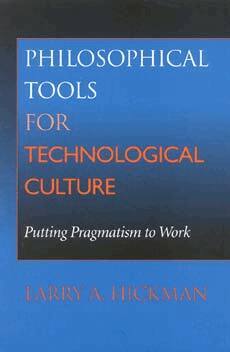
    Philosophical Tools for Technological Culture

    Putting Pragmatism to Work

    AvLarry A. Hickman

    Häftad, Engelska, 2001

    Del i serien Philosophy of Technology

    215 kr

    Beställningsvara. Skickas inom 10-15 vardagar. Fri frakt över 249 kr.

    Beskrivning

    "Hickman['s] . . . style of pragmatism provides us with flexible, philosophical 'tools' which can be used to analyze and penetrate various technology and technological cultural problems of the present. He, himself, uses this toolkit to make his analyses and succeeds very well indeed." —Don IhdeA practical and comprehensive appraisal of the value of philosophy in today's technological culture.Philosophical Tools for Technological Culture contends that technology—a defining mark of contemporary culture—should be a legitimate concern of philosophers. Larry A. Hickman contests the perception that philosophy is little more than a narrow academic discipline and that philosophical discourse is merely redescription of the ancient past. Drawing inspiration from John Dewey, one of America's greatest public philosophers, Hickman validates the role of philosophers as cultural critics and reformers in the broadest sense. Hickman situates Dewey's critique of technological culture within the debates of 20th-century Western philosophy by engaging the work of Richard Rorty, Albert Borgmann, Jacques Ellul, Walter Benjamin, Jürgen Habermas, and Martin Heidegger, among others. Pushing beyond their philosophical concerns, Hickman designs and assembles a set of philosophical tools to cope with technological culture in a new century. His pragmatic treatment of current themes—such as technology and its relationship to the arts, technosciences and technocrats, the role of the media in education, and the meaning of democracy and community life in an age dominated by technology—reveals that philosophy possesses powerful tools for cultural renewal. This original, timely, and accessible work will be of interest to readers seeking a deeper understanding of the meanings and consequences of technology in today's world.

    Produktinformation

    • Utgivningsdatum:2001-02-22
    • Mått:156 x 235 x 18 mm
    • Vikt:363 g
    • Format:Häftad
    • Språk:Engelska
    • Serie:Philosophy of Technology
    • Antal sidor:232
    • Förlag:Indiana University Press
    • ISBN:9780253214447

    Utforska kategorier

    • Teknik: allmänt inom Naturvetenskap och teknik
    • Filosofiska discipliner inom Filosofi och religion

    Recensioner i media

    "Hickman offers a refinement of his earlier John Dewey's Pragmatic Technology (CH, Jun'90), with nine essays inviting consideration of some of the pivotal problems and prospects of our technological culture. The essays are concerned with the paradoxical fact that the techniques and technologies ostensibly developed as means of control are now viewed by many individuals as spinning out of control, or at the very least, as operating beyond their personal control. The author argues that not only is technology as culture the legitimate concern of philosophers, but that they can be cultural critics and reformers in the process. One of the most interesting chapters is devoted to ways in which a techno-scientific education might serve to confront antiscientific elements in modern society, including religious fundamentalism (Islamic as well as Christian) and the splintering effects of contemporary specialism. The author contrasts Dewey's own critique of technological culture with those of Jacques Ellul and Martin Heidegger. In the closing chapter he also provides his own program for the effective reform of technological culture. He puts philosophy to work so that productive pragmatism may transform technocracy to improve the present and enhance the potential for future growth of individuals and communities alike. Upper-division undergraduates through professionals; two—year technical program students.November 2001"—J. W. Dauben, CUNY Herbert H. Lehman College

    Innehållsförteckning

    • Preliminary Table of Contents: AcknowledgmentsIntroduction1. Tuning Up Technology2. Technology and Community Life3. Productive Pragmatism, Critical Theory, and Agape4. Art, Technoscience, and Social Action5. Technoscience Education for a Life-Long Curriculum6. Literacy, Mediacy, and Technological Determinism7. Populism and the Cult of the Expert8. Hope, Salvation, and Responsibility9. The Next Technological RevolutionNotesBibliographyIndex