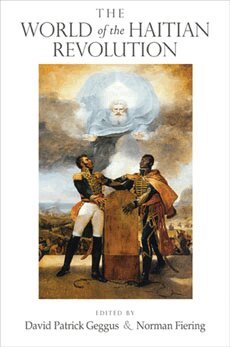
World of the Haitian Revolution
299 kr
Beställningsvara. Skickas inom 5-8 vardagar. Fri frakt över 249 kr.
Du är på sajten för privatpersoner.
299 kr
Beställningsvara. Skickas inom 5-8 vardagar. Fri frakt över 249 kr.
David Patrick Geggus teaches history at the University of Florida, Gainesville. Among his books are Slavery, War and Revolution and Haitian Revolutionary Studies (IUP, 2003). Norman Fiering is author of Moral Philosophy at Seventeenth-Century Harvard: A Discipline in Transition and Jonathan Edwards's Moral Thought and Its British Context. Fiering is past director and librarian of the John Carter Brown Library.
"Students of Haiti's past have seen two recent additions in English to the literature about the island's famous revolution—first the magisterial Toussaint Louverture: A Biography, by Madison Smartt Bell in 2007, (CH, Jul'07, 44-6405), and now the worthy The World of the Haitian Revolution. The latter is the fruit of a 2004 conference at the John Carter Brown Library commemorating the bicentennial of Haitian independence. Eighteen articles range from studies about Saint-Domingue on the eve of the 1791 slave insurrection to the transition from emancipation to the permanent break with France in 1804, and, finally, to the reverberations of the island's events upon other slave societies and upon fiction, the fine arts, and the craft of history. The most interesting articles question the inevitability of the Haitian Revolution, explore the French decision to treat the Haiti troubles in the same fashion as that of the peasant revolt in the Vendée, analyze the court cases for emancipation brought by Haitian exiles in the US legal system, and discuss the historic sites of revolution. Some scholars are edging toward an argument that the most important of the New World revolutions took place in the Caribbean and not on the mainland. Summing Up: Highly recommended. Upper-division undergraduates and above. — Choice"—J. A. Lewis, Western Carolina University, January 2010"[A] rich sample of recent work on colonial and revolutionary Haiti, and on the revolution's impact in the broader Atlantic world, in a format both accessible to a wide academic audience and of import and interest to specialists.vol. 85 no. 1 & 2 (2011)"—New West Indian Guide"Eighteen articles range from studies about Saint-Domingue on the eve of the 1791 slave insurrection to the transition from emancipation to the permanent break with France in 1804, and, finally, to the reverberations of the island's events upon other slave societies and upon fiction, the fine arts, and the craft of history. . . . Highly recommendedJanuary 2010"—Choice"Each chapter promises a major attempt at careful inquiry into complex issues, and each contributor is a recognized scholar of the Haitian Revolution and connected fields of scholarly inquiry. The volume brings a wide range of angles of vision and approaches to the revolution and its place in world history."—David Barry Gaspar, Duke University
Paolo Bernardini, Norman Fiering
Häftad, 2004
661 kr
Norman Fiering
Häftad, 2022
438 kr
Du är på sajten för privatpersoner.
299 kr
Beställningsvara. Skickas inom 5-8 vardagar. Fri frakt över 249 kr.
David Patrick Geggus teaches history at the University of Florida, Gainesville. Among his books are Slavery, War and Revolution and Haitian Revolutionary Studies (IUP, 2003). Norman Fiering is author of Moral Philosophy at Seventeenth-Century Harvard: A Discipline in Transition and Jonathan Edwards's Moral Thought and Its British Context. Fiering is past director and librarian of the John Carter Brown Library.
"Students of Haiti's past have seen two recent additions in English to the literature about the island's famous revolution—first the magisterial Toussaint Louverture: A Biography, by Madison Smartt Bell in 2007, (CH, Jul'07, 44-6405), and now the worthy The World of the Haitian Revolution. The latter is the fruit of a 2004 conference at the John Carter Brown Library commemorating the bicentennial of Haitian independence. Eighteen articles range from studies about Saint-Domingue on the eve of the 1791 slave insurrection to the transition from emancipation to the permanent break with France in 1804, and, finally, to the reverberations of the island's events upon other slave societies and upon fiction, the fine arts, and the craft of history. The most interesting articles question the inevitability of the Haitian Revolution, explore the French decision to treat the Haiti troubles in the same fashion as that of the peasant revolt in the Vendée, analyze the court cases for emancipation brought by Haitian exiles in the US legal system, and discuss the historic sites of revolution. Some scholars are edging toward an argument that the most important of the New World revolutions took place in the Caribbean and not on the mainland. Summing Up: Highly recommended. Upper-division undergraduates and above. — Choice"—J. A. Lewis, Western Carolina University, January 2010"[A] rich sample of recent work on colonial and revolutionary Haiti, and on the revolution's impact in the broader Atlantic world, in a format both accessible to a wide academic audience and of import and interest to specialists.vol. 85 no. 1 & 2 (2011)"—New West Indian Guide"Eighteen articles range from studies about Saint-Domingue on the eve of the 1791 slave insurrection to the transition from emancipation to the permanent break with France in 1804, and, finally, to the reverberations of the island's events upon other slave societies and upon fiction, the fine arts, and the craft of history. . . . Highly recommendedJanuary 2010"—Choice"Each chapter promises a major attempt at careful inquiry into complex issues, and each contributor is a recognized scholar of the Haitian Revolution and connected fields of scholarly inquiry. The volume brings a wide range of angles of vision and approaches to the revolution and its place in world history."—David Barry Gaspar, Duke University
Paolo Bernardini, Norman Fiering
Häftad, 2004
661 kr
Norman Fiering
Häftad, 2022
438 kr