• Fri frakt över 249 kr
  • •
  • Snabba leveranser
  • •
  • Billiga böcker
Kundservice

Du är på sajten för privatpersoner.

Företag, bibliotek eller offentlig verksamhet?

Du handlar på classic.bokus.com, där alla dina funktioner finns intakta.
Till classic.bokus.com
Bokus logotyp. Gå till startsidan.
  • Erbjudanden
  • Nyheter
  • Student
  • Topplistor
  • Barn & ungdom
  • Bokus Play
  • E-böcker
  • Pocketböcker
  • Spel & pussel

10% rabatt på allt med kod NYSTART10 →

Sidfot

Mina sidor

    Hjälp

    • Kundservice
    • Vanliga frågor och svar
    • Frakt och leverans
    • Retur vid ångerrätt
    • Reklamera vara
    • Betalning
    • Köpvillkor
    • Allmänna villkor
    • Information om webbplatsens tillgänglighet

    Om Bokus

    • Om oss
    • Pressrum
    • För studenter
    • För företag
    • För bibliotek och offentlig verksamhet
    • För leverantörer
    • Hållbarhet

    Populärt

    • Aktuella erbjudanden
    • Presentkort
    • Studentlitteratur
    • Nya böcker
    • Topplistor
    • Signerade böcker
    • Engelska böcker

    Inspiration

    • Boktips
    • BookTok
    • Populära bokserier
    • Barnbokskaraktärer
    • Populära författare
    Logotyp för Bokus
    Följ oss på Facebook (extern länk)Följ oss på Instagram (extern länk)Följ oss på YouTube (extern länk)Följ oss på TikTok (extern länk)
    bokus @ CookiesAnpassa cookiesIntegritetspolicyKöpvillkor
    Till Citymail hemsida (extern länk)Till Budbee hemsida (extern länk)Till Postnord hemsida (extern länk)Till Schenker hemsida (extern länk)Till Early Bird hemsida (extern länk)Till Walleys hemsida (extern länk)
    1. Medicin
    2. Medicin: allmänt
    3. Den medicinska professionen
    4. Medicinsk etik och läkaretik

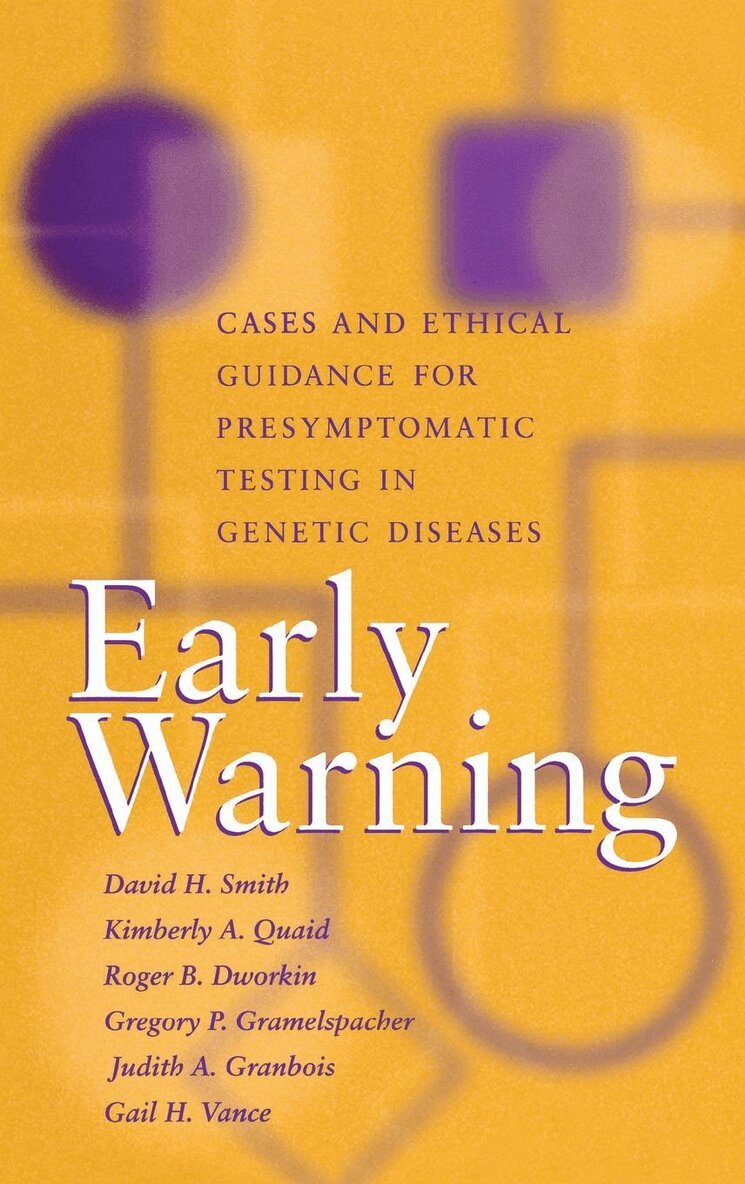
    Early Warning

    Cases and Ethical Guidance for Presymptomatic Testing in Genetic Diseases

    AvDavid H. Smith,Kimberly A. Quaid

    Inbunden, Engelska, 1998

    Del i serien Medical Ethics

    408 kr

    Beställningsvara. Skickas inom 10-15 vardagar. Fri frakt över 249 kr.

    Beskrivning

    "This timely, well-written book brings together the collective experience of experts from the fields of medicine, psychiatry, religious studies, bioethics, and molecular genetics in an effort to develop coherent guidelines for the counseling of potential sufferers from genetic diseases." —Journal of Religion and HealthThis book presents 29 case studies that identify the most important ethical issues that are likely to emerge from new technologies of genetic testing and develops a series of guidelines based on those case studies. By providing the clinical origins and rationale behind each of its recommendations, the book will help readers think through the ethical issues and will assist them in the development of additional guidelines.

    Produktinformation

    • Utgivningsdatum:1998-11-22
    • Mått:156 x 235 x undefined mm
    • Vikt:499 g
    • Format:Inbunden
    • Språk:Engelska
    • Serie:Medical Ethics
    • Antal sidor:200
    • Förlag:Indiana University Press
    • ISBN:9780253334015

    Utforska kategorier

    • Medicinsk etik och läkaretik inom Medicin
    • Medicinsk genetik inom Medicin

    Mer om författaren

    Roger B. Dworkin is the Robert H. McKinney Professor of Law at Indiana University School of Law-Bloomington and Nelson Poynter Scholar and Director of Medical Studies at Indiana University's Poynter Center for the Study of Ethics and American Institutions. Dworkin, who has previously served as Professor of Biomedical History at the University of Washington School of Medicine, is an expert on the relationship between law and the biomedical sciences. He is the author of Limits: The Role of the Law in Bioethical Decision Making, and numerous articles in the field as well as the co-author of a leading casebook on law and medicine. Gregory P. Gramelspacher, M.D. is the founder and Director of the Program in Medical Ethics, Indiana University School of Medicine. He is a general internist with research interests in the areas of death and dying, advance directives, and ethical implications of the human genome project.Judith A. Granbois joined the staff of The Poynter Center for the Study of Ethics and American Institutions in 1980. She has taught writing and ethics courses at Indiana University and is the co-author of articles on various topics in biomedical ethics.Dr. Kimberly A. Quaid is Co-Director, Clinical Associate Professor of Medical Genetics and Psychiatry and Clinical Associate Professor of Medical and Molecular Genetics and Psychiatry at the Indiana University School of Medicine. Dr. Quaid coordinated one of the first programs in the country to offer predictive testing for Huntington disease at Johns Hopkins Hospital. She works with families at risk for Huntington disease, Gerstmann-Straussler-Scheinker disease and Alzheimer disease both in providing education and testing to patients and their families as well as doing research on the clinical outcomes of testing and is internationally recognized for her work in the development of ethically sound protocols for genetic testing. She has published numerous journal articles and is author of "Implications of susceptibility testing with Apolipoprotein E," in Stephen G. Post (ed.) Ethics, Genetics and Alzheimer Disease. David H. Smith is Professor of Religious Studies at Indiana University and Director of The Poynter Center for the Study of Ethics and American Institutions. He is a founding member of the Hospice of Bloomington and the Association for Practical and Professional Ethics. His publications include Entrusted: The Moral Responsibilities of Trusteeship and Health and Medicine in the Anglican Tradition: Conscience, Community, and Compromise.Dr. Gail Vance is an Assistant Professor in the Department of Medical and Molecular Genetics. Dr. Vance joined the Indiana University School of Medicine faculty in 1992, after completing fellowships in clinical genetics and cytogenetics. Dr. Vance is board certified in Pediatrics (American Board of Pediatrics, l990), Clinical Pathology (American Board of Pathology, l989), and Medical Genetics and Clinical Cytogenetics (American Board of Genetics, 1993). Dr. Vance developed the Indiana Familial Cancer Program in the Department of Medical and Molecular Genetics in l993, to provide genetic counseling and genetic testing to individuals with a high risk for the development of cancer. She is also Assistant Director of the Cytogenetic laboratory.

    Innehållsförteckning

    • Introduction CasesCase 1 — Paul and MichaelCase 2 — Father and SonCase 3 — SarahCase 4 — Ann and JackCase 5 — CarolCase 6 — Kirsten and David Case 7 — RobertCase 8 — Mr. HCase 9 — NatalieCase 10 — Mary AnnCase 11 — MauriceCase 12 — Mr. LCase 13 — Mr. CrawfordCase 14 — Mr. and Mrs. AndersonCase 15 — JimmyCase 16 — HarrietCase 17 — CharleyCase 18 — Mr. and Mrs. BCase 19 — JulieCase 20 — BarbaraCase 21 — DougCase 22 — Uncle LeeCase 23 — EmilyCase 24 — Mrs. KCase 25 — RuthCase 26 — JackieCase 27 — Aunt MaryCase 28 — ScottCase 29 — Mrs. SawyerGuidelines and CommentaryGuideline IGuideline IIGuideline IIIGuideline IVGuideline VGuideline VIGuideline VIIGuideline VIIIGuideline IXGuideline XGuideline XIGlossaryReferences