• Fri frakt över 249 kr
  • •
  • Snabba leveranser
  • •
  • Billiga böcker
Kundservice

Du är på sajten för privatpersoner.

Företag, bibliotek eller offentlig verksamhet?

Du handlar på classic.bokus.com, där alla dina funktioner finns intakta.
Till classic.bokus.com
Bokus logotyp. Gå till startsidan.
  • Erbjudanden
  • Nyheter
  • Student
  • Topplistor
  • Barn & ungdom
  • Bokus Play
  • E-böcker
  • Pocketböcker
  • Spel & pussel

10% rabatt på allt med kod: NYSTART10 →

Sidfot

Mina sidor

    Hjälp

    • Kundservice
    • Vanliga frågor och svar
    • Frakt och leverans
    • Retur vid ångerrätt
    • Reklamera vara
    • Betalning
    • Köpvillkor
    • Allmänna villkor
    • Information om webbplatsens tillgänglighet

    Om Bokus

    • Om oss
    • Pressrum
    • För studenter
    • För företag
    • För bibliotek och offentlig verksamhet
    • För leverantörer
    • Hållbarhet

    Populärt

    • Aktuella erbjudanden
    • Presentkort
    • Studentlitteratur
    • Nya böcker
    • Topplistor
    • Signerade böcker
    • Engelska böcker

    Inspiration

    • Boktips
    • BookTok
    • Populära bokserier
    • Barnbokskaraktärer
    • Populära författare
    Logotyp för Bokus
    Följ oss på Facebook (extern länk)Följ oss på Instagram (extern länk)Följ oss på YouTube (extern länk)Följ oss på TikTok (extern länk)
    bokus @ CookiesAnpassa cookiesIntegritetspolicyKöpvillkor
    Till Citymail hemsida (extern länk)Till Budbee hemsida (extern länk)Till Postnord hemsida (extern länk)Till Schenker hemsida (extern länk)Till Early Bird hemsida (extern länk)Till Walleys hemsida (extern länk)
    1. Ekonomi och Ledarskap
    2. Industrier och branscher
    3. Transportindustri

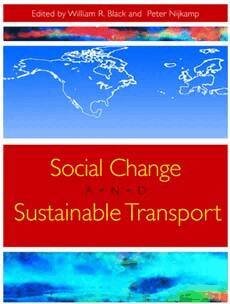
    Social Change and Sustainable Transport

    AvWilliam R. Black,Peter Nijkamp

    Inbunden, Engelska, 2002

    Del i serien Indiana University Press (IPS)

    451 kr

    Beställningsvara. Skickas inom 10-15 vardagar. Fri frakt över 249 kr.

    Beskrivning

    Transportation research has traditionally been dominated by engineering and logistics research approaches. This book integrates social, economic, and behavioral sciences into the transportation field. As its title indicates, emphasis is on socioeconomic changes, which increasingly govern the development of the transportation sector.The papers presented here originated at a conference on Social Change and Sustainable Transport held at the University of California at Berkeley in March 1999, under the auspices of the European Science Foundation and the National Science Foundation.The contributors, who represent a range of disciplines, including geography and regional science, economics, political science, sociology, and psychology, come from twelve different countries. Their subjects cover the consequences of environmentally sustainable transportation vs. the "business-as-usual" status quo, the new phenomenon of "edge cities," automobile dependence as a social problem, the influence of leisure or discretionary travel and of company cars, the problems of freight transport, the future of railroads in Europe, the imposition of electronic road tolls, potential transport benefits of e-commerce, and the electric car.

    Produktinformation

    • Utgivningsdatum:2002-11-29
    • Mått:216 x 279 x 21 mm
    • Vikt:1 247 g
    • Format:Inbunden
    • Språk:Engelska
    • Serie:Indiana University Press (IPS)
    • Antal sidor:320
    • Förlag:Indiana University Press
    • ISBN:9780253340672

    Utforska kategorier

    • Transportindustri inom Ekonomi och Ledarskap
    • Sociologi och antropologi inom Samhälle och politik
    • Regional planering inom Naturvetenskap och teknik

    Mer om författaren

    William Black is Professor of Geography and Public and Environmental Affairs at Indiana University. He directed rail planning for the State of Indiana during the rail restructuring in the Midwest and Northeast in the 1970s. He then served as a member of the Philadelphia-based task force that created Conrail. Returning to Indiana in 1980, he served as the first Director of the Indiana Department of Transportation. He has been a member of the Transportation Research Board (TRB) of the National Research Council for more than 30 years, and currently chairs the Committee on Social and Economic Factors in Transportation.Peter Nijkamp has been professor of regional and urban economics and of economic geography at the Free University in Amsterdam. He has published extensively in public policy, services planning, infrastructure management, and environmental protection. He has been an advisor to several Dutch ministries, regional and local policy councils, employers' organizations, private institutions, the EU, OECD, ECMT, ADB, European Roundtable of Industrialists, ICOMOS, the World Bank, and many other institutions. He is the 1996 recipient of the Spinoza Award.

    Innehållsförteckning

    • Pathways to Sustainable Transport and Basic Themes: IntroductionPart I. An Overview1. Social Change and Sustainable Transport: A Manifesto on Transatlantic Research Opportunities2. Social Trends and Research Needs in Transport and Environmental Planning3. Research Issues Regarding Societal Change and Transport: An Update4. Sustainable Transport5. Information and Communication Technologies and Transport6. Globalization and Transportation: Contradictions and Challenges7. Institutional Dimensions of Sustainable TransportPart II. Social Change and Sustainability of Transport8. Social Implications of Sustainable Transport9. EU Policy Scenario Building for Sustainable Mobility10. A Study of EU-U.S. Integrated Policies to Address the Consequences of Social Change for the Sustainability of Transport11. Transport-Land Use Relations in Restructuring Metropolitan Areas: Implications for Air Quality in Chicago and Stockholm12. Social Change and Transportation in U.S. Edge CitiesPart III. Dependence on the Automobile13. Keeping the Holy Grail: The "Mobility View" of the Danish Automobile Club FDM14. Car Dependence as a Social Problem: A Critical Essay on the Existing Literature and Future Needs15. Growing Up With and Without a Family Car16. Sustainable Lifestyles? Microsimulation of Household Formation, Housing Choice, and Travel BehaviorPart IV. Quality, Equity and Mobility17. Sustainable Transport and Quality of Life: A Psychological Analysis18. Introducing Environmental Equity Concerns into the Discourse on Sustainable Transport: A Research Agenda19. Women and Travel: The Sustainability Implications of Changing Roles20. Mobility Behavior of the Elderly: Its Impact on the Future Road Traffic System21. Residential Location and Daily Mobility Patterns: A Swedish Case Study of Households with ChildrenPart V. Increasing Travel and Transport22. Driven to Travel: The Identification of Mobility-Inclined Market Segments 23. Picnics, Pets, and Pleasant Places: The Distinguishing Characteristics of Leisure Travel Demand24. The Impact of Day Tourism on the Environment and Sustainability: The Northwestern Mediterranean Arc25. Company Cars and Company-Provided Parking26. Can a Decoupling of Traffic and Economic Growth Be Envisaged?Part VI. Sustainability and Freight Transport27. External Costs of Belgian Freight Traffic: A Network Analysis of Their Internalization28. Toward Multimodal Networks and Nodes of Freight Transport in the European Union29. Technological Innovations and Spatio-Organizational Changes: Toward a Sustainable Urban Freight Transport System30. The Future of Railway Transport in Europe: Toward Sustainable DevelopmentPart VII. Cultural Perspectives31. Transport Culture and the Economy of Speed: Speed Limits and Changing Patterns of Accessibility in the United Sates32. Transport and Logistics in City Regions: Driving Forces for Counterurbanization?33. N3: The Intersection of Transportation Networks, Communication Networks, and Community Networks Part VIII. Alternative Solutions34. Implementation of Pricing Measures for Sustainable Transport: Investigating Economic Efficiency and Social Acceptability35. Consumer E-Commerce, Virtual Accessibility, and Sustainable Transport 36. Uncertainty in Adoption of Sustainable Transport Technology: The Electric VehicleClosing Thoughts and a Look toward the Future