• Fri frakt över 249 kr
  • •
  • Snabba leveranser
  • •
  • Billiga böcker
Kundservice

Du är på sajten för privatpersoner.

Företag, bibliotek eller offentlig verksamhet?

Du handlar på classic.bokus.com, där alla dina funktioner finns intakta.
Till classic.bokus.com
Bokus logotyp. Gå till startsidan.
  • Erbjudanden
  • Nyheter
  • Student
  • Topplistor
  • Barn & ungdom
  • Bokus Play
  • E-böcker
  • Pocketböcker
  • Spel & pussel

10% rabatt på allt med kod: NYSTART10 →

Sidfot

Mina sidor

    Hjälp

    • Kundservice
    • Vanliga frågor och svar
    • Frakt och leverans
    • Retur vid ångerrätt
    • Reklamera vara
    • Betalning
    • Köpvillkor
    • Allmänna villkor
    • Information om webbplatsens tillgänglighet

    Om Bokus

    • Om oss
    • Pressrum
    • För studenter
    • För företag
    • För bibliotek och offentlig verksamhet
    • För leverantörer
    • Hållbarhet

    Populärt

    • Aktuella erbjudanden
    • Presentkort
    • Studentlitteratur
    • Nya böcker
    • Topplistor
    • Signerade böcker
    • Engelska böcker

    Inspiration

    • Boktips
    • BookTok
    • Populära bokserier
    • Barnbokskaraktärer
    • Populära författare
    Logotyp för Bokus
    Följ oss på Facebook (extern länk)Följ oss på Instagram (extern länk)Följ oss på YouTube (extern länk)Följ oss på TikTok (extern länk)
    bokus @ CookiesAnpassa cookiesIntegritetspolicyKöpvillkor
    Till Citymail hemsida (extern länk)Till Budbee hemsida (extern länk)Till Postnord hemsida (extern länk)Till Schenker hemsida (extern länk)Till Early Bird hemsida (extern länk)Till Walleys hemsida (extern länk)
    1. Historia och arkeologi
    2. Historia
    3. Amerikas historia

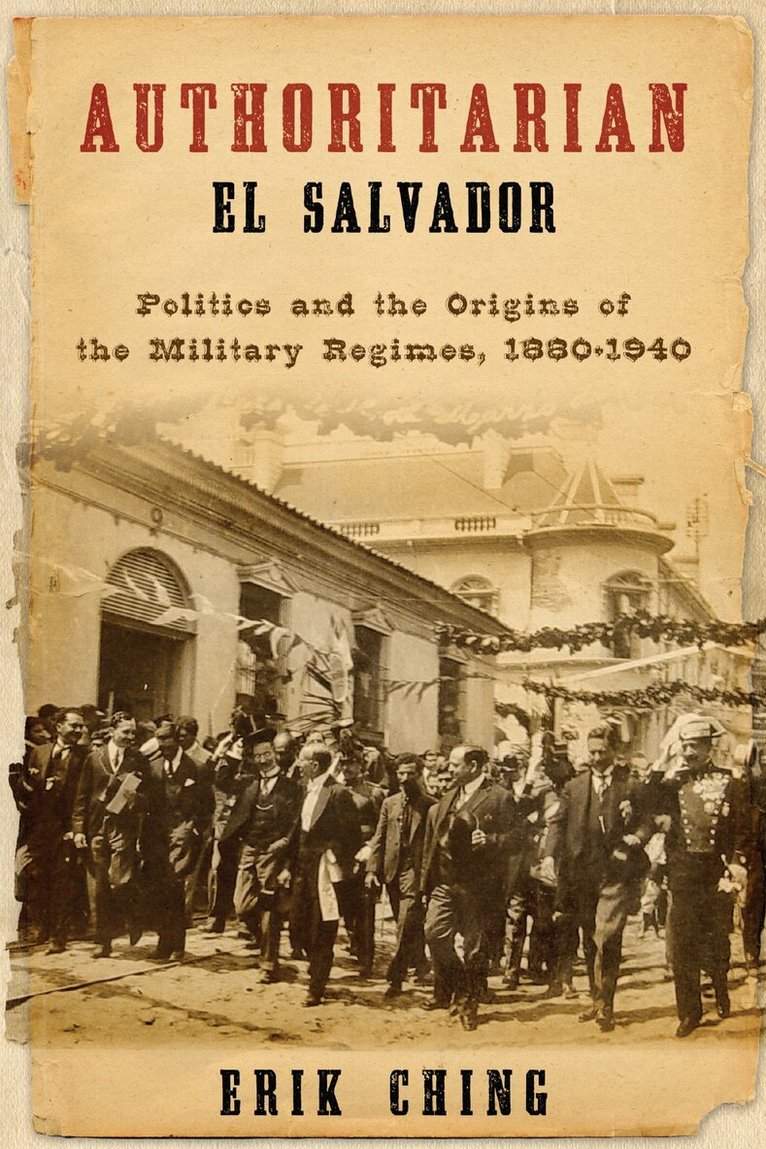
    Authoritarian El Salvador

    Politics and the Origins of the Military Regimes, 1880-1940

    AvErik Ching

    Häftad, Engelska, 2014

    Del i serien Kellogg Institute Series on Democracy and Development

    571 kr

    Beställningsvara. Skickas inom 5-8 vardagar. Fri frakt över 249 kr.

    Fler format och utgåvor

    Inbunden

    1 323 kr

    Beskrivning

    In December 1931, El Salvador's civilian president, Arturo Araujo, was overthrown in a military coup. Such an event was hardly unique in Salvadoran history, but the 1931 coup proved to be a watershed. Araujo had been the nation's first democratically elected president, and although no one could have foreseen the result, the coup led to five decades of uninterrupted military rule, the longest run in modern Latin American history. Furthermore, six weeks after coming to power, the new military regime oversaw the crackdown on a peasant rebellion in western El Salvador that is one of the worst episodes of state-sponsored repression in modern Latin American history. Democracy would not return to El Salvador until the 1990s, and only then after a brutal twelve-year civil war. In Authoritarian El Salvador: Politics and the Origins of the Military Regimes, 1880-1940, Erik Ching seeks to explain the origins of the military regime that came to power in 1931. Based on his comprehensive survey of the extant documentary record in El Salvador's national archive, Ching argues that El Salvador was typified by a longstanding tradition of authoritarianism dating back to the early- to mid-nineteenth century. The basic structures of that system were based on patron-client relationships that wove local, regional, and national political actors into complex webs of rival patronage networks. Decidedly nondemocratic in practice, the system nevertheless exhibited highly paradoxical traits: it remained steadfastly loyal to elections as the mechanism by which political aspirants acquired office, and it employed a political discourse laden with appeals to liberty and free suffrage. That blending of nondemocratic authoritarianism with populist reformism and rhetoric set the precedent for military rule for the next fifty years.

    Produktinformation

    • Utgivningsdatum:2014-01-15
    • Mått:152 x 229 x 25 mm
    • Vikt:648 g
    • Format:Häftad
    • Språk:Engelska
    • Serie:Kellogg Institute Series on Democracy and Development
    • Antal sidor:482
    • Förlag:University of Notre Dame Press
    • ISBN:9780268023751

    Utforska kategorier

    • Amerikas historia inom Historia och arkeologi
    • Statsskick: diktatur inom Samhälle och politik

    Mer om författaren

    Erik Ching is professor of history at Furman University. He is coauthor with Héctor Lindo Fuentes of Modernizing Minds in El Salvador: Education Reform and the Cold War, 1960–1980.

    Recensioner i media

    "Ching is one of the first scholars to systematically document this unprecedented political opening in Salvadoran history. This finding opens up new lines of inquiry for Salvadoran histiography, especially as this brief democratization relates to subsequent events such as the 1932 uprising and massacre. . . Ching once again offers fresh interpretations to another understudied period of Salvadoran history by illustrating how Martínez used a patronage network similar to the PND's but also incorporated elements of social reform to provide a modicum of legitimacy that later military governments would emulate, often to the extreme dissatisfaction of the landed elites." —Hispanic American Historical Review"Ching draws on extensive archival research and offers methodical analyses to make his case, going to great lengths to explain the historiographical significance of his case study. This is clearly a major contribution to the history of authoritarianism in El Salvador and Latin America." —Historian"The book is groundbreaking in its detail and the nuanced insights it offers into nation-state formation; as such, it deserves attention from a wide audience. Beyond area studies and thematic interests, students and teachers of historical methodologies will appreciate the transparency with which Ching analyzes both the voices in the documentary record as well as its silences. . . . [T]he book is groundbreaking in its detail and the nuanced insights it offers into nation-state formation; as such, it deserves attention from a wide audience. Beyond area studies and thematic interests, students and teachers of historical methodologies will appreciate the transparency with which Ching analyzes both the voices in the documentary record as well as its silences." —American Historical Review"While El Salvador's outsized role as a Cold War hot spot has inspired a wealth of scholarly writing, historical studies have not kept pace with the work done in other disciplines. This in-depth study of networks and politics before and after the turn of the 20th century does a great deal to remedy this imbalance. . . . A substantial contribution to the historical literature on Central America and to the wider historiography on links between local and national politics in Latin America." —Choice"With his Authoritarian El Salvador: Politics and the Origins of the Military Regimes, 1880–1940, Erik Ching makes a significant and original contribution to the historiography of Central America and to debates on patron-client relations and systems of political development. No doubt the enormous empirical research and attention to archival detail he presents will spark debate in the rich and growing literature on politics, democracy, and authoritarianism in post-independence Latin America." —Justin Wolfe, Tulane University"During the 1980s, when El Salvador was in the midst of a terrible civil war, numerous books were written that attempted to explain that small country's predicament but usually ended up quite short on detail and nuance. Now we have Erik Ching's very detailed and nuanced study that takes us not only back in time—to the nineteenth and early twentieth centuries—but to local environments where elites and clients interacted to decide the outcome of electoral contests that anointed municipal and national power holders. This book is indispensable for understanding a political culture that combined democratic rhetoric with violence and repression of dissenting points of view." —Knut Walter, author of The Regime of Anastasio Somoza, 1936–1956"This is an innovative and important work. In-depth research in local and national archives allowed Erik Ching to reveal the formal and informal mechanisms of Salvadoran politics until the eve of the Second World War. This book is an essential reference to understand the roots of political authoritarianism in El Salvador." —Héctor Lindo-Fuentes, Fordham University"A superbly researched study that includes an array of political areas, as, for example, prosopography, political discourse, electoral practice, state building, and network analysis." —Latin American Research Review