• Fri frakt över 249 kr
  • •
  • Snabba leveranser
  • •
  • Billiga böcker
Kundservice

Du är på sajten för privatpersoner.

Företag, bibliotek eller offentlig verksamhet?

Du handlar på classic.bokus.com, där alla dina funktioner finns intakta.
Till classic.bokus.com
Bokus logotyp. Gå till startsidan.
  • Erbjudanden
  • Nyheter
  • Student
  • Topplistor
  • Barn & ungdom
  • Bokus Play
  • E-böcker
  • Pocketböcker
  • Spel & pussel

10% rabatt på allt med kod: NYSTART10 →

Sidfot

Mina sidor

    Hjälp

    • Kundservice
    • Vanliga frågor och svar
    • Frakt och leverans
    • Retur vid ångerrätt
    • Reklamera vara
    • Betalning
    • Köpvillkor
    • Allmänna villkor
    • Information om webbplatsens tillgänglighet

    Om Bokus

    • Om oss
    • Pressrum
    • För studenter
    • För företag
    • För bibliotek och offentlig verksamhet
    • För leverantörer
    • Hållbarhet

    Populärt

    • Aktuella erbjudanden
    • Presentkort
    • Studentlitteratur
    • Nya böcker
    • Topplistor
    • Signerade böcker
    • Engelska böcker

    Inspiration

    • Boktips
    • BookTok
    • Populära bokserier
    • Barnbokskaraktärer
    • Populära författare
    Logotyp för Bokus
    Följ oss på Facebook (extern länk)Följ oss på Instagram (extern länk)Följ oss på YouTube (extern länk)Följ oss på TikTok (extern länk)
    bokus @ CookiesAnpassa cookiesIntegritetspolicyKöpvillkor
    Till Citymail hemsida (extern länk)Till Budbee hemsida (extern länk)Till Postnord hemsida (extern länk)Till Schenker hemsida (extern länk)Till Early Bird hemsida (extern länk)Till Walleys hemsida (extern länk)
    1. Filosofi och religion
    2. Religion och tro
    3. Religion: allmänt

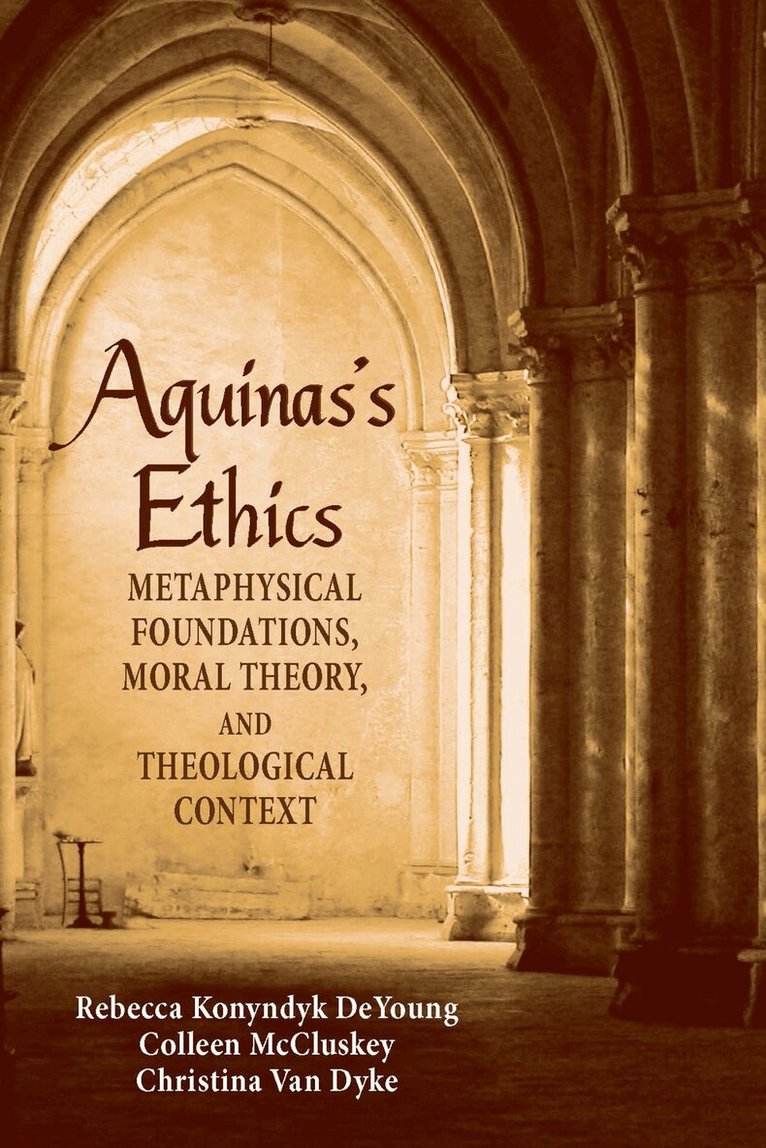
    Aquinas's Ethics

    Metaphysical Foundations, Moral Theory, and Theological Context

    AvRebecca Konyndyk DeYoung,Colleen McCluskey

    Häftad, Engelska, 2009

    318 kr

    Beställningsvara. Skickas inom 5-8 vardagar. Fri frakt över 249 kr.

    Fler format och utgåvor

    Inbunden

    858 kr

    Beskrivning

    The purpose of Aquinas's Ethics is to place Thomas Aquinas's moral theory in its full philosophical and theological context and to do so in a way that makes Aquinas (1224/5-1274) readily accessible to students and interested general readers, including those encountering Aquinas for the first time. Rebecca Konyndyk DeYoung, Colleen McCluskey, and Christina Van Dyke begin by explaining Aquinas's theories of the human person and human action, since these ground his moral theory. In their interpretation, Aquinas's theological commitments crucially shape his account of the human person, human capacities for action, and human flourishing. The authors develop a comprehensive picture of Aquinas's thought, which is designed to help students understand how his concept of happiness and the good life are part of a coherent, theologically-informed worldview.Many studies of Aquinas naturally focus on certain areas of his thought and tend to assume a general knowledge of the whole. Aquinas's Ethics takes the opposite approach: it intentionally links his metaphysics and anthropology to his action theory and ethics to illuminate how the moral theory is built on foundations laid elsewhere. The authors emphasize the integration of concepts of virtue, natural law, and divine grace within Aquinas's ethics, rather than treating such topics in isolation or opposition. Their approach, presented in clear and deliberately non-specialist language, reveals the coherent nature of Aquinas's account of the moral life and of what fulfills us as human beings. The result is a rich and engaging framework for further investigation of Aquinas's thought and its applications.

    Produktinformation

    • Utgivningsdatum:2009-05-15
    • Mått:152 x 229 x 15 mm
    • Vikt:553 g
    • Format:Häftad
    • Språk:Engelska
    • Antal sidor:260
    • Förlag:University of Notre Dame Press
    • ISBN:9780268026011

    Utforska kategorier

    • Religion: allmänt inom Filosofi och religion
    • Filosofiska discipliner inom Filosofi och religion

    Mer om författaren

    Christina Van Dyke is associate professor of philosophy at Calvin College.Rebecca Konyndyk DeYoung is professor of philosophy at Calvin College.Colleen McCluskey is associate professor of philosophy at Saint Louis University.

    Recensioner i media

    "The authors of Aquinas's Ethics have furnished budding Thomists and curious onlookers alike with an outstanding introduction to Aquinas' moral thought. Written for first (or perhaps second) time readers, this volume strikes just the right balance between technical argument and readability, without compromising the rich complexity of Thomas' account of human nature and the good life." —Scottish Journal of Theology"The study nicely reflects the authors' involvement with undergraduate teaching, which affords a refreshing level of presentation, replete with examples. . . . The result is an articulate and detailed presentation of what Aquinas says, yet affording less insight into the issues he was struggling with, or of the creative ways he develops to address them." —The Living Church"This is an excellent introduction not only to Aquinas's ethics per se but also to much of medieval Scholastic thought in general. . . .Those unfamiliar with medieval philosophy in general or Aquinas's ethics in particular will gain greatly from having read it. Even those who already have some such familiarity are sure to benefit from the particular metaphysical and integrationist frameworks this work offers." —Speculum"In this recent book, Rebecca DeYoung Konyndyk, Colleen McCluskey, and Christina Van Dyke have sought to provide a comprehensive yet manageable introduction to St. Thomas Aquinas' moral thought. The text itself flows well and is uncluttered by notations, with a fairly extensive scholarly apparatus confined to 46 pages of endnotes at the back of the book. Overall, Aquinas's Ethics is a very useful text that should find a wide readership." —Dialogue"While this book breaks no new ground, it offers a holistic and theologically informed reading of Aquinas' ethics. I highly recommend this book as a valuable introduction to the ethics of Thomas Aquinas. It is an eminently clear exposition of a complex system." —Catholic Library World"DeYoung, McCluskey, and Van Dyke hope to show the metaphysical foundations of Aquinas's moral theory by placing it within the broader Christian theological context of his work. . . . Rejecting as narrow and 'unbalanced' the contemporary view of Thomas as a 'natural law ethicist,' the authors try to restore (or relegate) the natural law to its rightful place in his thought. . . . It provides a first-rate introduction for the undergraduate audience." —Choice"DeYoung, McCluskey, and Van Dyke have written the ideal introduction to Aquinas's ethics, situating it in the broader context of his thinking about human nature and action. Although Aquinas cared more about—and wrote more about—ethics than about any other philosophical topic, it remains the most unjustly neglected aspect of his thought. I know of no better guide to that territory than this book." —Robert Pasnau, University of Colorado at Boulder"Aquinas's Ethics is an excellent contribution to the literature on Aquinas and ethics, providing an integrated and robust account of the relationship between a metaphysics of human nature, natural law theory, and virtue theory. Showing these inextricable connections, it is very much like the work of St. Thomas himself, and suggests why so many lesser theories of ethics are unsatisfying for their lack of depth and comprehensive reach." —John Kavanaugh, S.J., Saint Louis University"Aquinas's Ethics is a perfect introduction to one of the most sophisticated and influential ethical systems in Western thought. DeYoung, McCluskey, and Van Dyke capture the brilliant clarity of Aquinas's moral vision, offering an illuminating perspective true to both the theoretical depth and practical richness of Aquinas's writings. Those new to Aquinas's ideas will find this book eminently readable. Everyone—students and scholars alike—will appreciate its direct, distinctive voice and clear philosophical intelligence." —Scott MacDonald, Norma K. Regan Professor in Christian Studies, Cornell University