Christina Van Dyke - Böcker
Visar alla böcker från författaren Christina Van Dyke. Handla med fri frakt och snabb leverans.
4 produkter
4 produkter
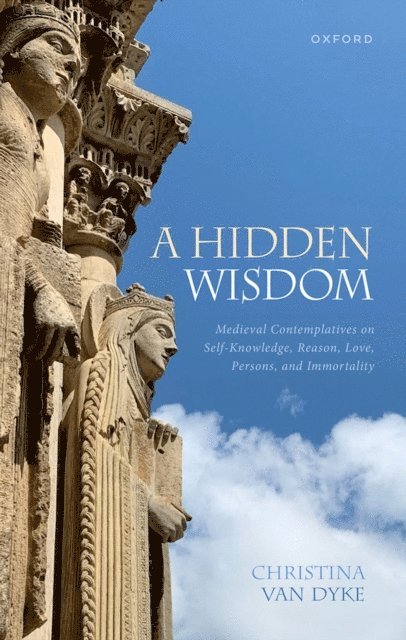
A Hidden Wisdom
Medieval Contemplatives on Self-Knowledge, Reason, Love, Persons, and Immortality
Inbunden, Engelska, 2022
549 kr
Skickas inom 7-10 vardagar
Medieval philosophy is primarily associated today with university-based disputations and the authorities cited in those disputations. In their own time, however, scholastic debates were recognized as just one part of wide-ranging philosophical and theological discussions. A Hidden Wisdom breaks new ground by drawing attention to another crucial component of these conversations: the Christian contemplative tradition. The period from 1200 to 1500, in particular, saw a dramatic increase in the production and consumption of mystical and contemplative literature in the 'Christian West', by laypeople as well as religious scholars, women as well as men. A Hidden Wisdom focuses on five topics of particular interest to both scholastics and contemplatives in this period, namely, self-knowledge, reason and its limits, love and the will, persons, and immortality and the afterlife. This focus centers the (often overlooked) contributions of medieval women and demonstrates that when we re-unite scholasticism with its contemplative counterpart, we gain not only a more accurate understanding of the scope of medieval Christian philosophy and theology but also an increased awareness of a deeply practical tradition that builds up as well as tears down, generates as well as deconstructs.The book's treatment of topics and figures is meant to be representative rather than exhaustive: a tasting menu, rather than a comprehensive study. The choice of topics offers a series of 'hooks' for philosophers to connect their own interests to issues central to medieval contemplative philosophy, while also providing medievalists in other disciplines a fresh lens through which to view these texts.
Aquinas's Ethics
Metaphysical Foundations, Moral Theory, and Theological Context
Häftad, Engelska, 2009
312 kr
Skickas inom 10-15 vardagar
The purpose of Aquinas's Ethics is to place Thomas Aquinas's moral theory in its full philosophical and theological context and to do so in a way that makes Aquinas (1224/5-1274) readily accessible to students and interested general readers, including those encountering Aquinas for the first time. Rebecca Konyndyk DeYoung, Colleen McCluskey, and Christina Van Dyke begin by explaining Aquinas's theories of the human person and human action, since these ground his moral theory. In their interpretation, Aquinas's theological commitments crucially shape his account of the human person, human capacities for action, and human flourishing. The authors develop a comprehensive picture of Aquinas's thought, which is designed to help students understand how his concept of happiness and the good life are part of a coherent, theologically-informed worldview.Many studies of Aquinas naturally focus on certain areas of his thought and tend to assume a general knowledge of the whole. Aquinas's Ethics takes the opposite approach: it intentionally links his metaphysics and anthropology to his action theory and ethics to illuminate how the moral theory is built on foundations laid elsewhere. The authors emphasize the integration of concepts of virtue, natural law, and divine grace within Aquinas's ethics, rather than treating such topics in isolation or opposition. Their approach, presented in clear and deliberately non-specialist language, reveals the coherent nature of Aquinas's account of the moral life and of what fulfills us as human beings. The result is a rich and engaging framework for further investigation of Aquinas's thought and its applications.
Aquinas's Ethics
Metaphysical Foundations, Moral Theory, and Theological Context
Inbunden, Engelska, 2009
1 070 kr
Skickas inom 10-15 vardagar
The purpose of Aquinas's Ethics is to place Thomas Aquinas's moral theory in its full philosophical and theological context and to do so in a way that makes Aquinas (1224/5-1274) readily accessible to students and interested general readers, including those encountering Aquinas for the first time. Rebecca Konyndyk DeYoung, Colleen McCluskey, and Christina Van Dyke begin by explaining Aquinas's theories of the human person and human action, since these ground his moral theory. In their interpretation, Aquinas's theological commitments crucially shape his account of the human person, human capacities for action, and human flourishing. The authors develop a comprehensive picture of Aquinas's thought, which is designed to help students understand how his concept of happiness and the good life are part of a coherent, theologically-informed worldview.Many studies of Aquinas naturally focus on certain areas of his thought and tend to assume a general knowledge of the whole. Aquinas's Ethics takes the opposite approach: it intentionally links his metaphysics and anthropology to his action theory and ethics to illuminate how the moral theory is built on foundations laid elsewhere. The authors emphasize the integration of concepts of virtue, natural law, and divine grace within Aquinas's ethics, rather than treating such topics in isolation or opposition. Their approach, presented in clear and deliberately non-specialist language, reveals the coherent nature of Aquinas's account of the moral life and of what fulfills us as human beings. The result is a rich and engaging framework for further investigation of Aquinas's thought and its applications.
16 724 kr
Skickas inom 10-15 vardagar
The Middle Ages saw a great flourishing of philosophy. Now, to help students and researchers make sense of the gargantuan—and, often, dauntingly complex—body of literature on the main traditions of thinking that stem from the Greek heritage of late antiquity, this new four-volume collection is the latest addition to Routledge’s acclaimed Critical Concepts in Philosophy series. Christina Van Dyke of Calvin College, USA, and an editor of the Cambridge History of Medieval Philosophy, has carefully assembled classic contributions, as well as more recent work, to create a one-stop ‘mini library’ of the best and most influential scholarship.With a comprehensive index and a useful synoptic introduction newly written by the editor, Medieval Philosophy will be welcomed as an indispensable resource for reference and research.