• Fri frakt över 249 kr
  • •
  • Snabba leveranser
  • •
  • Billiga böcker
Kundservice

Du är på sajten för privatpersoner.

Företag, bibliotek eller offentlig verksamhet?

Du handlar på classic.bokus.com, där alla dina funktioner finns intakta.
Till classic.bokus.com
Bokus logotyp. Gå till startsidan.
  • Erbjudanden
  • Nyheter
  • Student
  • Topplistor
  • Barn & ungdom
  • Bokus Play
  • E-böcker
  • Pocketböcker
  • Spel & pussel

10% rabatt på allt med kod: NYSTART10 →

Sidfot

Mina sidor

    Hjälp

    • Kundservice
    • Vanliga frågor och svar
    • Frakt och leverans
    • Retur vid ångerrätt
    • Reklamera vara
    • Betalning
    • Köpvillkor
    • Allmänna villkor
    • Information om webbplatsens tillgänglighet

    Om Bokus

    • Om oss
    • Pressrum
    • För studenter
    • För företag
    • För bibliotek och offentlig verksamhet
    • För leverantörer
    • Hållbarhet

    Populärt

    • Aktuella erbjudanden
    • Presentkort
    • Studentlitteratur
    • Nya böcker
    • Topplistor
    • Signerade böcker
    • Engelska böcker

    Inspiration

    • Boktips
    • BookTok
    • Populära bokserier
    • Barnbokskaraktärer
    • Populära författare
    Logotyp för Bokus
    Följ oss på Facebook (extern länk)Följ oss på Instagram (extern länk)Följ oss på YouTube (extern länk)Följ oss på TikTok (extern länk)
    bokus @ CookiesAnpassa cookiesIntegritetspolicyKöpvillkor
    Till Citymail hemsida (extern länk)Till Budbee hemsida (extern länk)Till Postnord hemsida (extern länk)Till Schenker hemsida (extern länk)Till Early Bird hemsida (extern länk)Till Walleys hemsida (extern länk)
    1. Samhälle och politik
    2. Politik och statsskick
    3. Statsskick och politiska processer
    4. Statsskick: demokrati

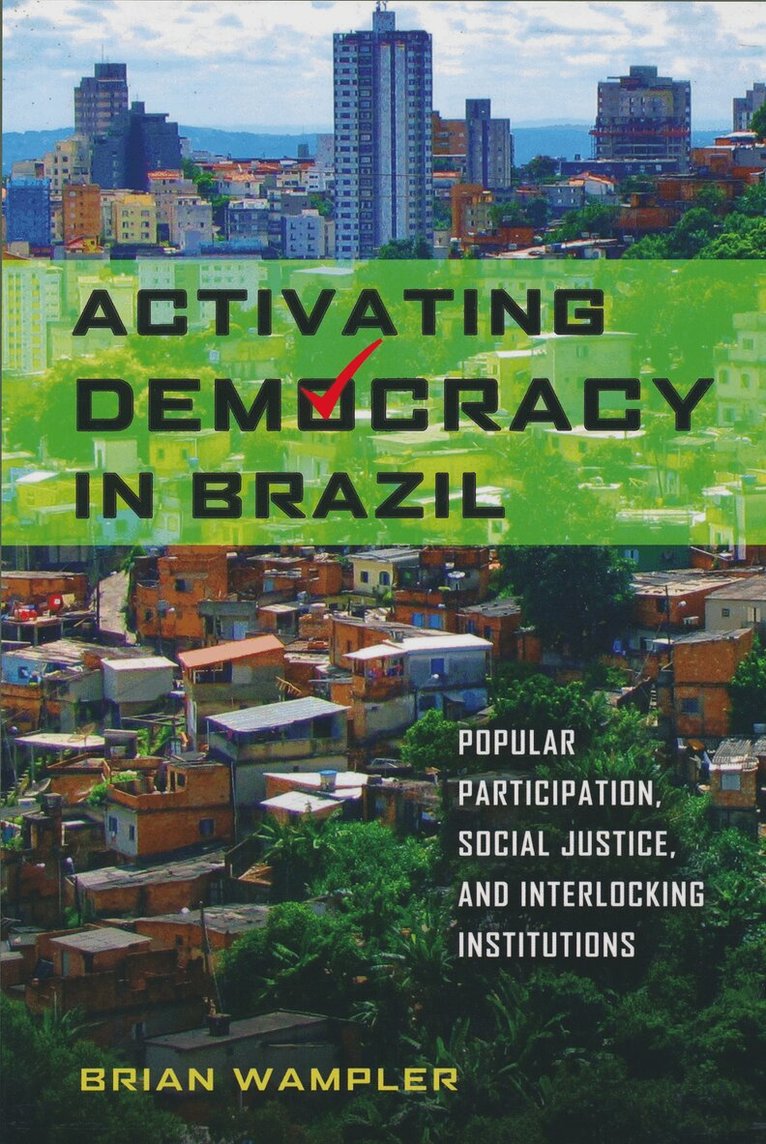
    Activating Democracy in Brazil

    Popular Participation, Social Justice, and Interlocking Institutions

    AvBrian Wampler

    Häftad, Engelska, 2015

    Del i serien Kellogg Institute Series on Democracy and Development

    409 kr

    Beställningsvara. Skickas inom 5-8 vardagar. Fri frakt över 249 kr.

    Fler format och utgåvor

    Inbunden

    1 103 kr

    Beskrivning

    In 1988, Brazil's Constitution marked the formal establishment of a new democratic regime. In the ensuing two and a half decades, Brazilian citizens, civil society organizations, and public officials have undertaken the slow, arduous task of building new institutions to ensure that Brazilian citizens have access to rights that improve their quality of life, expand their voice and vote, change the distribution of public goods, and deepen the quality of democracy. Civil society activists and ordinary citizens now participate in a multitude of state-sanctioned institutions, including public policy management councils, public policy conferences, participatory budgeting programs, and legislative hearings. Activating Democracy in Brazil examines how the proliferation of democratic institutions in Belo Horizonte, Brazil, has transformed the way in which citizens, CSOs, and political parties work together to change the existing state.According to Wampler, the 1988 Constitution marks the formal start of the participatory citizenship regime, but there has been tremendous variation in how citizens and public officials have carried it out. This book demonstrates that the variation results from the interplay of five factors: state formation, the development of civil society, government support for citizens' use of their voice and vote, the degree of public resources available for spending on services and public goods, and the rules that regulate forms of participation, representation, and deliberation within participatory venues. By focusing on multiple democratic institutions over a twenty-year period, this book illustrates how the participatory citizenship regime generates political and social change.

    Produktinformation

    • Utgivningsdatum:2015-04-15
    • Mått:152 x 229 x 17 mm
    • Vikt:422 g
    • Format:Häftad
    • Språk:Engelska
    • Serie:Kellogg Institute Series on Democracy and Development
    • Antal sidor:312
    • Förlag:University of Notre Dame Press
    • ISBN:9780268044305

    Utforska kategorier

    • Statsskick: demokrati inom Samhälle och politik
    • Amerikas historia inom Historia och arkeologi
    • Politik och statsskick inom Samhälle och politik

    Mer om författaren

    Brian Wampler is professor of political science at Boise State University. He is the author of Participatory Budgeting in Brazil: Contestation, Cooperation, and Accountability.

    Recensioner i media

    "Wampler argues that accessing citizenship rights requires activation democracy, which in turn depends on devising appropriate strategies to sustain collective action; overcoming the bias in representative democracy against the poor and other subaltern groups; and finally, translating "popular" demands into policy outcomes. . . .Activating Democracywill interest students of democratization and Brazilian and Latin American politics." —Democratization"[Wampler] demonstrates the need for and delivers a more contextualized, in-depth analysis of how participatory institutions are activated by motivating ordinary citizens and civil society organization (CSO) leaders to participate. . . . Within the details of this book, we begin to see exactly how the various types of participatory institutions across diverse policy sectors are activated." —Hispanic American Historical Review"As inspiring books normally do, Activating Democracy in Brazil offers new insights and raises new questions. It also offers directions on how to reinforce democracy through participation. Its framework should pave the way for cross-regional and country comparisons." —Latin American Politics and Society"This crucial book by Wampler sets [Brazil's practices of participatory democracy] in a necessary broader context not just for Brazil, but for new democracies generally. Wampler's detailed and clear analysis is based on extensive field research including many interviews with key actors and original survey data." —Choice"Activating Democracy in Brazil is an original work. Brian Wampler uses a longitudinal qualitative study of the city of Belo Horizonte, Minas Gerais, Brazil—with which the author has maintained contact directly and indirectly for a long period—to address a number of contemporary challenges in the participation debate. It brings together interviews, observations, survey data, and social indicators to tell a complex story from a variety of different directions." —Peter Spink, São Paulo School of Business Administration, Getulio Vargas Foundation"Activating Democracy in Brazil answers one of the most important questions of contemporary politics: how did a country notorious for its inequality and clientelism build one of the most successful participatory democracies in the world? In this carefully argued book, Wampler takes us through the institutions, showing how a range of new political practices that emerged out of the 1988 constitution have fundamentally transformed the nature of citizen engagement with the state. The lessons here go far beyond Brazil and should inspire all those interested in seeing the democratic project move forward." —Patrick Heller, Brown University"Brian Wampler has written the best book so far on the 'real working' of participatory government in Brazil. Wampler provides the reader with a multidimensional analysis of government in Belo Horizonte that goes from the grassroots level to several different government policies. In the end, he manages to provide an excellent view of how participatory policies weave together government and civil society actors. Everyone interested in participatory government should read this book." —Leonardo Avritzer, Federal University of Minas Gerais, Brazil"On every page of Wampler's book one can see a clarity in constructing the historical context and a didactic way in presenting the topics that he wants to delve into. By focusing on multiple democratic institutions, the book illustrates how the regime of participatory citizenship generates political and social changes." —Iberoamericana"Wampler's book, which covers a span of ten years, from 2000 to 2010, is the first to use longitudinal and cross-sectoral analysis to examine the variation in participatory institutions..." —Latin American Research Review