• Fri frakt över 249 kr
  • •
  • Snabba leveranser
  • •
  • Billiga böcker
Kundservice

Du är på sajten för privatpersoner.

Företag, bibliotek eller offentlig verksamhet?

Du handlar på classic.bokus.com, där alla dina funktioner finns intakta.
Till classic.bokus.com
Bokus logotyp. Gå till startsidan.
  • Erbjudanden
  • Nyheter
  • Student
  • Topplistor
  • Barn & ungdom
  • Bokus Play
  • E-böcker
  • Pocketböcker
  • Spel & pussel

10% rabatt på allt med kod: NYSTART10 →

Sidfot

Mina sidor

    Hjälp

    • Kundservice
    • Vanliga frågor och svar
    • Frakt och leverans
    • Retur vid ångerrätt
    • Reklamera vara
    • Betalning
    • Köpvillkor
    • Allmänna villkor
    • Information om webbplatsens tillgänglighet

    Om Bokus

    • Om oss
    • Pressrum
    • För studenter
    • För företag
    • För bibliotek och offentlig verksamhet
    • För leverantörer
    • Hållbarhet

    Populärt

    • Aktuella erbjudanden
    • Presentkort
    • Studentlitteratur
    • Nya böcker
    • Topplistor
    • Signerade böcker
    • Engelska böcker

    Inspiration

    • Boktips
    • BookTok
    • Populära bokserier
    • Barnbokskaraktärer
    • Populära författare
    Logotyp för Bokus
    Följ oss på Facebook (extern länk)Följ oss på Instagram (extern länk)Följ oss på YouTube (extern länk)Följ oss på TikTok (extern länk)
    bokus @ CookiesAnpassa cookiesIntegritetspolicyKöpvillkor
    Till Citymail hemsida (extern länk)Till Budbee hemsida (extern länk)Till Postnord hemsida (extern länk)Till Schenker hemsida (extern länk)Till Early Bird hemsida (extern länk)Till Walleys hemsida (extern länk)
    1. Samhälle och politik
    2. Samhälle och kultur
    3. Kultur och medier
    4. Referensverk och tvärvetenskap

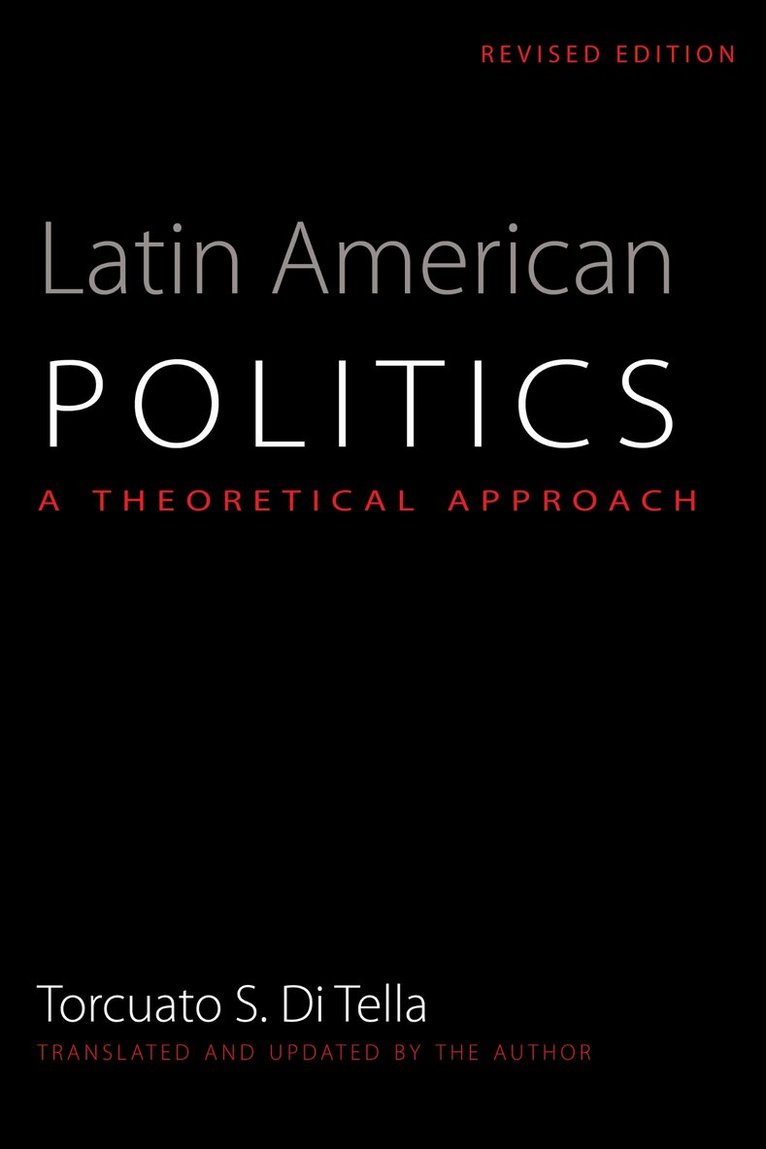
    Latin American Politics

    A Theoretical Approach

    AvTorcuato S. Di Tella

    Häftad, Engelska, 2001

    Del i serien LLILAS Translations from Latin America Series

    271 kr

    Beställningsvara. Skickas inom 10-15 vardagar. Fri frakt över 249 kr.

    Beskrivning

    First published in English in 1990 as Latin American Politics: A Theoretical Framework, a translation of Torcuato S. Di Tella's original SociologÍa de los procesos polÍticos, this new edition also focuses on the prerequisites for democracy in any society and on the role of the popular classes in social change. Di Tella draws on the work of Montesquieu, Burke, Tocqueville, Marx, Weber, and Durkheim in formulating his explanatory theories. These theories are then tested against crucial events in Latin American history-from the rebellions of the eighteenth century to the caudillos of the nineteenth century and the militarism of the twentieth century. This edition is more attuned to an English-speaking audience, with a new chapter addressing the historical process in Argentina from the 1930s to 2000. Latin American Politics is written in a style easily accessible to the general reader or student, while its emphasis on the growth of democracy in Latin America makes it particularly timely.

    Produktinformation

    • Utgivningsdatum:2001-08-01
    • Mått:152 x 229 x 15 mm
    • Vikt:454 g
    • Format:Häftad
    • Språk:Engelska
    • Serie:LLILAS Translations from Latin America Series
    • Antal sidor:253
    • Förlag:University of Texas Press
    • ISBN:9780292716131

    Utforska kategorier

    • Referensverk och tvärvetenskap inom Samhälle och politik
    • Statsvetenskap och politisk teori inom Samhälle och politik

    Mer om författaren

    Torcuato S. Di Tella is Professor of Sociology at the University of Buenos Aires. He has also been a visiting professor at Columbia University, the University of Texas at Austin, and Stanford University.

    Innehållsförteckning

    • Preface and Acknowledgments 1. The Study of Latin American Politics The Fall and Rise of Democracy Sociological Laws and Historical Processes The Program to Be Developed 2. Tensions in the Class Structure: From Social Mobilization to Autonomous Organization The Social Pyramid Social Mobilization and Mobilizationism Factors Triggering a Mobilizational Coalition Populism as a Type of Mobilizational Coalition Populism as a Stage in the Development of a Party Bipolarity 3. Actors and Coalitions Social Actors as Collective Entities Political Weight The Church and Armed Forces: Effective and Normative Noninvolvement The State as an Autonomous Actor Intellectuals and Political Elites Coalitions Multiclass Integrative Parties: The Mexican Case 4. Violence and Revolution The Motivational Structure at the Level of the Individual The Structural Approach: Violence and Revolution Mass Society Violence, Repression, and Legitimacy The Level of Menace: Historical Comparisons 5. Military Interventionism The Military Role: Omnipotence or Illusion? Aristocratic Control: Nineteenth-Century Brazil Military Reformism: Tenentismo and IbaÑismo The Military-lndustrial Convergence in Argentina From Moderating Role to Transformative Intervention 6. Socialist Labor Parties: The Early Experience The Problem of Organization: Militants and Bureaucrats Socialist Labor Parties The Contrast between Chilean and Argentine Social Structures The Peculiarity of the Impact of Immigration in Argentina The Intellectuals of the Labor Movement The EarlyArgentine Political Party System Authoritarian Populism in Chile: The First IbÁÑez Experience 7. Varieties of Populism and Their Transformative Tendencies "Aprista" or Middle-Class Populist Parties Social-Revolutionary Parties "Peronist" or Populist Labor Parties The Co-optation of the Labor Movement in Argentina The Changed Cultural Milieu of the Working Class Argentine Industrialists and the Peronist Elite Peronism and Varguismo Contrasted The Relevance of the Party System 8. A Modeled Historical Sequence: Argentina, 1938-2000 Period 1. Stable Situation before "Times of Troubles" (1938-1939) Period 2. Tensions and Menaces on the Increase (1942-1944) Period 3. Rise of Peronism and Its Access to Power (1944-1946) Period 4. Breakup of the Peronist Coalition (1954-1955) Period 5. The "Impossible Game" (1958-1976) Period 6. Unstable Dictatorship (1976-1982) Period 7. Breakup of the "Proceso" Coalition, Rise of Alfonsinismo (1982-1984) Period 8. The Menemista Transformation of Peronism (1991-1998) Period 9. Breakup of the Menemista Coalition, Alianza Access to Power (1998-1999) Period 10. Right-Left Bipolarity: The End of "Argentine Exceptionalism"? (2000-?) Notes Bibliography Index