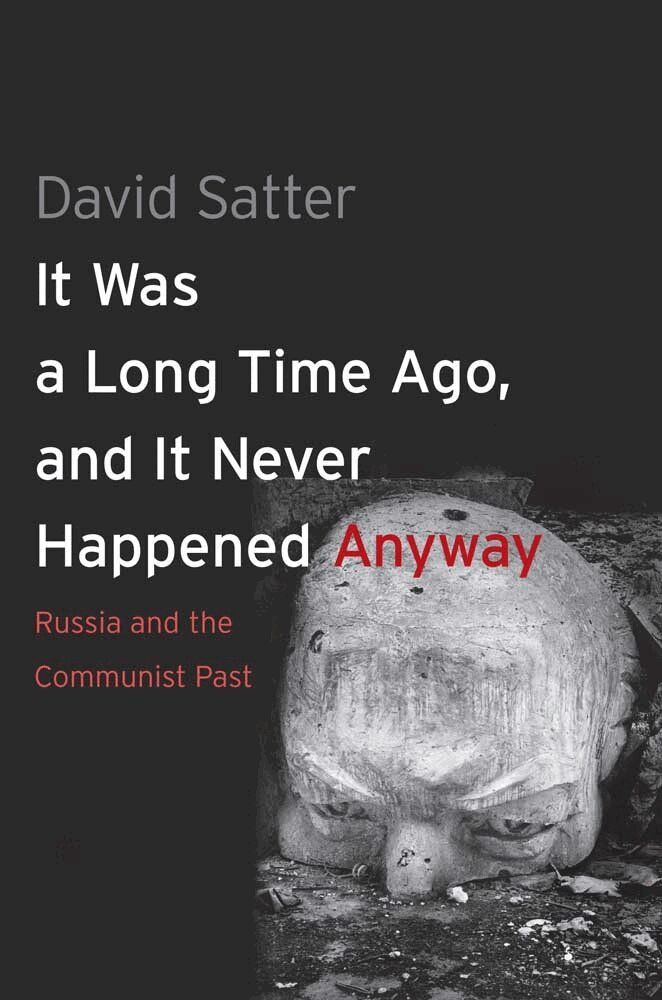
"A book full of vivid and well-chosen anecdotes."—Financial Times"David Satter has written a book full of vivid and well chosen anecdotes. . . . The use of nostalgia is Satter's field. Russia is not, he believes, able to give itself a chance; in love with their chains, its people cannot face up to the horrors of a past they wish to ignore or romanticize."—John Lloyd, Financial Times"Rich in detail and enthused by civil passion, It Was A Long Time Ago contains many precise, moving and original observations."—Alexander Etkind, Times Literary Supplement"This book, its title deliberately inviting a loud shout of ‘No!’ is more vehement than his previous studies of post-Soviet Russia, but just as impeccably argued."—Donald Rayfield, Literary Review"Satter casts fascinating light on the (comparatively cheerful) way in which repression was endured by the citizens of the USSR. . . . An informed and insightful essay – with disturbing implications."—Michael Kerrigan, The Scotsman"A meticulous, sweeping and wrenching history of Russia's burial of Soviet crimes. It is also a sensitive, compelling and convincing exploration of the importance of memory. But it makes a broader contention - that forgetting is a symptom of an illness that Russia contracted before the Soviet era . . . a humane, measured, first-hand, historically and philosophically rooted argument that is hard to refute."—Andrew Gardner, European Voice"Impeccably argued. . . . Satter is a man whom no Russian leader would wish to meet, let alone shake by the hand, but he has their measure."—Donald Rayfield, Literary Review"A meticulous, sweeping and wrenching history of Russia's burial of Soviet crimes . . . [and] a sensitive, compelling and convincing exploration of the importance of memory."—European Voice"Truly illuminating. . . . Satter is both a gifted journalist and a chronicler of intellectual and political currents. . . . Splendidly researched and engagingly written, this book offers invaluable vignettes of various reactions to the still unprocessed remembrance of totalitarian times."—Vladimir Tismaneanu, International Affairs"Highly successful in shedding light on both the nature of the Soviet system and the post-Communist period, this is a lucid, illuminating portrait of the outlook and attitudes of Russians. This book is one of the best I have ever read about the Soviet system and what it left behind."—Paul Hollander, author ofPolitical Will and Personal Belief: The Decline and Fall of Soviet Communism"David Satter has written a fascinating account of what the Soviet Union and post-Soviet Russia have really been like and why the failure of today's Russians to face up to that reality has ominous consequences for them and us."—Richard Pipes, Baird Professor of History, Emeritus, Harvard University"The central message of this important new book—that Russia cannot reverse its current decline without first coming to terms with the crimes of its Soviet past—is both sobering and absolutely compelling."—Carl Gershman, President of the National Endowment for Democracy"David Satter has put the whole Lenin/Stalin experience in a welcome fresh perspective, with a fine analysis of the broad motivations, particularly the terror mentality."—Robert Conquest, author of The Great Terror"In this penetrating analysis of Russia today, David Satter demonstrates how terror, ideology and mass murder were integrated and institutionalized in the Soviet Union, then dismantled in economic collapse, and are now resurrected in a modern, lighter authoritarian regime, minus the ideology. 'It Never Happened' gives the reader original insights and analysis by a Russian expert par excellence, and one exceptionally well written."—Richard V. Allen, Senior Fellow, Hoover Institution and former National Security Advisor to Ronald Reagan