• Fri frakt över 249 kr
  • •
  • Snabba leveranser
  • •
  • Billiga böcker
Kundservice

Du är på sajten för privatpersoner.

Företag, bibliotek eller offentlig verksamhet?

Du handlar på classic.bokus.com, där alla dina funktioner finns intakta.
Till classic.bokus.com
Bokus logotyp. Gå till startsidan.
  • Erbjudanden
  • Nyheter
  • Student
  • Topplistor
  • Barn & ungdom
  • Bokus Play
  • E-böcker
  • Pocketböcker
  • Spel & pussel

10% rabatt på allt med kod NYSTART10 →

Sidfot

Mina sidor

    Hjälp

    • Kundservice
    • Vanliga frågor och svar
    • Frakt och leverans
    • Retur vid ångerrätt
    • Reklamera vara
    • Betalning
    • Köpvillkor
    • Allmänna villkor
    • Information om webbplatsens tillgänglighet

    Om Bokus

    • Om oss
    • Pressrum
    • För studenter
    • För företag
    • För bibliotek och offentlig verksamhet
    • För leverantörer
    • Hållbarhet

    Populärt

    • Aktuella erbjudanden
    • Presentkort
    • Studentlitteratur
    • Nya böcker
    • Topplistor
    • Signerade böcker
    • Engelska böcker

    Inspiration

    • Boktips
    • BookTok
    • Populära bokserier
    • Barnbokskaraktärer
    • Populära författare
    Logotyp för Bokus
    Följ oss på Facebook (extern länk)Följ oss på Instagram (extern länk)Följ oss på YouTube (extern länk)Följ oss på TikTok (extern länk)
    bokus @ CookiesAnpassa cookiesIntegritetspolicyKöpvillkor
    Till Citymail hemsida (extern länk)Till Budbee hemsida (extern länk)Till Postnord hemsida (extern länk)Till Schenker hemsida (extern länk)Till Early Bird hemsida (extern länk)Till Walleys hemsida (extern länk)
    1. Psykologi och pedagogik
    2. Pedagogik
    3. Undervisning i specifika ämnen

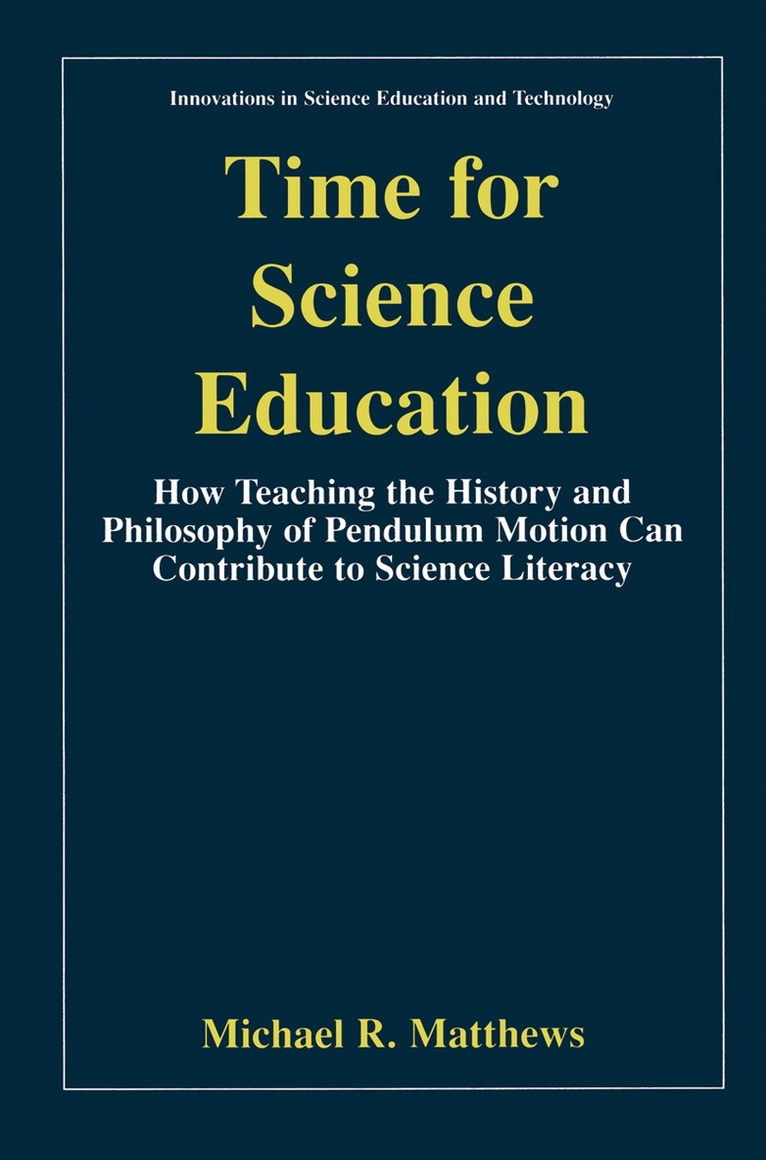
    Time for Science Education

    How Teaching the History and Philosophy of Pendulum Motion can Contribute to Science Literacy

    AvMichael Matthews

    Häftad, Engelska, 2000

    Del 8 i serien Innovations in Science Education and Technology

    1 578 kr

    Beställningsvara. Skickas inom 10-15 vardagar. Fri frakt över 249 kr.

    Fler format och utgåvor

    E-bok

    2 137 kr

    Beskrivning

    The book's argument depends, as do most proposals in education, upon cer­ tain positions in the philosophy of education. I believe that education should be primarily concerned with developing understanding, with initiation into worth­ while traditions of intellectual achievement, and with developing capacities for clear, analytic and critical thought. These have been the long-accepted goals of liberal education. In a liberal education, students should come to know and appre­ ciate a variety of disciplines, know them at an appropriate depth, see the interconnectedness of the disciplines, or the modes of thought, and finally have some critical disposition toward what is being learned, to be genuinely open­ minded about intellectual things. These liberal goals are contrasted with goals such as professional training, job preparation, promotion of self-esteem, social engineering, entertainment, or countless other putative purposes of schooling that are enunciated by politicians, administrators, and educators. The book's argument might be consistent with other views of education­ especially ones about the training of specialists (sometimes called a professional view of education)-but the argument fits best with a liberal view of education. The liberal hope has always been that if education is done well, then other per­ sonal and social goods will follow. The development of informed, critical, and moral capacities is the cornerstone for personal and social achievements.

    Produktinformation

    • Utgivningsdatum:2000-10-31
    • Mått:155 x 235 x 26 mm
    • Vikt:703 g
    • Format:Häftad
    • Språk:Engelska
    • Serie:Innovations in Science Education and Technology
    • Antal sidor:440
    • Förlag:Springer Science+Business Media
    • ISBN:9780306458804

    Utforska kategorier

    • Undervisning i specifika ämnen inom Psykologi och pedagogik

    Recensioner i media

    'Michael Matthews ... has just published a book that should be read by all serious physics educationists. ... Given the lamentable lack of books on physics education that try to show how the history and philosophy of science can be incorporated into real physics, Matthew's book is highly recommended.' Ivan Slade in Physics World, February 2001 'I recommend this wide-ranging and fascinating book to all science educators, and I hope that Matthew will publish a shortened version of it for science (physics) educators and classroom teachers. The story of the pendulum, as told here, would enliven the physics classroom and make it reach beyond the textbook.' CJSMTE/RCESMT, 1:4 (2001) 'Mathew's book is a true work of scholarship and I have no hesitation in urging anyone interested in informing debates about science education to read it from cover to cover.' Studies in Science Education

    Innehållsförteckning

    • Acknowledgements. Preface. 1. Learning about the Pendulum and Improving Science Education. 2. Navigation and the Longitude Problem. 3. Ancient and Medieval Timekeeping. 4. Galileo and the Pendulum Clock. 5. Galileo's Analysis of Pendulum Motion. 6. Christiaan Huygens and the Pendulum Clock. 7. Perfecting Mechanical Timekeeping and Solving the Longitude Problem. 8. The Pendulum in Newton's Physics. 9. Clocks and Culture: The Clock Analogy in Philosophy and Theology. 10. Science and Philosophy: Some Lessons from the History of Pendulum Motion. 11. Teaching and Learning about Time and Pendulum Motion: Some Theoretical Considerations. 12. Teaching and Learning about Time and Pendulum Motion: Some Pedagogical Considerations. 13. Science Education and Culture. Endnotes. References. Credits.