E-bok, Engelska, 2002
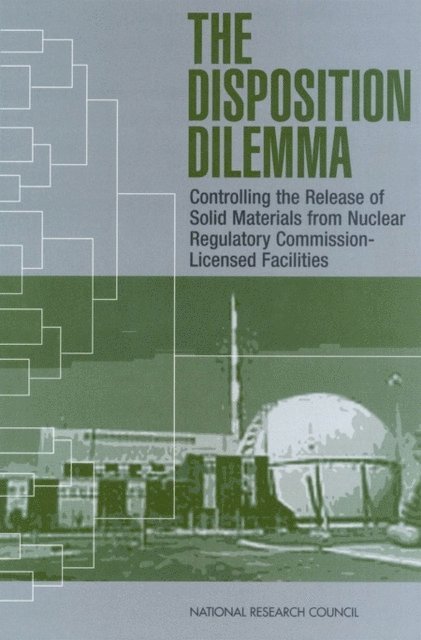
Disposition Dilemma
Av Committee on Alternatives for Controlling the Release of Solid Materials from Nuclear Regulatory Commission-Licensed Facilities, Board on Energy and Environmental Systems, Division on Engineering and Physical Sciences, National Research Council
915 kr
Skickas måndag 12/10
Beskrivning
The U.S. Nuclear Regulatory Commission (USNRC) and its predecessor, the U.S. Atomic Energy Commission (AEC), have attempted since the 1970s to give greater uniformity to the policy and regulatory framework that addresses the disposition of slightly radioactive solid material. The issue remains unresolved and controversial. The USNRC has tried to issue policy statements and standards for the release of slightly radioactive solid material from regulatory control, while such material has been released and continues to be released under existing practices. In 1980 the USNRC proposed regulatory changes to deregulate contaminated metal alloys but withdrew them in 1986 and began work with the Environmental Protection Agency (EPA) to develop more broadly applicable federal guidance. In 1990 the USNRC issued a more sweeping policy, as directed by the Low Level Radioactive Waste Policy Amendments Act of 1985 (LLWPAA), declaring materials with low concentrations of radioactivity contamination "below regulatory concern" (BRC) and hence deregulated. Congress intervened to set aside the BRC policy in the Energy Policy Act of 1992, after the USNRC''s own suspension of the policy. Subsequent attempts by USNRC staff to build consensus among stakeholder groups as a basis for future policy articulations were met by boycotts of stakeholder meetings, both in the immediate aftermath of the BRC policy and again in 1999 during public hearings on a new examination of the disposition of such materials. The only USNRC standard addressing the disposition of slightly radioactive solid material is a guidance document published in June 1974 by the AEC, whose regulatory authority over civilian nuclear facilities the USNRC assumed upon its creation a few months later in January 1975.
In August 2000, with another examination of this issue under way, the USNRC requested that the National Research Council form a committee to provide advice in a written report. The National Research Council established the Committee on Alternatives for Controlling the Release of Solid Materials from Nuclear Regulatory Commission-Licensed Facilities to address this task. The committee''s task involved evaluating and providing recommendations on the history of the technical bases and policies and precedents for managing slightly radioactive solid material from USNRC-licensed facilities; the sufficiency of technical bases needed to establish standards for release of solid materials from regulatory control ("clearance standards") and the adequacy of measurement technologies; the concerns of stakeholders and how the USNRC should incorporate them; and the efforts of international organizations on clearance standards. The committee was also asked to examine the current system for release of slightly radioactive solid material from regulatory control, to recommend whether the USNRC should continue to use this system and to recommend changes if appropriate. The committee''s fact-finding process included two site visits to waste brokering facilities and nearly 40 invited presentations from the USNRC, the U.S. Department of Energy (DOE), and EPA staff; stakeholder organizations; nuclear industry organizations; and other interested parties.
In conducting its study, the committee first examined the current system of standards, guidance, and practices used by the USNRC and agreement states to determine whether to release slightly radioactive solid material from further regulatory control under the Atomic Energy Act. The committee found that the current, workable system allows licensees to release material according to pre-established criteria but contains inconsistencies such that nuclear reactor licensees can release materials only if there is no detectable radioactivity (above background levels), whereas materials licensees can do so if small detectable levels are found. The committee evaluated technical analyses of the estimated doses of the final disposition of slightly radioactive solid materials. These analyses were conducted by federal agencies and international organizations, including the International Atomic Energy Agency (IAEA), the European Commission, and other groups. The Disposition Dilemma:Controlling the Release of Solid Materials from Nuclear Regulatory Commission-Licensed Facilities explains the committee''s findings and recommendations.
Produktinformation
- Utgivningsdatum: 2002-05-13
- Format: E-bok
- Språk: Engelska
- Antal sidor: 248
- Förlag: National Academies Press
- ISBN: 9780309501033
Utforska kategorier
Betyg & recensioner
0 recensioner
Inga recensioner tillgängliga.