Häftad, Engelska, 2026
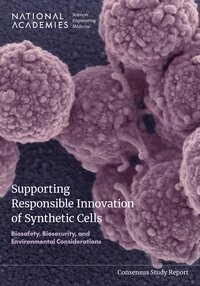
Supporting Responsible Innovation of Synthetic Cells
Av and Medicine National Academies of Sciences, Engineering, and Places Center for Health, People, Social and Economic Systems Program Area, Life Sciences and Biotechnology Program Area, and Biosecurity Considerations for Synthetic Cell Research and Development Committee on the External Review of Environmental, Biosafety
301 kr
Tillfälligt slut
Beskrivning
Synthetic cells represent a rapidly advancing frontier in engineering biology, offering new ways to understand living systems and developing innovative solutions across health, environmental management, agriculture, and manufacturing. Constructed from biomolecular components and designed to perform life-like functions, synthetic cells have the potential to enable more predictable, controllable, and adaptable biological technologies with wide-ranging societal and economic benefits.Supporting Responsible Innovation of Synthetic Cells: Biosafety, Biosecurity, and Environmental Considerations examines how this emerging field can advance while addressing biosafety, biosecurity, and environmental considerations. The report finds that many risks associated with synthetic cells are similar to those posed by existing chemical and microbial systems but may arise in new ways due to novel combinations of features, boundary-blurring system architectures, and emerging applications, creating uncertainty for risk-benefit evaluation and oversight.To support responsible innovation, the report outlines a path forward grounded in adaptive, evidence-based, and proportionate governance. Key recommendations include establishing a coordinated national biotechnology governance strategy, strengthening the empirical data and research infrastructure for risk assessment, modernizing biosafety and biosecurity oversight, and promoting transparency, public engagement, and international collaboration.By aligning scientific advancement with adaptive and coordinated governance, this report provides a framework for ensuring that synthetic cell research develops in ways that are safe, secure, and responsive to societal needs, helping realize the promise of this emerging technology while managing uncertainty and risk.
Produktinformation
- Utgivningsdatum: 2026-06-30
- Mått: 178 x 254 x 25 mm
- Vikt: 301 g
- Format: Häftad
- Språk: Engelska
- Antal sidor: 238
- Förlag: National Academies Press
- ISBN: 9780309602044
Utforska kategorier
Betyg & recensioner
0 recensioner
Inga recensioner tillgängliga.