• Fri frakt över 249 kr
  • •
  • Snabba leveranser
  • •
  • Billiga böcker
Kundservice

Du är på sajten för privatpersoner.

Företag, bibliotek eller offentlig verksamhet?

Du handlar på classic.bokus.com, där alla dina funktioner finns intakta.
Till classic.bokus.com
Bokus logotyp. Gå till startsidan.
  • Erbjudanden
  • Student
  • Topplistor
  • Barn & ungdom
  • Bokus Play
  • E-böcker
  • Ljudböcker
  • Pocketböcker
  • Spel & pussel

Upp till 25% på utvalda nyheter →

Sidfot

Mina sidor

    Hjälp

    • Kundservice
    • Vanliga frågor och svar
    • Frakt och leverans
    • Retur vid ångerrätt
    • Reklamera vara
    • Betalning
    • Köpvillkor
    • Allmänna villkor
    • Information om webbplatsens tillgänglighet

    Om Bokus

    • Om oss
    • Pressrum
    • För studenter
    • För företag
    • För bibliotek och offentlig verksamhet
    • För leverantörer
    • Hållbarhet

    Populärt

    • Aktuella erbjudanden
    • Presentkort
    • Studentlitteratur
    • Nya böcker
    • Topplistor
    • Signerade böcker
    • Engelska böcker

    Inspiration

    • Boktips
    • BookTok
    • Populära bokserier
    • Barnbokskaraktärer
    • Populära författare
    Logotyp för Bokus
    Följ oss på Facebook (extern länk)Följ oss på Instagram (extern länk)Följ oss på YouTube (extern länk)Följ oss på TikTok (extern länk)
    bokus @ CookiesAnpassa cookiesIntegritetspolicyKöpvillkor
    Till Citymail hemsida (extern länk)Till Budbee hemsida (extern länk)Till Postnord hemsida (extern länk)Till Schenker hemsida (extern länk)Till Early Bird hemsida (extern länk)Till Walleys hemsida (extern länk)
    1. Data och IT
    2. Programmeringsböcker

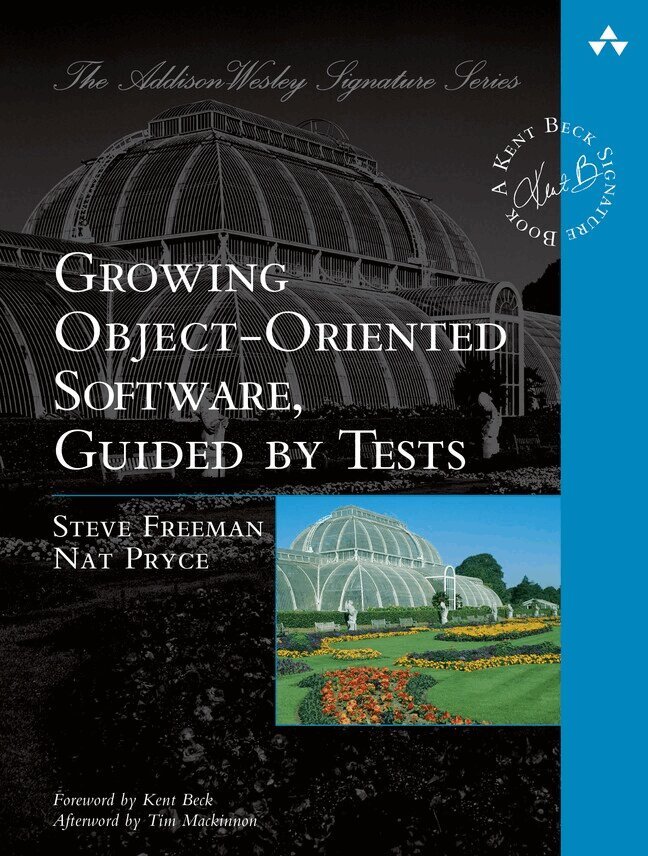
    Growing Object-Oriented Software, Guided by Tests

    AvSteve Freeman,Nat Pryce

    Häftad, Engelska, 2009

    Del i serien Addison-Wesley Signature Series (Beck)

    414 kr

    Beställningsvara. Skickas inom 7-10 vardagar. Fri frakt över 249 kr.

    Beskrivning

    Foreword by Kent Beck


    "The authors of this book have led a revolution in the craft of programming by controlling the environment in which software grows.” --Ward Cunningham


    “At last, a book suffused with code that exposes the deep symbiosis between TDD and OOD. This one's a keeper.” --Robert C. Martin


    “If you want to be an expert in the state of the art in TDD, you need to understand the ideas in this book.”--Michael Feathers


    Test-Driven Development (TDD) is now an established technique for delivering better software faster. TDD is based on a simple idea: Write tests for your code before you write the code itself. However, this "simple" idea takes skill and judgment to do well. Now there's a practical guide to TDD that takes you beyond the basic concepts. Drawing on a decade of experience building real-world systems, two TDD pioneers show how to let tests guide your development and “grow” software that is coherent, reliable, and maintainable.


    Steve Freeman and Nat Pryce describe the processes they use, the design principles they strive to achieve, and some of the tools that help them get the job done. Through an extended worked example, you’ll learn how TDD works at multiple levels, using tests to drive the features and the object-oriented structure of the code, and using Mock Objects to discover and then describe relationships between objects. Along the way, the book systematically addresses challenges that development teams encounter with TDD--from integrating TDD into your processes to testing your most difficult features. Coverage includes


    •   Implementing TDD effectively: getting started, and maintaining your momentum

        throughout the project

    •   Creating cleaner, more expressive, more sustainable code

    •   Using tests to stay relentlessly focused on sustaining quality

    •   Understanding how TDD, Mock Objects, and Object-Oriented Design come together

        in the context of a real software development project

    •   Using Mock Objects to guide object-oriented designs

    •   Succeeding where TDD is difficult: managing complex test data, and testing persistence

        and concurrency


    Produktinformation

    • Utgivningsdatum:2009-10-29
    • Mått:180 x 230 x 20 mm
    • Vikt:620 g
    • Format:Häftad
    • Språk:Engelska
    • Serie:Addison-Wesley Signature Series (Beck)
    • Antal sidor:384
    • Upplaga:1
    • Förlag:Pearson Education
    • ISBN:9780321503626

    Utforska kategorier

    • Programmeringsböcker inom Data och IT

    Mer om författaren

    Steve Freeman is an independent consultant specializing in Agile software development. A founder member of the London Extreme Tuesday Club, he was chair of the first XPDay and is a frequent organizer and presenter at international conferences. Steve has worked in a variety of organizations, from writing shrink-wrap software for IBM, to prototyping for major research laboratories. Steve has a Ph.D. from Cambridge University, and degrees in statistics and music. Steve is based in London, UK.  Nat Pryce has worked as a programmer, architect, trainer, and consultant in a variety of industries, including sports reportage, marketing communications, retail, telecoms, and finance. With a Ph.D. from Imperial College London, he has also worked on research projects and does occasional university teaching. An early adopter of Extreme Programming, he has written or contributed to several open source libraries that support Test Driven Development. He was one of the founding organizers of the London XPDay and regularly presents at international conferences. Nat is based in London, UK.  Freeman and Pryce were joint winners of the 2006 Agile Alliance Gordon Pask award.

    Innehållsförteckning

    • Foreword     xvPreface     xviiAcknowledgments     xxiAbout the Authors     xxiii  PART I: INTRODUCTION     1  Chapter 1: What Is the Point of Test-Driven Development?     3Software Development as a Learning Process     3Feedback Is the Fundamental Tool     4Practices That Support Change     5Test-Driven Development in a Nutshell     6The Bigger Picture     7Testing End-to-End     8Levels of Testing     9External and Internal Quality     10  Chapter 2: Test-Driven Development with Objects     13A Web of Objects     13Values and Objects     13Follow the Messages     14Tell, Don’t Ask     17But Sometimes Ask     17Unit-Testing the Collaborating Objects     18Support for TDD with Mock     19  Chapter 3: An Introduction to the Tools     21Stop Me If You’ve Heard This One Before     21A Minimal Introduction to JUnit 4     21Hamcrest Matchers and assertThat()     24jMock2: Mock Objects     25  PART II: THE PROCESS OF TEST-DRIVEN DEVELOPMENT     29  Chapter 4: Kick-Starting the Test-Driven Cycle     31Introduction     31First, Test a Walking Skeleton     32Deciding the Shape of the Walking Skeleton     33Build Sources of Feedback     35Expose Uncertainty Early     36  Chapter 5: Maintaining the Test-Driven Cycle     39Introduction     39Start Each Feature with an Acceptance Test     39Separate Tests That Measure Progress from Those That Catch Regressions     40Start Testing with the Simplest Success Case     41Write the Test That You’d Want to Read     42Watch the Test Fail     42Develop from the Inputs to the Outputs     43Unit-Test Behavior, Not Methods     43Listen to the Tests     44Tuning the Cycle     45  Chapter 6: Object-Oriented Style     47Introduction     47Designing for Maintainability     47Internals vs. Peers     50No And’s, Or’s, or But’s     51Object Peer Stereotypes     52Composite Simpler Than the Sum of Its Parts     53Context Independence     54Hiding the Right Information     55An Opinionated View     56  Chapter 7: Achieving Object-Oriented Design     57How Writing a Test First Helps the Design     57Communication over Classification     58Value Types     59Where Do Objects Come From?     60Identify Relationships with Interfaces     63Refactor Interfaces Too     63Compose Objects to Describe System Behavior     64Building Up to Higher-Level Programming     65And What about Classes?     67  Chapter 8: Building on Third-Party Code     69Introduction     69Only Mock Types That You Own     69Mock Application Objects in Integration Tests     71  PART III: A WORKED EXAMPLE     73  Chapter 9: Commissioning an Auction Sniper     75To Begin at the Beginning     75Communicating with an Auction     78Getting There Safely     79This Isn’t Real     81  Chapter 10: The Walking Skeleton     83Get the Skeleton out of the Closet     83Our Very First Test     84Some Initial Choices     86  Chapter 11: Passing the First Test     89Building the Test Rig     89Failing and Passing the Test     95The Necessary Minimum     102  Chapter 12: Getting Ready to Bid     105An Introduction to the Market     105A Test for Bidding     106The AuctionMessageTranslator     112Unpacking a Price Message     118Finish the Job     121  Chapter 13: The Sniper Makes a Bid     123Introducing AuctionSniper     123Sending a Bid     126Tidying Up the Implementation     131Defer Decisions     136Emergent Design     137  Chapter 14: The Sniper Wins the Auction     139First, a Failing Test     139Who Knows about Bidders?     140The Sniper Has More to Say     143The Sniper Acquires Some State     144The Sniper Wins     146Making Steady Progress     148  Chapter 15: Towards a Real User Interface     149A More Realistic Implementation     149Displaying Price Details     152Simplifying Sniper Events     159Follow Through     164Final Polish     168Observations     171  Chapter 16: Sniping for Multiple Items     175Testing for Multiple Items     175Adding Items through the User Interface     183Observations     189  Chapter 17: Teasing Apart Main     191Finding a Role     191Extracting the Chat     192Extracting the Connection     195Extracting the SnipersTableModel     197Observations     201  Chapter 18: Filling In the Details     205A More Useful Application     205Stop When We’ve Had Enough     205Observations     212  Chapter 19: Handling Failure     215What If It Doesn’t Work?     215Detecting the Failure     217Displaying the Failure     218Disconnecting the Sniper     219Recording the Failure     221Observations     225  PART IV: SUSTAINABLE TEST-DRIVEN DEVELOPMENT     227  Chapter 20: Listening to the Tests     229Introduction     229I Need to Mock an Object I Can’t Replace (without Magic)     230Logging Is a Feature     233Mocking Concrete Classes     235Don’t Mock Values     237Bloated Constructor     238Confused Object     240Too Many Dependencies     241Too Many Expectations     242What the Tests Will Tell Us (If We’re Listening)     244  Chapter 21: Test Readability     247Introduction     247Test Names Describe Features     248Canonical Test Structure     251Streamline the Test Code     252Assertions and Expectations     254Literals and Variables     255  Chapter 22: Constructing Complex Test Data     257Introduction     257Test Data Builders     258Creating Similar Objects     259Combining Builders     261Emphasizing the Domain Model with Factory Methods     261Removing Duplication at the Point of Use     262Communication First     264  Chapter 23: Test Diagnostics     267Design to Fail     267Small, Focused, Well-Named Tests     268Explanatory Assertion Messages     268Highlight Detail with Matchers     268Self-Describing Value     269Obviously Canned Value     270Tracer Object     270Explicitly Assert That Expectations Were Satisfied     271Diagnostics Are a First-Class Feature     271  Chapter 24: Test Flexibility     273Introduction     273Test for Information, Not Representation     274Precise Assertions     275Precise Expectations     277“Guinea Pig” Objects     284  PART V: ADVANCED TOPICS     287  Chapter 25: Testing Persistence     289Introduction     289Isolate Tests That Affect Persistent State     290Make Tests Transaction Boundaries Explicit     292Testing an Object That Performs Persistence Operations     294Testing That Objects Can Be Persisted     297But Database Tests Are S-l-o-w!     300  Chapter 26: Unit Testing and Threads     301Introduction     301Separating Functionality and Concurrency Policy     302Unit-Testing Synchronization     306Stress-Testing Passive Objects     311Synchronizing the Test Thread with Background Threads     312The Limitations of Unit Stress Tests     313  Chapter 27: Testing Asynchronous Code     315Introduction     315Sampling or Listening     316Two Implementations     318Runaway Tests     322Lost Updates     323Testing That an Action Has No Effect     325Distinguish Synchronizations and Assertions     326Externalize Event Sources     326  Afterword: A Brief History of Mock Objects     329Appendix A: jMock2 Cheat Sheet     335Appendix B: Writing a Hamcrest Matcher     343Bibliography     347Index     349