Addison-Wesley Signature Series (Beck) - Böcker
491 kr
Skickas inom 7-10 vardagar
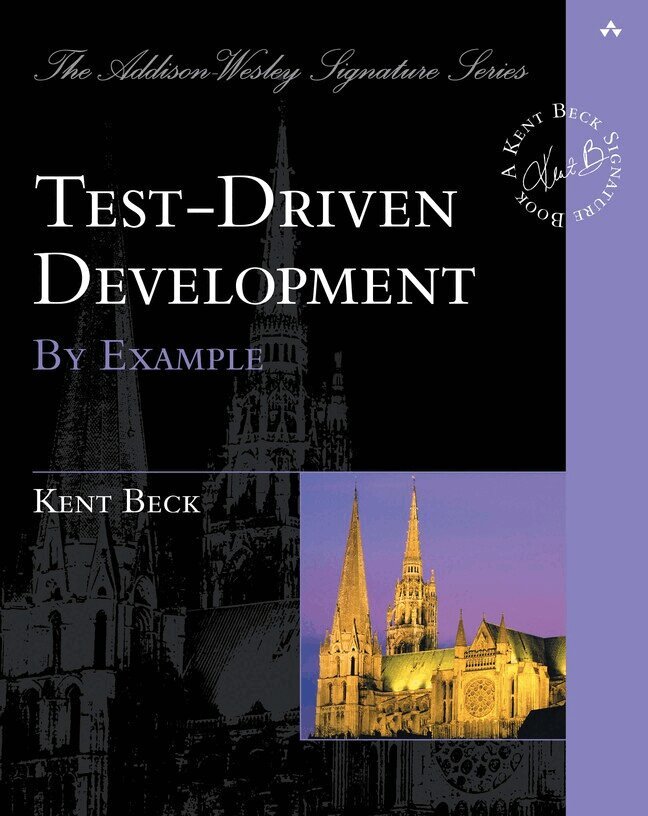
Quite simply, test-driven development is meant to eliminate fear in application development. While some fear is healthy (often viewed as a conscience that tells programmers to "be careful!"), the author believes that byproducts of fear include tentative, grumpy, and uncommunicative programmers who are unable to absorb constructive criticism. When programming teams buy into TDD, they immediately see positive results. They eliminate the fear involved in their jobs, and are better equipped to tackle the difficult challenges that face them. TDD eliminates tentative traits, it teaches programmers to communicate, and it encourages team members to seek out criticism However, even the author admits that grumpiness must be worked out individually! In short, the premise behind TDD is that code should be continually tested and refactored. Kent Beck teaches programmers by example, so they can painlessly and dramatically increase the quality of their work.
535 kr
Skickas inom 7-10 vardagar
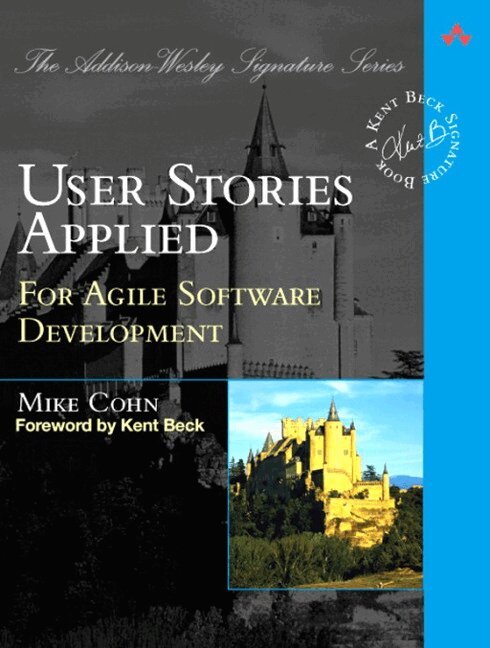
Thoroughly reviewed and eagerly anticipated by the agile community, User Stories Applied offers a requirements process that saves time, eliminates rework, and leads directly to better software.
The best way to build software that meets users' needs is to begin with "user stories": simple, clear, brief descriptions of functionality that will be valuable to real users. In User Stories Applied, Mike Cohn provides you with a front-to-back blueprint for writing these user stories and weaving them into your development lifecycle.
You'll learn what makes a great user story, and what makes a bad one. You'll discover practical ways to gather user stories, even when you can't speak with your users. Then, once you've compiled your user stories, Cohn shows how to organize them, prioritize them, and use them for planning, management, and testing.
User role modeling: understanding what users have in common, and where they differ Gathering stories: user interviewing, questionnaires, observation, and workshops Working with managers, trainers, salespeople and other "proxies" Writing user stories for acceptance testing Using stories to prioritize, set schedules, and estimate release costs Includes end-of-chapter practice questions and exercisesUser Stories Applied will be invaluable to every software developer, tester, analyst, and manager working with any agile method: XP, Scrum... or even your own home-grown approach.
339 kr
Skickas inom 7-10 vardagar
“Kent is a master at creating code that communicates well, is easy to understand, and is a pleasure to read. Every chapter of this book contains excellent explanations and insights into the smaller but important decisions we continuously have to make when creating quality code and classes.”
–Erich Gamma, IBM Distinguished Engineer
“Many teams have a master developer who makes a rapid stream of good decisions all day long. Their code is easy to understand, quick to modify, and feels safe and comfortable to work with. If you ask how they thought to write something the way they did, they always have a good reason. This book will help you become the master developer on your team. The breadth and depth of topics will engage veteran programmers, who will pick up new tricks and improve on old habits, while the clarity makes it accessible to even novice developers.”
–Russ Rufer, Silicon Valley Patterns Group
“Many people don’t realize how readable code can be and how valuable that readability is. Kent has taught me so much, I’m glad this book gives everyone the chance to learn from him.”
–Martin Fowler, chief scientist, ThoughtWorks
“Code should be worth reading, not just by the compiler, but by humans. Kent Beck distilled his experience into a cohesive collection of implementation patterns. These nuggets of advice will make your code truly worth reading.”
–Gregor Hohpe, author of Enterprise Integration Patterns
“In this book Kent Beck shows how writing clear and readable code follows from the application of simple principles. Implementation Patterns will help developers write intention revealing code that is both easy to understand and flexible towards future extensions. A must read for developers who are serious about their code.”
–Sven Gorts
“Implementation Patterns bridges the gap between design and coding. Beck introduces a new way of thinking about programming by basing his discussion on values and principles.”
–Diomidis Spinellis, author of Code Reading and Code Quality
Software Expert Kent Beck Presents a Catalog of Patterns Infinitely Useful for Everyday Programming
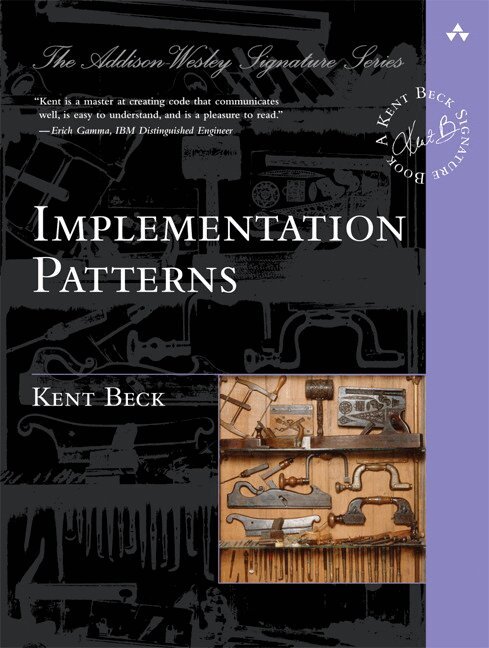
Great code doesn’t just function: it clearly and consistently communicates your intentions, allowing other programmers to understand your code, rely on it, and modify it with confidence. But great code doesn’t just happen. It is the outcome of hundreds of small but critical decisions programmers make every single day. Now, legendary software innovator Kent Beck–known worldwide for creating Extreme Programming and pioneering software patterns and test-driven development–focuses on these critical decisions, unearthing powerful “implementation patterns” for writing programs that are simpler, clearer, better organized, and more cost effective.
Beck collects 77 patterns for handling everyday programming tasks and writing more readable code. This new collection of patterns addresses many aspects of development, including class, state, behavior, method, collections, frameworks, and more. He uses diagrams, stories, examples, and essays to engage the reader as he illuminates the patterns. You’ll find proven solutions for handling everything from naming variables to checking exceptions.
This book covers
The value of communicating through code and the philosophy behind patterns How and when to create classes, and how classes encode logic Best practices for storing and retrieving state Behavior: patterns for representing logic, including alternative paths Writing, naming, and decomposing methods Choosing and using collections Implementation pattern variations for use in building frameworksImplementation Patterns will help programmers at all experience levels, especially those who have benefited from software patterns or agile methods. It will also be an indispensable resource for development teams seeking to work together more efficiently and build more maintainable software. No other programming book will touch your day-to-day work more often.
339 kr
Skickas inom 7-10 vardagar
"This remarkable book combines practical advice, ready-to-use techniques, anda deep understanding of why this is the right way to develop software. I haveseen software teams transformed by the ideas in this book."
--Mike Cohn, author of Agile Estimating and Planning
"As a lean practitioner myself, I have loved and used their first book for years.When this second book came out, I was delighted that it was even better. If youare interested in how lean principles can be useful for software developmentorganizations, this is the book you are looking for. The Poppendiecks offer abeautiful blend of history, theory, and practice."
--Alan Shalloway, coauthor of Design Patterns Explained
"I've enjoyed reading the book very much. I feel it might even be better than thefirst lean book by Tom and Mary, while that one was already exceptionallygood! Mary especially has a lot of knowledge related to lean techniques inproduct development and manufacturing. It's rare that these techniques areactually translated to software. This is something no other book does well(except their first book)."
--Bas Vodde
"The new book by Mary and Tom Poppendieck provides a well-written andcomprehensive introduction to lean principles and selected practices for softwaremanagers and engineers. It illustrates the application of the values andpractices with well-suited success stories. I enjoyed reading it."
--Roman Pichler
"In Implementing Lean Software Development, the Poppendiecks explore moredeeply the themes they introduced in Lean Software Development. They beginwith a compelling history of lean thinking, then move to key areas such asvalue, waste, and people. Each chapter includes exercises to help you apply keypoints. If you want a better understanding of how lean ideas can work withsoftware, this book is for you."
--Bill Wake, independent consultant
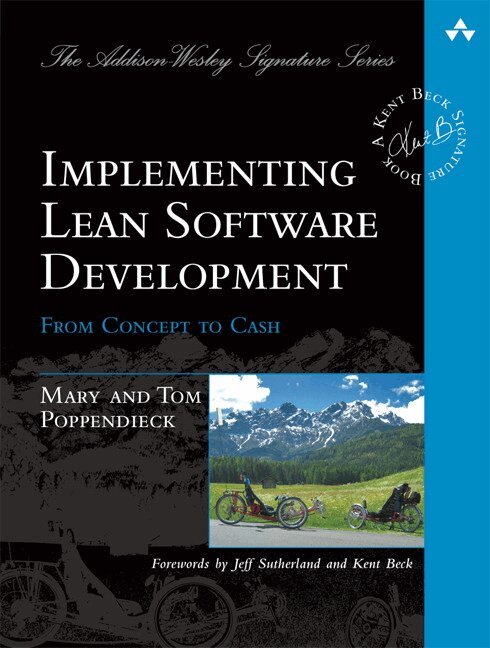
In 2003, Mary and Tom Poppendieck's Lean Software Development introduced breakthrough development techniques that leverage Lean principles to deliver unprecedented agility and value. Now their widely anticipated sequel and companion guide shows exactly how to implement Lean software development, hands-on.
This new book draws on the Poppendiecks' unparalleled experience helping development organizations optimize the entire software value stream. You'll discover the right questions to ask, the key issues to focus on, and techniques proven to work. The authors present case studies from leading-edge software organizations, and offer practical exercises for jumpstarting your own Lean initiatives.
Managing to extend, nourish, and leverage agile practices Building true development teams, not just groups Driving quality through rapid feedback and detailed discipline Making decisions Just-in-Time, but no later Delivering fast: How PatientKeeper delivers 45 rock-solid releases per year Making tradeoffs that really satisfy customers Implementing Lean Software Development is indispensable to anyone who wants more effective development processes--managers, project leaders, senior developers, and architects in enterprise IT and software companies alike.407 kr
Skickas inom 7-10 vardagar
Foreword by Kent Beck
"The authors of this book have led a revolution in the craft of programming by controlling the environment in which software grows.” --Ward Cunningham
“At last, a book suffused with code that exposes the deep symbiosis between TDD and OOD. This one's a keeper.” --Robert C. Martin
“If you want to be an expert in the state of the art in TDD, you need to understand the ideas in this book.”--Michael Feathers
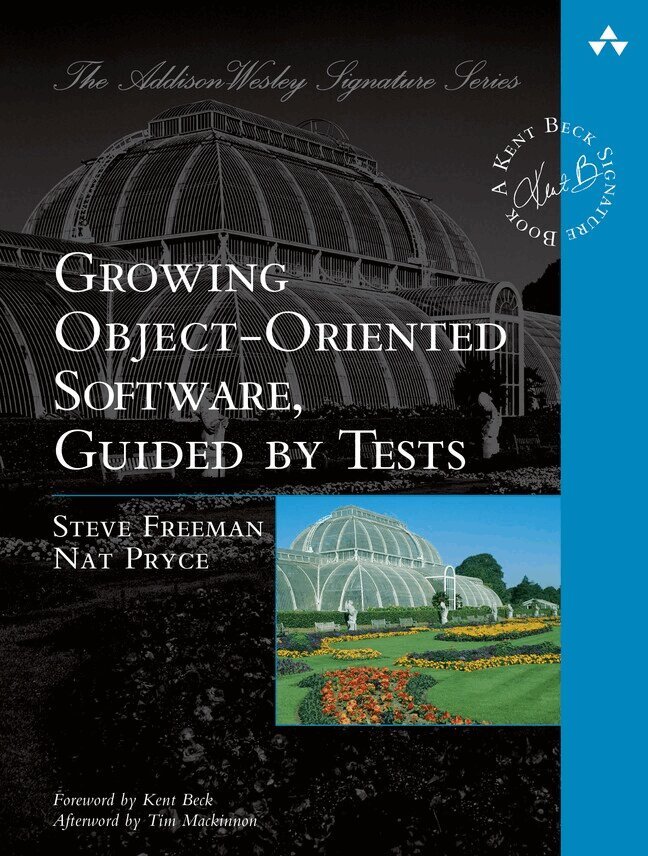
Test-Driven Development (TDD) is now an established technique for delivering better software faster. TDD is based on a simple idea: Write tests for your code before you write the code itself. However, this "simple" idea takes skill and judgment to do well. Now there's a practical guide to TDD that takes you beyond the basic concepts. Drawing on a decade of experience building real-world systems, two TDD pioneers show how to let tests guide your development and “grow” software that is coherent, reliable, and maintainable.
Steve Freeman and Nat Pryce describe the processes they use, the design principles they strive to achieve, and some of the tools that help them get the job done. Through an extended worked example, you’ll learn how TDD works at multiple levels, using tests to drive the features and the object-oriented structure of the code, and using Mock Objects to discover and then describe relationships between objects. Along the way, the book systematically addresses challenges that development teams encounter with TDD--from integrating TDD into your processes to testing your most difficult features. Coverage includes
• Implementing TDD effectively: getting started, and maintaining your momentum
throughout the project
• Creating cleaner, more expressive, more sustainable code
• Using tests to stay relentlessly focused on sustaining quality
• Understanding how TDD, Mock Objects, and Object-Oriented Design come together
in the context of a real software development project
• Using Mock Objects to guide object-oriented designs
• Succeeding where TDD is difficult: managing complex test data, and testing persistence
and concurrency