• Fri frakt över 249 kr
  • •
  • Snabba leveranser
  • •
  • Billiga böcker
Kundservice

Du är på sajten för privatpersoner.

Företag, bibliotek eller offentlig verksamhet?

Du handlar på classic.bokus.com, där alla dina funktioner finns intakta.
Till classic.bokus.com
Bokus logotyp. Gå till startsidan.
  • Erbjudanden
  • Nyheter
  • Student
  • Topplistor
  • Barn & ungdom
  • Bokus Play
  • E-böcker
  • Pocketböcker
  • Spel & pussel

10% rabatt på allt med kod: NYSTART10 →

Sidfot

Mina sidor

    Hjälp

    • Kundservice
    • Vanliga frågor och svar
    • Frakt och leverans
    • Retur vid ångerrätt
    • Reklamera vara
    • Betalning
    • Köpvillkor
    • Allmänna villkor
    • Information om webbplatsens tillgänglighet

    Om Bokus

    • Om oss
    • Pressrum
    • För studenter
    • För företag
    • För bibliotek och offentlig verksamhet
    • För leverantörer
    • Hållbarhet

    Populärt

    • Aktuella erbjudanden
    • Presentkort
    • Studentlitteratur
    • Nya böcker
    • Topplistor
    • Signerade böcker
    • Engelska böcker

    Inspiration

    • Boktips
    • BookTok
    • Populära bokserier
    • Barnbokskaraktärer
    • Populära författare
    Logotyp för Bokus
    Följ oss på Facebook (extern länk)Följ oss på Instagram (extern länk)Följ oss på YouTube (extern länk)Följ oss på TikTok (extern länk)
    bokus @ CookiesAnpassa cookiesIntegritetspolicyKöpvillkor
    Till Citymail hemsida (extern länk)Till Budbee hemsida (extern länk)Till Postnord hemsida (extern länk)Till Schenker hemsida (extern länk)Till Early Bird hemsida (extern länk)Till Walleys hemsida (extern länk)
    1. Ekonomi och Ledarskap
    2. Ledarskapsböcker
    3. Projektledning

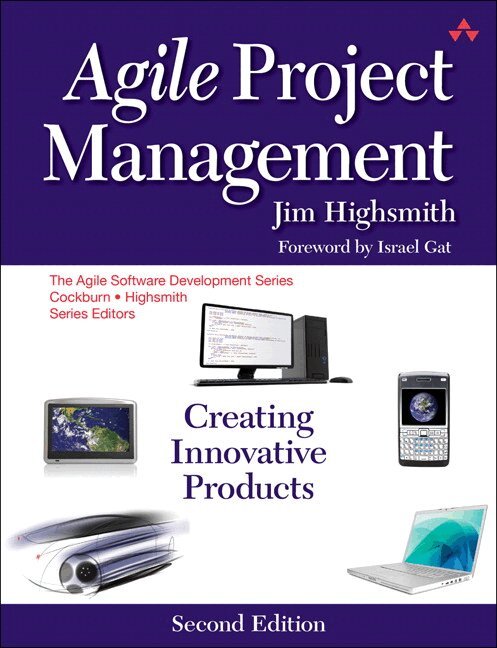
    Agile Project Management

    Creating Innovative Products

    AvJim Highsmith

    Häftad, Engelska, 2009

    Del i serien Agile Software Development Series

    749 kr

    Beställningsvara. Skickas inom 3-6 vardagar. Fri frakt över 249 kr.

    Beskrivning

    Best practices for managing projects in agile environments—now updated with new techniques for larger projects


    Today, the pace of project management moves faster. Project management needs to become more flexible and far more responsive to customers. Using Agile Project Management (APM), project managers can achieve all these goals without compromising value, quality, or business discipline. In Agile Project Management, Second Edition, renowned agile pioneer Jim Highsmith thoroughly updates his classic guide to APM, extending and refining it to support even the largest projects and organizations.


    Writing for project leaders, managers, and executives at all levels, Highsmith integrates the best project management, product management, and software development practices into an overall framework designed to support unprecedented speed and mobility. The many topics added in this new edition include incorporating agile values, scaling agile projects, release planning, portfolio governance, and enhancing organizational agility. Project and business leaders will especially appreciate Highsmith’s new coverage of promoting agility through performance measurements based on value, quality, and constraints.


    This edition’s coverage includes:

    • Understanding the agile revolution’s impact on product development
    • Recognizing when agile methods will work in project management, and when they won’t
    • Setting realistic business objectives for Agile Project Management
    •  Promoting agile values and principles across the organization
    • Utilizing a proven Agile Enterprise Framework that encompasses governance, project and iteration management, and technical practices
    • Optimizing all five stages of the agile project: Envision, Speculate, Explore, Adapt, and Close
    • Organizational and product-related processes for scaling agile to the largest projects and teams
    • Agile project governance solutions for executives and management
    •  The “Agile Triangle”: measuring performance in ways that encourage agility instead of discouraging it
    • The changing role of the agile project leader


    Produktinformation

    • Utgivningsdatum:2009-07-30
    • Mått:192 x 231 x 24 mm
    • Vikt:740 g
    • Format:Häftad
    • Språk:Engelska
    • Serie:Agile Software Development Series
    • Antal sidor:432
    • Upplaga:2
    • Förlag:Pearson Education
    • ISBN:9780321658395

    Utforska kategorier

    • Projektledning inom Ekonomi och Ledarskap
    • Programmeringsböcker inom Data och IT

    Mer om författaren

    Jim Highsmith directs Cutter Consortium’s agile consulting practice. He has over 30 years experience as an IT manager, product manager, project manager, consultant, and software developer. Jim is the author of Agile Project Management: Creating Innovative Products, Addison Wesley 2004; Adaptive Software Development: A Collaborative Approach to Managing Complex Systems, Dorset House 2000 and winner of the prestigious Jolt Award, and Agile Software Development Ecosystems, Addison Wesley 2002. Jim is the recipient of the 2005 international Stevens Award for outstanding contributions to systems development.  He is also co-editor, with Alistair Cockburn, of the Agile Software Development Series of books from Addison Wesley. Jim is a coauthor of the Agile Manifesto, a founding member of The Agile Alliance, coauthor of the Declaration Interdependence for project leaders, and cofounder and first president of the Agile Project Leadership Network. A frequent speaker at conferences worldwide, Jim has published dozens of articles in major industry publications.  Jim has consulted with IT and product development organizations and software companies in the U.S., Europe, Canada, South Africa, Australia, Japan, India, and New Zealand to help them adapt to the accelerated pace of development in increasingly complex, uncertain environments. Jim’s areas of consulting include the areas of Agile Software Development, Project Management, and Collaboration. He has held technical and management positions with software, computer hardware, banking, and energy companies. Jim holds a B.S. in electrical engineering and an M.S. in management.

    Innehållsförteckning

    • Introduction 1Conventions 2The Agile Software Development Series 2Chapter 1: The Agile Revolution 5Agile Business Objectives 10Continuous Innovation 10Product Adaptability 10Improved Time-to-Market 11People and Process Adaptability 11Reliable Results 12Agility Defined 12Agile Leadership Values 14Agile Performance Measurement 19The APM Framework 21Performance Possibilities 22Final Thoughts 25Chapter 2: Value over Constraints 27Continuous Flow of Customer Value 28Innovation 30Execution 32Lean Thinking 33Iterative, Feature-Based Delivery 34Technical Excellence 37Simplicity 40Generative Rules 40Barely Sufficient Methodology 42Delivery versus Compliance 43Final Thoughts 45Chapter 3: Teams over Tasks 47Leading Teams 47Building Self-Organizing (Self-Disciplined) Teams 51Get the Right People 52Insist on Accountability 53Foster Self-Discipline 54Encourage Collaboration 55Participatory Decision Making 56Shared Space 58Customer Collaboration 59No More Self-Organizing Teams? 60Final Thoughts 61Chapter 4: Adapting over Conforming 63The Science of Adaptation 65Exploring 68Responding to Change 70Product, Process, People 71Barriers or Opportunities 72Reliable, Not Repeatable 73Reflection and Retrospective 75Principles to Practices 75Final Thoughts 76Chapter 5: An Agile Project Management Model 77An Agile Enterprise Framework 78Portfolio Governance Layer 78Project Management Layer 79Iteration Management Layer 80Technical Practices Layer 80An Agile Delivery Framework 80Phase: Envision 83Phase: Speculate 83Phase: Explore 84Phase: Adapt 84Phase: Close 85Not a Complete Product Lifecycle 85Selecting and Integrating Practices 86Judgment Required 87Project Size 88An Expanded Agile Delivery Framework 88Final Thoughts 89Chapter 6: The Envision Phase 91A Releasable Product 93Envisioning Practices 94Product Vision 96Product Architecture 101Guiding Principles 104Project Objectives and Constraints 105Project Data Sheet 105Tradeoff Matrix 108Exploration Factor 109Project Community 112Participant Identification 115Product Team—Development Team Interaction 118Delivery Approach 122Self-Organization Strategy 123Process Framework Tailoring 124Practice Selection and Tailoring 125Final Thoughts 127Chapter 7: The Speculate Phase 129Speculating on Product and Project 130Product Backlog 133What Is a Feature, a Story? 134The Focus of Stories 135Story Cards 137Creating a Backlog 140Release Planning 142Scope Evolution 144Iteration 0 147Iterations 1-N 148First Feasible Deployment 152Estimating 153Other Card Types 155Final Thoughts 156Chapter 8: Advanced Release Planning 157Release (Project) Planning 157Wish-based Planning (Balancing Capacity and Demand) 159Multi-Level Planning 161A Complete Product Planning Structure 163Capabilities 166Capability Cases 167Creating a Product Backlog and Roadmap 168An Optimum Planning Structure 169Value Point Analysis 171Value Point Determination: Roles and Timing 173Calculating Relative Value Points 174Calculating Monetary Value Points 176Non-Customer-Facing Stories 177Value and Priority 177Release Planning Topics 178Planning Themes and Priorities 179Increasing Productivity 181Risk Analysis and Mitigation 182Planning and Scanning 186Timeboxed Sizing 188Other Story Types 190Work-in-Process versus Throughput 194Emerging Practices 197Kanban 197Consolidated Development 198Hyper-development and Release 200Final Thoughts 201Chapter 9: The Explore Phase 203Agile Project Leadership 205Iteration Planning and Monitoring 206Iteration Planning 206Workload Management 212Monitoring Iteration Progress 213Technical Practices 215Technical Debt 216Simple Design 218Continuous Integration 220Ruthless Automated Testing 222Opportunistic Refactoring 223Coaching and Team Development 225Focusing the Team 227Molding a Group of Individuals into a Team 228Developing the Individual’s Capabilities 232Moving Rocks, Hauling Water 233Coaching the Customers 233Orchestrating Team Rhythm 235Participatory Decision Making 236Decision Framing 238Decision Making 240Decision Retrospection 244Leadership and Decision Making 245Set- and Delay-Based Decision Making 246Collaboration and Coordination 248Daily Stand-Up Meetings 248Daily Interaction with the Product Team 250Stakeholder Coordination 251Final Thoughts 251Chapter 10: The Adapt and Close Phases 253Adapt 254Product, Project, and Team Review and Adaptive Action 256Customer Focus Groups 256Technical Reviews 259Team Performance Evaluations 259Project Status Reports 261Adaptive Action 268Close 268Final Thoughts 270Chapter 11: Scaling Agile Projects 271The Scaling Challenge 272Scaling Factors 273Up and Out 275Uncertainty and Complexity 276An Agile Scaling Model 276Building Large Agile Teams 278Organizational Design 279Collaboration/Coordination Design 281Decision-Making Design 284Knowledge Sharing and Documentation 287Self-Organizing Teams of Teams 291Team Self-Discipline 293Process Discipline 294Scaling Up–Agile Practices 294Product Architecture 295Roadmaps and Backlogs 296Multi-level Release Plans 297Maintaining Releasable Products 298Inter-team Commitment Stories 299Tools 302Scaling Out–Distributed Projects 302Final Thoughts 304Chapter 12: Governing Agile Projects 307Portfolio Governance 308Investment and Risk 309Executive-Level Information Requirements 311Engineering-Level Information Generation 313An Enterprise-Level Governance Model 316Using the Agile Governance Model 320Portfolio Management Topics 321Designing an Agile Portfolio 321Agile Methodology “Fit” 323Final Thoughts 325Chapter 13: Beyond Scope, Schedule, and Cost: Measuring Agile Performance 327What Is Quality? 329Planning and Measuring 333Adaptive Performance–Outcomes and Outputs 335Measurement Issues 336Measurement Concepts 339Beyond Budgeting 339Measuring Performance in Organizations 342Outcome Performance Metrics 346Constraints 347Community Responsibility 348Improving Decision Making 349Planning as a Guide 350Output Performance Metrics 351Five Core Metrics 351Outcomes and Outputs 354Shortening the Tail 355Final Thoughts 357Chapter 14: Reliable Innovation 359The Changing Face of New Product Development 360Agile People and Processes Deliver Agile Products 362Reliable Innovation 364The Value-Adding Project Leader 366Final Thoughts 367Bibliography 369Index 379TOC, 9780321658395, 6/18/09

    Betyg & recensioner

    5/5