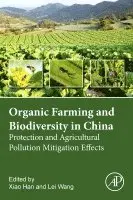
Häftad, Engelska, 2024
Organic Agriculture and Biodiversity in China
1473 kr
Beställningsvara. Skickas inom 11-20 vardagar. Fri frakt över 249 kr.
Beskrivning
Written by experts from the Nanjing Institute of Environmental Science, Ministry of Ecology and Environment (MEE), Jiangsu Vocational College of Agriculture and Forestry, Hebei University of Engineering, and other esteemed institutions, this book explores the role that organic agriculture plays in protecting biodiversity and how the government can support or hinder organic agriculture. Through the utilization of in-depth interviews with farmers and government agencies, field surveying, and literature review, the book critically reviews novel research to provide a systematic comparison of biodiversity between organic and conventional agriculture.
Organic Agriculture and Biodiversity in China is an important resource for researchers, students, policymakers, and the general public seeking to understand the environmental impact of organic agriculture.
- Reviews the origin and development of organic agriculture
- Introduces the current status and policies of biodiversity conservation in China
- Compares the biodiversity between organic and conventional agriculture
- Presents innovative information from exclusive studies on organic agriculture development and biodiversity protection in China
Produktinformation
- Utgivningsdatum: 2024-02-27
- Mått: 152 x 229 x 16 mm
- Vikt: 410 g
- Format: Häftad
- Språk: Engelska
- Antal sidor: 250
- Förlag: Elsevier Science
- ISBN: 9780323906029
Mer om författaren
Xiao Han is an Assistant Research Fellow at the Nanjing Institute of Environmental Science, Ministry of Ecology and Environment, and a Lecturer at Jiangsu Vocational College of Agriculture and Forestry. She holds a Ph.D. in Ecology from China Agricultural University, specializing in the field of organic farming. Her research primarily focuses on the impacts of organic farming on soil carbon sequestration, biodiversity conservation, and the research and application of organic tea technology. Lei Wang is a professor at Nanjing Institute of Environmental Sciences, Ministry of Ecology and Environment. His primary research areas are regional ecological environment assessment and organic industry development. He has currently published over 30 articles in journals including Natrue Geoscience, Geoderma, Agriculture, Ecosystems & Environment, and others. Additionally, he currently holds the position of Deputy Director of the Soil Ecology Committee of the Chinese Soil Science Society, and he is also a member of the Carbon Peak and Carbon Neutrality Committee of the Chinese Society for Environmental Sciences.
Recensioner i media
"This book fills a research gap and provides the international academic community with a vital window into China’s unique practices and achievements in this field.... [It] is clearly structured and logically rigorous, with 11 chapters divided into four parts.... a highly academic, practical, and forward-looking work. Its key strength lies in its in-depth analysis of the connections between organic agriculture and biodiversity. Published at a critical time of global resource depletion and biodiversity loss, it is significant for promoting organic agriculture, protecting biodiversity, and advancing China’s green transformation. It provides practical guidance for local governments, agricultural enterprises, and environmental organizations, as well as theoretical support for scholars, offering valuable insights into the development, challenges, and future trends of organic agriculture in China and global biodiversity protection." — Ran An, Ph.D. (Shandong University in China and UCLA in the United States), Agriculture and Human Values, October 2024"...explore[s] how organic agriculture and other sustainable farming practices impact agricultural biodiversity, food security, and ecological safety in China, considering the Kunming–Montreal Global Biodiversity Framework’s guidelines for biodiversity conservation.... Discuss[es] China’s efforts to develop organic farming and the organic industry’s prospects in the domestic market,... [including] the national and local public policies in support of organic agriculture and environmental protection... and a study measuring the effects of organic agriculture production on biodiversity." --September 2024 Issue, Journal of Economic Literature (Volume 62, no. 3)
Betyg & recensioner
0 recensioner
Inga recensioner tillgängliga.