• Fri frakt över 249 kr
  • •
  • Snabba leveranser
  • •
  • Billiga böcker
Kundservice

Du är på sajten för privatpersoner.

Företag, bibliotek eller offentlig verksamhet?

Du handlar på classic.bokus.com, där alla dina funktioner finns intakta.
Till classic.bokus.com
Bokus logotyp. Gå till startsidan.
  • Erbjudanden
  • Nyheter
  • Student
  • Topplistor
  • Barn & ungdom
  • Bokus Play
  • E-böcker
  • Pocketböcker
  • Spel & pussel

10% rabatt på allt med kod: NYSTART10 →

Sidfot

Mina sidor

    Hjälp

    • Kundservice
    • Vanliga frågor och svar
    • Frakt och leverans
    • Retur vid ångerrätt
    • Reklamera vara
    • Betalning
    • Köpvillkor
    • Allmänna villkor
    • Information om webbplatsens tillgänglighet

    Om Bokus

    • Om oss
    • Pressrum
    • För studenter
    • För företag
    • För bibliotek och offentlig verksamhet
    • För leverantörer
    • Hållbarhet

    Populärt

    • Aktuella erbjudanden
    • Presentkort
    • Studentlitteratur
    • Nya böcker
    • Topplistor
    • Signerade böcker
    • Engelska böcker

    Inspiration

    • Boktips
    • BookTok
    • Populära bokserier
    • Barnbokskaraktärer
    • Populära författare
    Logotyp för Bokus
    Följ oss på Facebook (extern länk)Följ oss på Instagram (extern länk)Följ oss på YouTube (extern länk)Följ oss på TikTok (extern länk)
    bokus @ CookiesAnpassa cookiesIntegritetspolicyKöpvillkor
    Till Citymail hemsida (extern länk)Till Budbee hemsida (extern länk)Till Postnord hemsida (extern länk)Till Schenker hemsida (extern länk)Till Early Bird hemsida (extern länk)Till Walleys hemsida (extern länk)
    1. Naturvetenskap och teknik
    2. Teknik och industri
    3. Maskinteknik och material

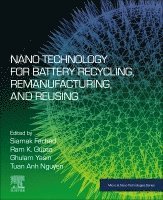
    Nano Technology for Battery Recycling, Remanufacturing, and Reusing

    AvSiamak Farhad,Ghulam Yasin

    Häftad, Engelska, 2022

    Del i serien Micro and Nano Technologies

    2 430 kr

    Beställningsvara. Skickas inom 10-15 vardagar. Fri frakt över 249 kr.

    Beskrivning

    Nanotechnology for Battery Recycling, Remanufacturing, and Reusing explores how nanotechnology is currently being used in battery recycling, remanufacturing and reusing technologies to make them economically and environmentally feasible. The book shows how nanotechnology can be used to enhance and improve battery recycling, remanufacturing and reusing technologies, covering the fundamentals of battery recycling, remanufacturing and reusing technologies, the role of nanotechnology, the separation, regeneration and reuse of nanomaterials from battery waste,� nano-enabled approaches for battery recycling, and nano-enabled approaches for battery remanufacturing and reusing.

    This book will help researchers and engineers to better understand the role of nanotechnology in the field of battery recycling, remanufacturing and reusing. It will be an important reference source for materials scientists and engineers who would like to learn more about how nanotechnology is being used to create new battery recycling processes.


    • Outlines practical and cost-efficient processes for recycling and reusing batteries
    • Highlights the different types of nanomaterials used in battery recycling processes
    • Assesses major challenges with integrating nanotechnology into battery manufacturing processes on an industrial scale

    Produktinformation

    • Utgivningsdatum:2022-04-29
    • Mått:191 x 235 x 33 mm
    • Vikt:1 090 g
    • Format:Häftad
    • Språk:Engelska
    • Serie:Micro and Nano Technologies
    • Antal sidor:520
    • Förlag:Elsevier Science
    • ISBN:9780323911344

    Utforska kategorier

    • Maskinteknik och material inom Naturvetenskap och teknik

    Mer om författaren

    Siamak Farhad is Associate Professor in the Department of Mechanical Engineering, at The University of Akron,Ohio, USA. His primary and secondary research fields are energy and measurement, with a focus on energy, both energy conversion and storage, with particular emphasis on batteries, fuel cells, and piezoelectrics, from nano/microstructure design to the cell, device and system design. His focus in the field of measurement is on new sensors, is interdisciplinary and linked to nanotechnology, electrochemistry, thermal science, and material science. His research is based on both modeling and experiment; the selected research topics are, recycling and regeneration of lithium-ion battery materials, optimization of electrodes nano/microstructure for lithium battery, ceramic solid-state lithium battery, and piezoelectric materials for sensor and energy harvester. Ghulam Yasin is a researcher in the School of Environment and Civil Engineering at Dongguan University of Technology, Guangdong, China. His expertise covers the design and development of hybrid devices and technologies of carbon nanostructures and advanced nanomaterials for for real-world impact in energy-related and other functional applications. Tuan Anh Nguyen is a Senior Principal Research Scientist at the Institute for Tropical Technology, Vietnam Academy of Science and Technology, Hanoi, Vietnam. He received a BS in physics from Hanoi University in 1992, a BS in economics from Hanoi National Economics University in 1997, and a PhD in chemistry from the Paris Diderot University, France, in 2003. He was a Visiting Scientist at Seoul National University, South Korea, in 2004, and the University of Wollongong, Australia, in 2005. He then worked as a Postdoctoral Research Associate and Research Scientist at Montana State University, United States in 2006-09. In 2012 he was appointed as the Head of the Microanalysis Department at the Institute for Tropical Technology. His research areas of interest include smart sensors, smart networks, smart hospitals, smart cities, complexiverse, and digital twins. He has edited more than 74 books for Elsevier, 12 books for CRC Press, 1 book for Springer, 1 book for RSC, and 2 books for IGI Global. He is the Editor-in-Chief of Kenkyu Journal of Nanotechnology & Nanoscience. Ram Gupta is a Professor in the Department of Chemistry at Pittsburg State University, Kansas, United States. His research focus is in green energy production and storage using nanomaterials, optoelectronics and photovoltaics devices, organic-inorganic heterojunctions for sensors, nanomagnetism, conducting polymers and composites as well as bio-based polymers, bio-compatible nanofibers for tissue regeneration, scaffold and antibacterial applications, and bio-degradable metallic implants.

    Innehållsförteckning

    • Part 1: Introduction 1. Types of batteries in market and their statistics2. Nanomaterials in batteries3. Closed loop in battery recycling, remanufacturing, and reusing4. Nanotechnology and recycling, remanufacturing, and reusing battery 5. Available technologies for recycling, remanufacturing, and reusing batteries: An introduction6. Underdevelopment and promising technologies of recycling, remanufacturing, and reusing batteries: An introduction7. Modeling and analysis tools for recycling, remanufacturing, and reusing batteries: An introductionPart 2: Recycling, Remanufacturing and Reusing Batteries 8. Environmental aspects of recycling, remanufacturing, and reusing batteries 9. Economical aspects of recycling, remanufacturing, and reusing batteries10. Safety aspects of recycling, remanufacturing, and reusing batteries 11. Government supports and incentive programs for recycling, remanufacturing, and reusing batteries12. Regulations and standards for recycling, remanufacturing, and reusing batteries 13. Disassembly of battery packs for recycling14. Industry experience in recycling, remanufacturing, and reusing batteriesPart 3: Nanotechnology for Battery Recycling15. Mechanical and physical processes of battery recycling and the role of nanotechnology 16. Pyrometallurgical processes of battery recycling and the role of nanotechnology 17. Hydrometallurgical processes of battery recycling and the role of nanotechnology18. Emerging processes and technologies of battery recycling and the role of nanotechnology 19. Separation technologies of nanomaterials from batteries20. Regeneration technologies of nanomaterials of recycled batteries 21. Equipment for recycling batteries and separation of nanomaterials22. Potential environmental impacts of non-recycled battery nanomaterials23. Battery design to improve its recyclabilityPart 4: Recycling Battery Components and Nanomaterials 24. Recycling battery cathode materials 25. Recycling battery anode materials 26. Recycling battery electrolyte materials 27. Recycling battery current collector materials 28. Recycling of battery casing materials 29. Recycling battery polymer materials30. Recycling battery ceramic materials 31. Recycling battery metallic materials 32. Recycling lithium, cobalt, and nickel and returning to battery production cyclePart 5: Battery Remanufacturing and Reusing from Recycled Nanomaterials 33. Battery manufacturing from recycled nanomaterials34. Blending fresh and recycled nanomaterials in battery manufacturing 35. Applications of batteries made from recycled nanomaterials36. Safety of batteries made from recycled nanomaterials37. Current and future market for batteries made from recycled nanomaterials38. Performance of batteries made from recycled nanomaterials39. Industry experience in using batteries made from recycled nanomaterials40. Future trends and threats for remanufacturing and reusing batteries from recycled nanomaterials