• Fri frakt över 249 kr
  • •
  • Snabba leveranser
  • •
  • Billiga böcker
Kundservice

Du är på sajten för privatpersoner.

Företag, bibliotek eller offentlig verksamhet?

Du handlar på classic.bokus.com, där alla dina funktioner finns intakta.
Till classic.bokus.com
Bokus logotyp. Gå till startsidan.
  • Erbjudanden
  • Nyheter
  • Student
  • Topplistor
  • Barn & ungdom
  • Bokus Play
  • E-böcker
  • Pocketböcker
  • Spel & pussel

10% rabatt på allt med kod: NYSTART10 →

Sidfot

Mina sidor

    Hjälp

    • Kundservice
    • Vanliga frågor och svar
    • Frakt och leverans
    • Retur vid ångerrätt
    • Reklamera vara
    • Betalning
    • Köpvillkor
    • Allmänna villkor
    • Information om webbplatsens tillgänglighet

    Om Bokus

    • Om oss
    • Pressrum
    • För studenter
    • För företag
    • För bibliotek och offentlig verksamhet
    • För leverantörer
    • Hållbarhet

    Populärt

    • Aktuella erbjudanden
    • Presentkort
    • Studentlitteratur
    • Nya böcker
    • Topplistor
    • Signerade böcker
    • Engelska böcker

    Inspiration

    • Boktips
    • BookTok
    • Populära bokserier
    • Barnbokskaraktärer
    • Populära författare
    Logotyp för Bokus
    Följ oss på Facebook (extern länk)Följ oss på Instagram (extern länk)Följ oss på YouTube (extern länk)Följ oss på TikTok (extern länk)
    bokus @ CookiesAnpassa cookiesIntegritetspolicyKöpvillkor
    Till Citymail hemsida (extern länk)Till Budbee hemsida (extern länk)Till Postnord hemsida (extern länk)Till Schenker hemsida (extern länk)Till Early Bird hemsida (extern länk)Till Walleys hemsida (extern länk)
    1. Samhälle och politik
    2. Samhälle och kultur
    3. Kultur och medier
    4. Referensverk och tvärvetenskap

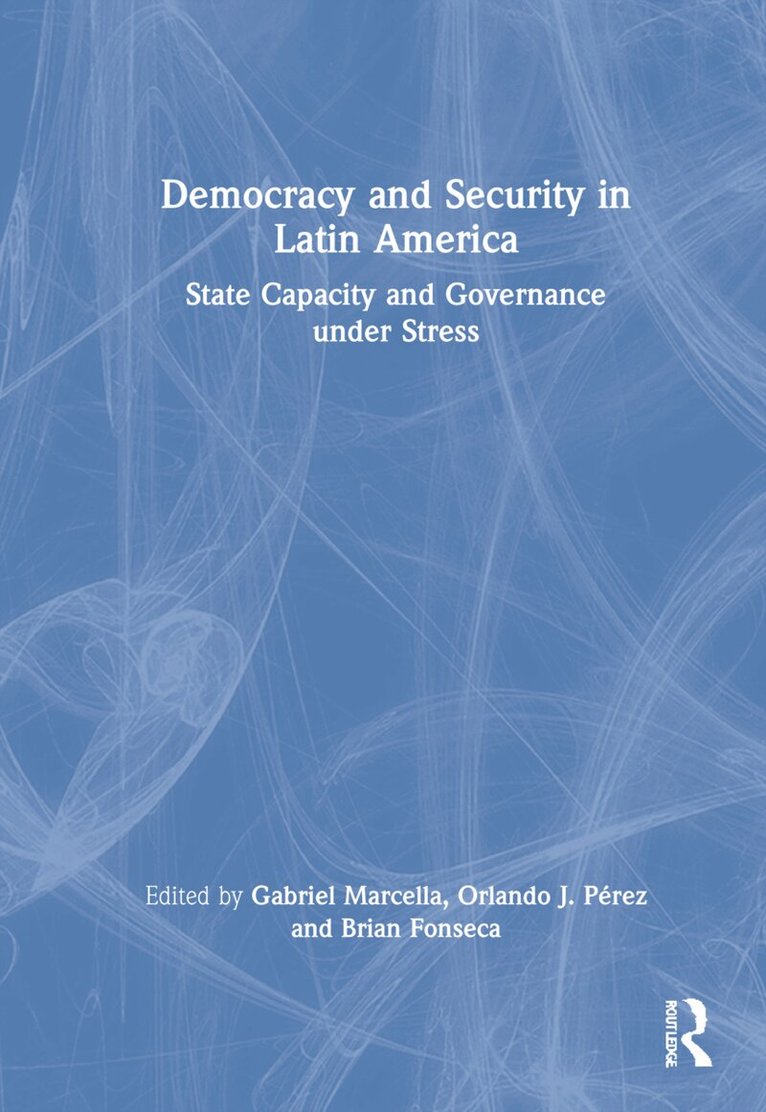
    Democracy and Security in Latin America

    State Capacity and Governance under Stress

    AvGabriel Marcella,Orlando J. Pérez

    Inbunden, Engelska, 2021

    2 423 kr

    Beställningsvara. Skickas inom 10-15 vardagar. Fri frakt över 249 kr.

    Beskrivning

    The COVID-19 pandemic has highlighted the need for governments to generate the necessary capacity to address important security and institutional challenges; this volume deepens our understanding of the nature and extent of state governance in Latin America.State capacity is multidimensional, with all elements interacting to produce stable governance and security. As such, a collection of scholars and practitioners use an explicit interdisciplinary approach, drawing on the contributions of history, political science, economics, public policy, military studies, and other fields to gain a rounded understanding of the link between security and democracy.Democracy and Security in Latin America is divided in two sections:Part 1 focuses on the challenges to governance and key institutions such as police, courts, armed forces. and the prison system.Part 2 features country case studies that illustrate particularly important security challenges and various means by which the state has confronted them.Democracy and Security in Latin America should appeal not only to those seeking to learn more about the capacity of the democratic state in Latin America to effectively provide public security in times of stress, but to all those curious about the reality that a democracy must have security to function.

    Produktinformation

    • Utgivningsdatum:2021-11-05
    • Mått:178 x 254 x 17 mm
    • Vikt:453 g
    • Format:Inbunden
    • Språk:Engelska
    • Antal sidor:220
    • Förlag:Taylor & Francis Ltd
    • ISBN:9780367260521

    Utforska kategorier

    • Referensverk och tvärvetenskap inom Samhälle och politik
    • Statsskick: demokrati inom Samhälle och politik
    • Politik och statsskick inom Samhälle och politik

    Mer om författaren

    Gabriel Marcella is Distinguished Fellow and former Director of the Americas Studies at the U.S. Army War College. He served as International Affairs Advisor to the Commander-in-Chief at the U.S. Southern Command, and consultant to the Departments of State and Defense on Latin American security. He has written extensively on Latin American security and U.S. policy, teaching strategy, and the Washington interagency process.Orlando J. Pérez is Dean of the School of Liberal Arts and Sciences and Professor of Political Science at the University of North Texas at Dallas. His teaching and research interests include comparative politics, Latin American politics, U.S.-Latin American relations, civil-military relations, public opinion, and empirical democratic theory. As a consultant, he has worked on public opinion surveys, democratization, civil-military relations, and anti-corruption issues for the U.S. Agency for International Development (USAID) and the UN Development Program. He is the author of Civil-Military Relations in Post-Conflict Societies: Transforming the Role of the Military in Central America (Routledge, 2017); Political Culture in Panama: Democracy after Invasion (2011), and Co-editor (with Richard Millett and Jennifer Holmes) of Latin American Democracy: Emerging Reality or Endangered Species? (Routledge, 2015). He received a BA in political science from Florida International University and an MA and PhD in political science from the University of Pittsburgh.Brian Fonseca is a Director of the Jack D. Gordon Institute for Public Policy at Florida International University’s (FIU) Steven J. Green School of International and Public Affairs and an Adjunct Professor in the Department of Politics and International Relations. Brian’s technical expertise is in U.S. National Security and Foreign Policy. He also serves as a Cybersecurity Policy Fellow at the D.C.-based think tank New America and Chair of the Americas Linkage Committee at the Greater Miami Chamber of Commerce. His recent publications include an edited volume with Eduardo A. Gamarra titled Culture and National Security in the Americas (2017) and is coauthor of The New US Security Agenda: Trends and Emerging Threats (2017). His analysis has been featured in local and national media and he serves as the on-air Political Analyst for South Florida’s WSVN-Fox News. From 1997 to 2004, he served in the U.S. Marine Corps and facilitated the training of foreign military forces in both hostile theaters and during peacetime operations.

    Recensioner i media

    "This book is an important contribution for any student, professor or researcher interested in the issue of security and its relationship with Latin American democracy…Democracy and Security in Latin America: State Capacity and Governance under Stress proves to be a valuable contribution to the debate on security, governance and criminality, and could stimulate the debate on these arguments, rekindling it with new questions. Therefore, I consider this work a good exercise to understand the structural and recent challenges at continental, regional and national levels in governance and security, both continually tested by old and new threats. It is a work of an academic nature but accessible reading for all those interested in the above-mentioned topics."Pablo A. Baisotti, Small Wars Journal"A timely and valuable contribution to the scholarly production on security in Latin America. At a moment when there are more questions than answers to the challenges of violence, transnational organized crime, and cyber threats, this book sheds light to the usually dark corridors of public policy-making in one of this Hemisphere’s most complex agendas. Unwilling to deprive insecurity of its complexity, this collection of articles provides fresh approaches to issues that will prevail in this region for the foreseeable future."Luis G. Solis, President of Costa Rica (2014–2018)"This powerful, timely, and compelling volume analyzes the capacity of the democratic state in Latin America to effectively provide public security and national defense. Regional experts focus on four key institutional structures (police, prison system, judiciary, and armed forces), applied to eight countries: Argentina, Brazil, Chile, Colombia, Cuba, Mexico, Peru, and Venezuela. The interdisciplinary analysis, policy implications, and recommendations make this a must-read for those seeking to understand the growing challenges of state capacity and governance in Latin America."Lieutenant General (ret) Frederick S. Rudesheim, Director, William J. Perry Center for Hemispheric Defense Studies"This timely look at one of the most vexing issues of hemispheric democracy—state capacity in security affairs—is long overdue and fills an important niche in our understanding of regional issues. More to the point, this volume provides policymakers with some of the tools they will need to address existing and emerging challenges across the region within a democratic construct, just at a point when the democratic construct itself is under intensifying pressure. It should be widely read and referenced."Eric Farnsworth, Vice President of the Council of the Americas and Americas Society"In this book, we are finally presented with a comprehensive and much needed interdisciplinary approach to a vexing problem that has plagued academics and policymakers for years – building state capacity to address Latin America’s complex security challenges. The editors could not have brought together a more impressive list of contributors to offer analysis and recommendations to the problem of building state capacity in the region."Frank O. Mora, PhD., Professor of Politics and International Relations at Florida International University (FIU) and former Director of the Kimberly Green Latin American and Caribbean Center

    Innehållsförteckning

    • Introduction Part 1: Institutions 1. The Crisis of Governance 2. Policing 3. Judicial System 4. Prisons 5. Ministry of Defense and The Armed Forces Part 2: Country Studies 6. Colombia: Security Challenges and State Capacity 7. Mexico: Dilemma between Democratic Recession and Internal Security 8. Brazil: The Evolution of Civil-Military Relations and Security 9. Peru: Counterinsurgency and the Rule of Law during Re-democratization 10. Cuba: The Exceptional Case 11. Venezuela: The Erosion of Security Capacity 12. Argentina: Legality or Disobedience? 13. Chile: A Secure Democracy? 14. Conclusion