• Fri frakt över 249 kr
  • •
  • Snabba leveranser
  • •
  • Billiga böcker
Kundservice

Du är på sajten för privatpersoner.

Företag, bibliotek eller offentlig verksamhet?

Du handlar på classic.bokus.com, där alla dina funktioner finns intakta.
Till classic.bokus.com
Bokus logotyp. Gå till startsidan.
  • Erbjudanden
  • Nyheter
  • Student
  • Topplistor
  • Barn & ungdom
  • Bokus Play
  • E-böcker
  • Pocketböcker
  • Spel & pussel

10% rabatt på allt med kod: NYSTART10 →

Sidfot

Mina sidor

    Hjälp

    • Kundservice
    • Vanliga frågor och svar
    • Frakt och leverans
    • Retur vid ångerrätt
    • Reklamera vara
    • Betalning
    • Köpvillkor
    • Allmänna villkor
    • Information om webbplatsens tillgänglighet

    Om Bokus

    • Om oss
    • Pressrum
    • För studenter
    • För företag
    • För bibliotek och offentlig verksamhet
    • För leverantörer
    • Hållbarhet

    Populärt

    • Aktuella erbjudanden
    • Presentkort
    • Studentlitteratur
    • Nya böcker
    • Topplistor
    • Signerade böcker
    • Engelska böcker

    Inspiration

    • Boktips
    • BookTok
    • Populära bokserier
    • Barnbokskaraktärer
    • Populära författare
    Logotyp för Bokus
    Följ oss på Facebook (extern länk)Följ oss på Instagram (extern länk)Följ oss på YouTube (extern länk)Följ oss på TikTok (extern länk)
    bokus @ CookiesAnpassa cookiesIntegritetspolicyKöpvillkor
    Till Citymail hemsida (extern länk)Till Budbee hemsida (extern länk)Till Postnord hemsida (extern länk)Till Schenker hemsida (extern länk)Till Early Bird hemsida (extern länk)Till Walleys hemsida (extern länk)
    1. Djur och Natur
    2. Naturböcker
    3. Växtböcker

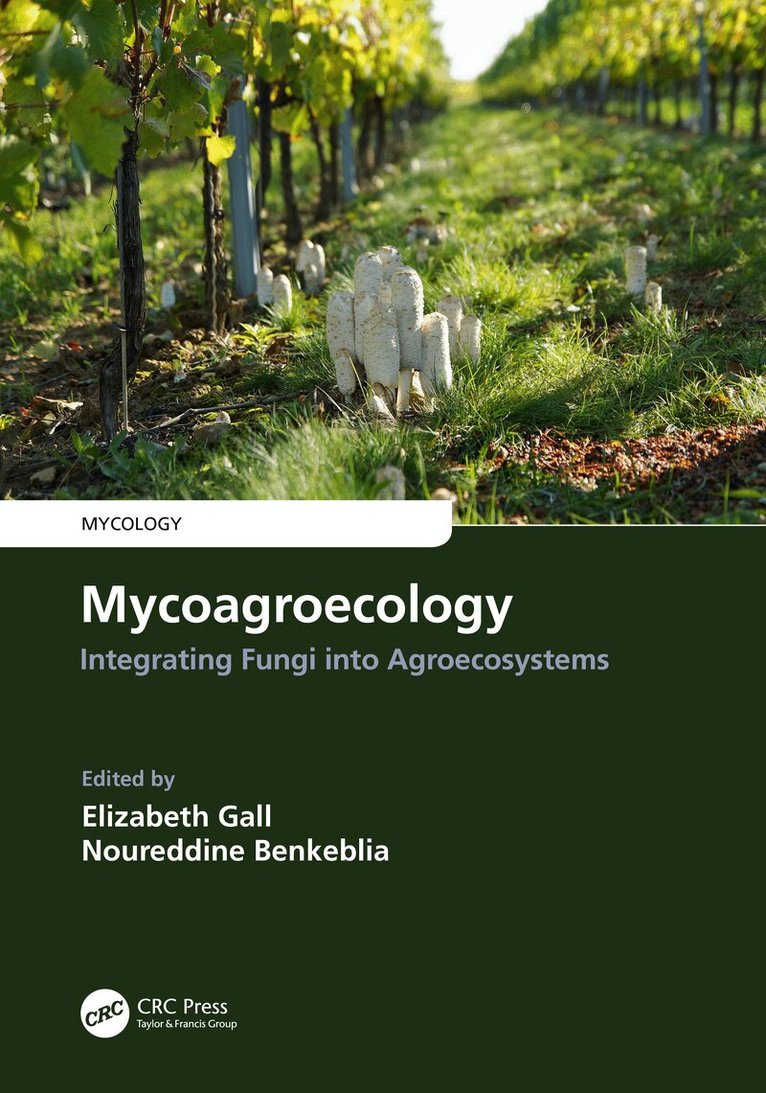
    Mycoagroecology

    Integrating Fungi into Agroecosystems

    AvElizabeth Gall,Noureddine Benkeblia

    Inbunden, Engelska, 2022

    Del i serien Mycology

    1 187 kr

    Beställningsvara. Skickas inom 10-15 vardagar. Fri frakt över 249 kr.

    Beskrivning

    During the 20th century, agriculture underwent many unsustainable changes for the sake of greater food production. Today, the effects of climate change are becoming ever more apparent and the global population continues to grow, placing additional pressures on agricultural systems. For this reason, it is vital to turn international agriculture towards a sustainable future capable of providing healthy, bountiful foods by using methods that preserve and reconstruct the balance of natural ecosystems.Fungi are an underappreciated, underutilized group of organisms with massive potential to aid in the production of healthy food and other products while also increasing the sustainability of agricultural systems. Mycoagroecology: Integrating Fungi into Agroecosystems lays the foundations for integrated fungal-agricultural understanding and management, the proposed practice of “mycoagroecology”. Suitable for students and professionals of multiple disciplines, this text includes nine introductory chapters that create a firm foundation in ecosystem functioning, evolution and population dynamics, fungal biology, principles of crop breeding and pest management, basic economics of agriculture, and the history of agricultural development during the 20th century. The latter half of the text is application-oriented, integrating the knowledge from the introductory chapters to help readers understand more deeply the various roles of fungi in natural and agricultural systems:PARTNERS: This text explores known benefits of wild plant-fungal mutualisms, and how to foster and maintain these relationships in a productive agricultural setting.PESTS AND PEST CONTROL AGENTS: This text acknowledges the historical and continuing role of agriculturally significant fungal pathogens, surveying modern chemical, biotechnological, and cultural methods of controlling them and other pests. However, this book also emphasizes the strong potential of beneficial fungi to biologically control fungal, insect, and other pests.PRODUCTS: This text covers not just isolated production of mushrooms on specialized farms but also the potential for co-cropping mushrooms in existing plant-based farms, making farm systems more self-sustaining while adding valuable and nutritious new products. An extensive chapter is also devoted to the many historical and forward-facing uses of fungi in food preservation and processing.

    Produktinformation

    • Utgivningsdatum:2022-11-17
    • Mått:178 x 254 x 22 mm
    • Vikt:1 180 g
    • Format:Inbunden
    • Språk:Engelska
    • Serie:Mycology
    • Antal sidor:278
    • Förlag:Taylor & Francis Ltd
    • ISBN:9780367335243

    Utforska kategorier

    • Växtböcker inom Djur och Natur
    • Svampböcker inom Djur och Natur
    • Svampar inom Naturvetenskap och teknik

    Mer om författaren

    Elizabeth “Izzie” Gall graduated from Tufts University in 2015 with a plant biology degree and a fierce passion for mycology. As an intern at the New York Botanical Garden, she founded Morel Dilemma, a podcast intended to impart her love of fungi to listeners of diverse backgrounds. After the internship ended, Izzie worked as a laboratory technician at New York University but continued the podcast, researching and producing episodes about mushroom cultivation, mycorrhizal relationships, foraging practices and safety, and fungi in the fossil record, among other topics. In 2017, Izzie attended graduate school in mycology and plant pathology at Michigan State University before returning to outreach. She is delighted to bring readers of all levels to a deeper understanding of fungi and their utility in natural and agricultural spaces. Izzie currently lives in Knoxville, Tennessee, U.S.A. with her husband Nate.Noureddine Benkeblia is a Professor of Crop Science, Department of Life Sciences, Faculty of Science and Technology, University of the West Indies Mona Campus, Jamaica. He is also Head of the Laboratory of Crop Science (Life Sciences Department) and Head of the Laboratory of Tree Fruits and Aromatic Crops (Biotechnology Centre), and coordinator of the graduate agriculture programmes. His main research areas focus on the environmental stresses on the physiology and biochemistry of crops including pre- and postharvest metabolism, and the metabolome. Prof. N. Benkeblia has an extensive research (more than 30 years) experience in horticultural sciences, and teaching at undergraduate, graduate and postgraduate levels in many countries. Prof. N. Benkeblia published over 230 publications including books, chapters and research papers. His is member of many international scientific societies NGO, and was recipient of many awards. He is also Associate Editor of several scientific journals e.g. Canadian Journal of Plant Science and PLOS Climate among others.

    Innehållsförteckning

    • INTRODUCTION1 Nutrient Cycling and Trophic Lifestyles (Elizabeth Gall and Noureddine Benkeblia)1.1 Photosynthesis: Primary Calorie Production1.2 Primary and Secondary Metabolites1.3 The Carbon Cycle1.4 The Nitrogen Cycle1.5 Heterotroph Lifestyles1.5.1 Ingestive Heterotrophs1.5.2 Absorptive Heterotrophs1.6 Agroecological Applications2 Evolution and Symbiosis (Elizabeth Gall)2.1 Fitness and Genes2.2 Species2.3 Evolution and Evolutionary Pressures2.4 Coevolution and Symbiosis2.4.1 Mutualism2.4.2 Predators and Prey2.4.3 Competition2.4.4 Commensalism and Parasitism2.5 Context Dependence of Symbiosis2.6 Agroecological Applications3 Population Dynamics (Elizabeth Gall)3.1 Energy Flow in Ecosystems3.2 Growth Curves3.3 Carrying Capacity and Population Cycles3.4 Agroecological Applications4 The Kingdom Fungi (Steven Stephenson and Elizabeth Gall)4.1 Basic Structures of Fungi4.2 Basic Classification of Fungi and Fungus-Like Organisms4.2.1 Slime Molds4.3 Taxonomy of Macrofungi4.4 Taxonomy of Microfungi4.5 Sexual Reproduction4.5.1 Basidiomycetes4.5.2 Ascomycetes4.6 Asexual and Sexual Stages4.7 Fundamental Niches of Fungi4.7.1 Saprotrophic Fungi4.7.2 Fungi in Symbioses4.8 Secondary Metabolites of Interest4.8.1 Culinary Use4.8.2 Poisons or Toxins4.8.3 Medicinal Compounds5 Limiting Factors in Agriculture (Noureddine Benkeblia)5.1 Meteorological Limiting Factors5.1.1 Extreme Temperature as a Limiting Factor5.1.1.1 High Temperatures5.1.1.2 Low Temperatures5.1.1.3 Long-Term Effects of Extreme Temperatures5.1.2 CO2 Concentration as a Limiting Factor5.2 Where Meteorological and Land Factors Meet: Water as a Limiting Factor5.3 Limiting Land Factors: Nutrient Supply5.3.1 Nitrogen (N)5.3.2 Phosphorus (P)5.3.3 Potassium (K)6 Principles of Crop Breeding and Productivity (Elizabeth Gall)6.1 Artificial Evolutionary Pressure6.2 Metabolite Limits of Selective Breeding6.3 Photosynthetic Limits of Selective Breeding6.4 Evolved Alternatives to C3 Photosynthesis6.4.1 C4 Photosynthesis6.4.2 CAM Photosynthesis6.4.3 Evolutionary Limits6.5 Other Methods to Increase Yields and Efficiency6.5.1 Intercropping6.5.2 Crop Rotation6.5.3 Directed Genetic Modification6.6 Developing Cooperative Varieties of Plants and Fungi7 Pests and Pest Management Methods (Juan F. Barrera)7.1 Humans Versus Pests7.2 Pest Management Strategies and Tactics7.3 Economics and Ecology of Pests7.3.1 The Economic Approach7.3.2 The Ecological Approach7.3.2.1 r-Pests7.3.2.2 K-Pests7.3.2.3 Intermediate Pests7.4 The Future of Pest Management7.4.1 Biologically Intensive IPM7.4.2 Agroecologically Integrated Pest Management7.4.3 Ecologically Based Pest Management (EBPM)7.4.4 Total System Approach7.4.5 Integrated Management of Biodiversity (IMB)7.4.6 Integrated Crop Management (ICM)7.4.7 Integrated Production7.4.8 Integrated Agroecosystem Design and Management (IADM)7.4.9 Crop Health and Salutogenesis7.4.10 Holistic Pest Management (HPM)7.5 Conclusion8 Economic Factors in Agriculture (Elizabeth Gall and Barbara Laff)8.1 Supply and Demand8.1.1 Agricultural Supply: Balancing Inputs and Outputs with Costs and Income8.1.2 Agricultural Demand: Glut Price Cycles8.2 Farm Sizes and Types8.2.1 Farm Consolidation8.3 Market Distortions8.3.1 Government Interventions8.4 Other Factors8.4.1 Ecological Considerations8.4.2 Intellectual Property Law8.4.2.1 Plants as Intellectual Property8.4.2.2 Patents and Seed Re-Use8.5 Conclusion9 The Green Revolution: Agricultural Shifts of the 20th Century (Elizabeth Gall)9.1 The United States: From Dust Bowl to Green Revolution9.2 Mexico and The Initial Green Revolution9.3 The Philippines, China, and Southeast Asia: Global Attention and Wild Success9.4 Patterns of the Green Revolution9.5 Environmental Impacts of High-Input Systems9.5.1 Fertilizer9.5.2 Irrigation9.5.3 Monoculture9.6 Economic Impact9.7 Government Interventions9.8 ConclusionMYCOAGROECOLOGY10 The Second Green Revolution and the Role of Mycoagroecology (Elizabeth Gall)10.1 Mycology: Revealing the Fungal Roles of Partners, Pests, Pest-Control Agents, and Products10.2 Agroecology: Integrating Productivity and Sustainability10.2.1 Industrial Farms Value Production over Ecosystem Balance10.2.2 Buffering the Ecosystem from the Farm10.2.3 Closing the Loop: The Farm as an Island Ecosystem10.2.4 The Farm as a Productive Portion of the Ecosystem10.2.5 Incorporating Other Techniques10.3 Mycoagroecology10.3.1 Partners10.3.2 Pests and Pest-Control Agents10.3.3 Products10.4 Mycoagroecology is Compatible with the Goals of the Second Green Revolution10.4.1 Address “Orphan” Regions and Crops10.4.2 Return to Polyculture10.4.3 Reduce the Need for Synthetic Inputs10.4.4 Maintain Smallholder Competitiveness10.5 ConclusionFUNGI AS PARTNERS11 Plant-Fungal Mutualisms (Jason C. Slot)11.1 Plant-Fungal Mutualisms Vary According to Plant "Compartments"11.2 Arbuscular Mycorrhizal Fungi Colonize Diverse Plant Roots Worldwide11.3 Ectomycorrhizal Fungi Colonize Roots of Woody Plants in Northern and Temperate Forests11.4 Mycorrhizal Relationships are Structurally and Ecologically Diverse11.4.1 Plants in a Community Can Benefit from Shared Mycorrhizal Networks11.4.2 Mycoheterotrophs Exploit Plant-Fungal Mutualisms11.5 Endophytic Fungi are Common Residents of Plant Tissues11.6 Fungi can Provide Benefits to Other Plant Mutualisms11.7 Plant-Fungal Mutualisms Require an Adapted Fungal Community12 Incorporating Microbes into Agricultural Soils (Elizabeth Gall)12.1 Types of Soil Microbes12.1.1 Arbuscular Mycorrhizal (AM) Fungi12.1.2 Ectomycorrhizal (ECM) Fungi12.1.3 Root Endophytes12.1.4 Other Soil Microbes12.2 Industrial Agricultural Practices Destroy Soil Microbial Communities12.2.1 Monoculture12.2.2 Other Microbiome-Damaging Practices12.3 Restoring Microbial Populations is Possible and Effective12.4 Methods for Reintroducing Microbes to Agricultural Soils12.4.1 Soil Inoculation12.4.2 Trap Plants12.4.3 Seed Coating12.4.4 Monospecies vs. Community Inoculation12.5 Management Practices for Soil Microbe Retention12.6 ConclusionFUNGI AS PESTS AND PEST-CONTROL AGENTS13 Fungal Diseases in Agriculture: Significance, Management, and Control (Noureddine Benkeblia)13.1 Significance of Fungal Diseases in Agriculture13.2 Management and Control of Fungal Diseases in Agriculture13.2.1 Chemical Control13.2.2 Cultural Methods and Integrated Pest Management (IPM)13.2.3 Biological Control Agents (BCA)14 Fungal Pathogens in Forested Ecosystems (Denita Hadziabdic, Aaron Onufrak, and Romina Gazis)14.1 Detection Tools and Surveillance Methods14.2 Fusarium Dieback – Invasive Shot Hole Borers14.2.1 Disease Biology and Impact14.2.2 Detection and Identification of the Pathogen and Vector14.3 Laurel Wilt14.3.1 Disease Biology and Impact14.3.2 Detection and Identification of the Pathogen and Vector14.4 Thousand Cankers Disease14.4.1 Disease Biology and Impact14.4.2 Detection and Identification of the Pathogen and Vector14.5 Management of Fungal Diseases in Forested Areas14.5.1 Cultural Practices14.5.1.1 Quarantine and Sanitation14.5.1.2 Resource Management14.5.1.3 Plant Breeding14.5.2 Chemical Management14.5.3 Biological Control15 Fungal Interactions with Other Pests (Guillermo Valero-David and Jason C. Slot)15.1 Insects15.1.1 Fungi are an Important Food Source for Insects and Their Relatives15.1.1.1 Attine Ants15.1.1.2 Macroterminiti Termites15.1.1.3 Ambrosia Beetles15.1.2 Insects are Important Vectors of Plant Pathogenic Fungi15.1.3 Fungi are Important Pathogens of Insects15.1.3.1 Entomopathogenic Fungi in Soils15.1.4 Fungal-Insect Interactions are Important Factors in Ecosystem Processes15.2 Nematodes15.2.1 Nematodes Consume Fungi, Resulting in Varied Impacts on Agroecosystems15.2.2 Diverse Fungi Attack and Consume Nematodes15.2.3 Nematodes and Plant Pathogenic Fungi Can Act Synergistically to Cause Plant Disease15.2.4 Coevolution of Fungi and Nematodes Has Resulted in Diverse AssociationsFUNGI AS PRODUCTS16 Principles of Modern Fungal Cultivation (Elizabeth Gall)16.1 Protein Value of Mushrooms16.2 Limiting Factors in Mushroom Cultivation16.2.1 Carbon Dioxide Concentrations16.2.2 Carbon and Nitrogen16.2.3 Other Macronutrients16.2.4 Water16.2.5 Light16.2.6 Micronutrients16.3 Modern Mushroom Cultivation16.3.1 Starting Substrate16.3.2 Mushroom Spawn16.4 Genetic Aspects of Mushroom Cultivation17 Integrating Fungi into Existing Farms (Elizabeth Gall)17.1 Mushroom Cultivation Recycles Agro-Industrial Waste17.2 Abundance of Lignocellulosic Waste17.3 Selecting Substrates and Fungal Strains17.4 Mushroom Cultivation Locations17.4.1 Mushroom Cultivation in Buildings17.4.2 Mushroom Cultivation in Woods17.4.3 Mushroom Cultivation in Fields17.4.4 Co-Cropping with Ectomycorrhizal Fungi17.5 Other Potential Uses of Mushrooms17.5.1 Mushroom Growing Kits17.5.2 Spent Mushroom Substrate17.5.3 Mycoremediation of Damaged Landscapes17.5.4 Bioprospecting: “Pests” with Agricultural Utility17.6 Conclusion18 Fungi in Food Processing (Noureddine Benkeblia)18.1 Fermented and Aged Food Products18.1.1 Fermented Foods are Diverse and Numerous18.1.2 Breads18.1.3 Fermented Meats18.1.4 Cheeses18.1.5 Yogurts and Other Fermented Dairy Products18.2 Fermented Beverages18.2.1 Alcoholic Fruit-Based Beverages (Wines)18.2.2 Alcoholic Grain-based Beverages (Beers)18.2.3 Other Alcoholic Beverages18.2.4 Non-Alcoholic Fermented Beverages18.3 Food Additives and Ingredients18.4 Bioprocessing and Novel Food Production by Fungi