• Fri frakt över 249 kr
  • •
  • Snabba leveranser
  • •
  • Billiga böcker
Kundservice

Du är på sajten för privatpersoner.

Företag, bibliotek eller offentlig verksamhet?

Du handlar på classic.bokus.com, där alla dina funktioner finns intakta.
Till classic.bokus.com
Bokus logotyp. Gå till startsidan.
  • Erbjudanden
  • Nyheter
  • Student
  • Topplistor
  • Barn & ungdom
  • Bokus Play
  • E-böcker
  • Pocketböcker
  • Spel & pussel

10% rabatt på allt med kod: NYSTART10 →

Sidfot

Mina sidor

    Hjälp

    • Kundservice
    • Vanliga frågor och svar
    • Frakt och leverans
    • Retur vid ångerrätt
    • Reklamera vara
    • Betalning
    • Köpvillkor
    • Allmänna villkor
    • Information om webbplatsens tillgänglighet

    Om Bokus

    • Om oss
    • Pressrum
    • För studenter
    • För företag
    • För bibliotek och offentlig verksamhet
    • För leverantörer
    • Hållbarhet

    Populärt

    • Aktuella erbjudanden
    • Presentkort
    • Studentlitteratur
    • Nya böcker
    • Topplistor
    • Signerade böcker
    • Engelska böcker

    Inspiration

    • Boktips
    • BookTok
    • Populära bokserier
    • Barnbokskaraktärer
    • Populära författare
    Logotyp för Bokus
    Följ oss på Facebook (extern länk)Följ oss på Instagram (extern länk)Följ oss på YouTube (extern länk)Följ oss på TikTok (extern länk)
    bokus @ CookiesAnpassa cookiesIntegritetspolicyKöpvillkor
    Till Citymail hemsida (extern länk)Till Budbee hemsida (extern länk)Till Postnord hemsida (extern länk)Till Schenker hemsida (extern länk)Till Early Bird hemsida (extern länk)Till Walleys hemsida (extern länk)
    1. Historia och arkeologi
    2. Historia

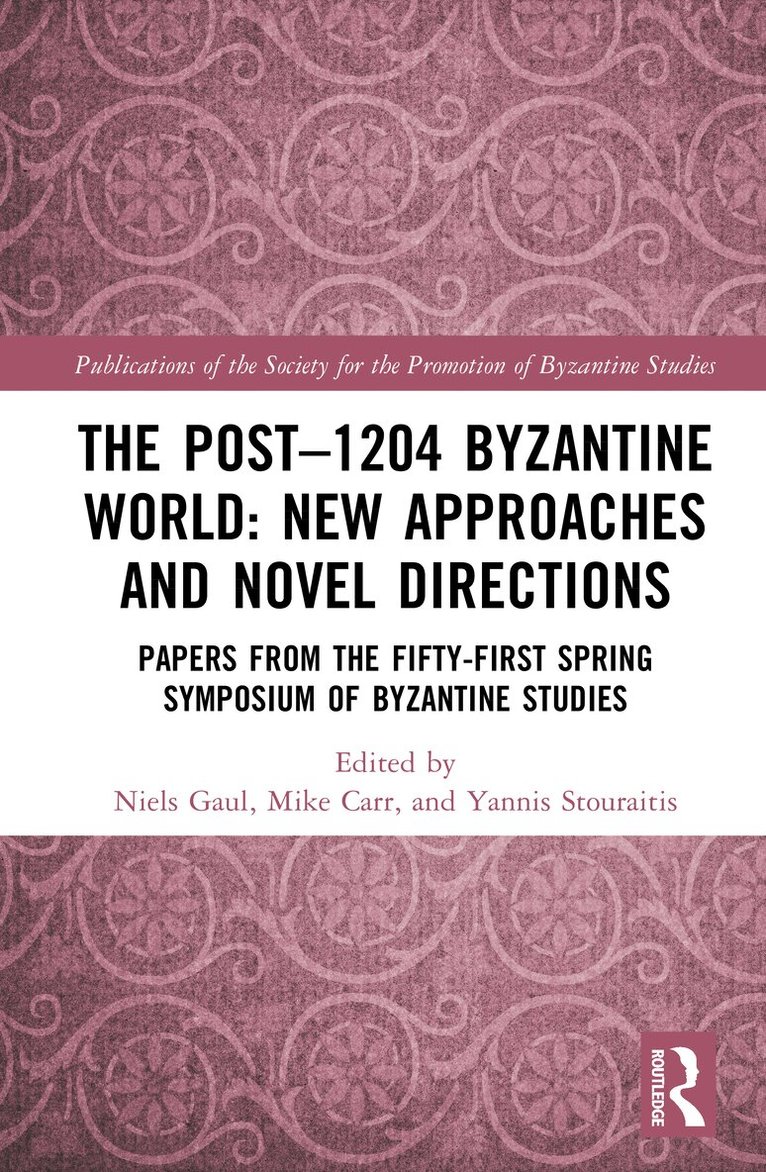
    Post-1204 Byzantine World: New Approaches and Novel Directions

    Papers from the Fifty-First Spring Symposium of Byzantine Studies

    AvNiels Gaul,Mike Carr

    Inbunden, Engelska, 2026

    Del i serien Publications of the Society for the Promotion of Byzantine Studies

    2 421 kr

    Slutsåld

    Beskrivning

    This volume offers fresh perspectives on the Byzantine world in the aftermath of the Fourth Crusade and the conquest of Constantinople in 1204: a world of small-state complexities that upended centuries of empire focused on the imperial city.Across six parts, it pursues new directions in the study of this fragmented late Byzantine world, from Southern Italy via Epiros to Trebizond. Part I reconsiders the so-called key dates of 1204, 1261 and 1453, making a compelling case against investing any of them with teleological meaning or treating them as definitive cut-off points. Part II critically revisits key concepts, such as the oft-employed ‘successor state’ or Byzantine ‘Greekness’. Part III explores the shifting fortunes of Constantinople from the years after 1261 into the early Ottoman era, highlighting points of convergence across Byzantine and Ottoman – and indeed Italian and South-Slavonic – narratives and practices. Part IV reassesses the continuing significance of rhetorical production in the late Byzantine period and its close connection to the workings of empire. Part V examines these workings anew, with attention to networks of petition, imperial effigies and often unexpected connections across the wider Mediterranean world. The final part offers an annotated transcript of the last two Spring Symposium papers delivered by the late Ruth Macrides: an exciting glimpse of her final project, ‘Sharing the Throne’.Rich in scope and insight, this book will be of interest to students of the late Byzantine and late medieval Mediterranean worlds, as well as to scholars of the early Ottoman empire.

    Produktinformation

    • Utgivningsdatum:2026-11-12
    • Mått:156 x 234 x undefined mm
    • Format:Inbunden
    • Språk:Engelska
    • Serie:Publications of the Society for the Promotion of Byzantine Studies
    • Antal sidor:464
    • Förlag:Taylor & Francis Ltd
    • ISBN:9780367350604

    Utforska kategorier

    • Historia inom Historia och arkeologi
    • Forntidens historia inom Historia och arkeologi
    • Religion: allmänt inom Filosofi och religion

    Mer om författaren

    Niels Gaul is the A. G. Leventis Professor of Byzantine Studies and currently Head of Classics at the University of Edinburgh, United Kingdom. His recent publications include The Greek Revolution of 1821: European Contexts, Scottish Connections (2024), co-edited with Roderick Beaton.Mike Carr is Senior Lecturer in Late Medieval History at the University of Edinburgh, United Kingdom. His work focuses on the interactions between Latins, Byzantines, and Muslims in the medieval Mediterranean, especially the role of mer­chants and religious institutions in cross-cultural trade and con­flict. He is the author of Merchant Crusaders in the Aegean, 1291–1352 (2015). His recent books include Military Diasporas: Building of Empire in the Middle East and Europe (550 BCE–1500 CE) (2022), co-edited with Georg Christ and Patrick Sänger, and Crusading Against Christians in the Middle Ages (2024), co-edited with Nikos Chrissis and Gianluca Raccagni.Yannis Stouraitis is Senior Lecturer in Byzantine History at the University of Edinburgh, United Kingdom. His research focuses on collective identifications, war ethics and the social aspects of warfare, migration, and mnemohistory. His most important recent publications are Identities and Ideologies in the Medieval East Roman World (2022) and War and Collective Identities in the Middle Ages: East, West, and Beyond (2023).

    Innehållsförteckning

    • List of FiguresList of Tables List of MapsList of AbbreviationsPrefaceNotes on ContributorsNote on the Spelling of NamesIntroduction: Entering the Post-1204 Byzantine WorldNiels Gaul, Mike Carr and Yannis StouraitisPART IDefining a Period: Key Dates1 Did the Fall of Constantinople in 1204 Transform Byzantium?Michael Angold2 1261 – A Historical Break?Dimiter Angelov3 The Reconquest of Constantinople Did Not Take Place: Towards an Unintelligible Historiography of Late ByzantiumMatthew Kinloch4 Ottoman Perspectives on Byzantium around 1453Dimitri J. KastritsisPART IIKey Concepts and Novel Approaches5 Trebizond – a ‘Successor State’? (De)Constructing a Constantinopolicentric ConceptAnnika Asp6 Byzantine Canon Law in Southern Italy after the Fourth Crusade:From Legal Culture to Cultural IdentityJames Morton7 Captives, Slaves, and Latin Categories of GreeknessAlasdair C. Grant 8 The Empire of Nicaea Goes DigitalPossibilities and ConstraintsEkaterini MitsiouConstantinople (and Beyond): Theatre of Power, Site of Memory9 The Byzantios of Theodore MetochitesPaul Magdalino10 Mehmed II’s Patria, Byzas’s Palace, and the Topkapı Palace: Ottoman Hellenism in the Fifteenth CenturyAslıhan Akışık-Karakullukçu11 The Poetics of Ruin and Reuse in Late Medieval Antiquarian Culture: A Cross-Cultural PerspectiveIda TothPART IVEmpire of Rhetoric12 From Oral to Written and Back Again: Late Byzantine Rhetoric at the Interface between Performance and Book CultureAlexander Riehle13 Nicholas Kabasilas, the Juridical School of Thessalonike, and the Context of his Treatise Against the Archons Marie-Hélène Congourdeau14 A Brief Note on an Unknown Work by Nicholas Kabasilas in Codex Vaticanus Graecus 16Anna Gioffreda15 Eloquence as a Gift: The Rhetoric of Piety in Donation Documents of Three Palaiologan LadiesAnna Adashinskaya16 Ioseph Bryennios’s Chapters: Enhancing the Effects of Didactic AuthorityFlorin LeontePART VWorkings of Empire17 Petition, Philanthropia and Networking in Palaiologan ConstantinopleChristos Malatras18 Rome Is Where the Emperor’s Portrait Is: Anna Christidou’s ‘Via Egnatia Project’ and the Boundaries of Empire in Palaiologan ByzantiumNiels Gaul19 Anna of Savoy in the History of Ioannes Kantakouzenos: A Persuasive Paradox? Brian McLaughlin20 Male Fashion in Late Byzantine Funerary Portraits: Threading Connections in Fifteenth-Century Mystras (Case Studies)Andrea Mattiello21 Imperial Orators as Power Brokers in Fifteenth-Century ByzantiumNathanael AschenbrennerPART VIRuth Macrides: Sharing the Throne22 Sharing the Throne: Succession in Late Byzantium Ruth Macrides (†)23 Blood or Election? The Imperial Office in the Thirteenth CenturyRuth Macrides (†)Index