• Fri frakt över 249 kr
  • •
  • Snabba leveranser
  • •
  • Billiga böcker
Kundservice

Du är på sajten för privatpersoner.

Företag, bibliotek eller offentlig verksamhet?

Du handlar på classic.bokus.com, där alla dina funktioner finns intakta.
Till classic.bokus.com
Bokus logotyp. Gå till startsidan.
  • Erbjudanden
  • Nyheter
  • Student
  • Topplistor
  • Barn & ungdom
  • Bokus Play
  • E-böcker
  • Pocketböcker
  • Spel & pussel

Må bättre, för mindre! Upp till 50% rabatt på hälsoböcker

Sidfot

Mina sidor

    Hjälp

    • Kundservice
    • Vanliga frågor och svar
    • Frakt och leverans
    • Retur vid ångerrätt
    • Reklamera vara
    • Betalning
    • Köpvillkor
    • Allmänna villkor
    • Information om webbplatsens tillgänglighet

    Om Bokus

    • Om oss
    • Pressrum
    • För studenter
    • För företag
    • För bibliotek och offentlig verksamhet
    • För leverantörer
    • Hållbarhet

    Populärt

    • Aktuella erbjudanden
    • Presentkort
    • Studentlitteratur
    • Nya böcker
    • Topplistor
    • Signerade böcker
    • Engelska böcker

    Inspiration

    • Boktips
    • BookTok
    • Populära bokserier
    • Barnbokskaraktärer
    • Populära författare
    Logotyp för Bokus
    Följ oss på Facebook (extern länk)Följ oss på Instagram (extern länk)Följ oss på YouTube (extern länk)Följ oss på TikTok (extern länk)
    bokus @ CookiesAnpassa cookiesIntegritetspolicyKöpvillkor
    Till Citymail hemsida (extern länk)Till Budbee hemsida (extern länk)Till Postnord hemsida (extern länk)Till Schenker hemsida (extern länk)Till Early Bird hemsida (extern länk)Till Walleys hemsida (extern länk)
    1. Ekonomi och Ledarskap
    2. Nationalekonomi
    3. Ekonomisk historia

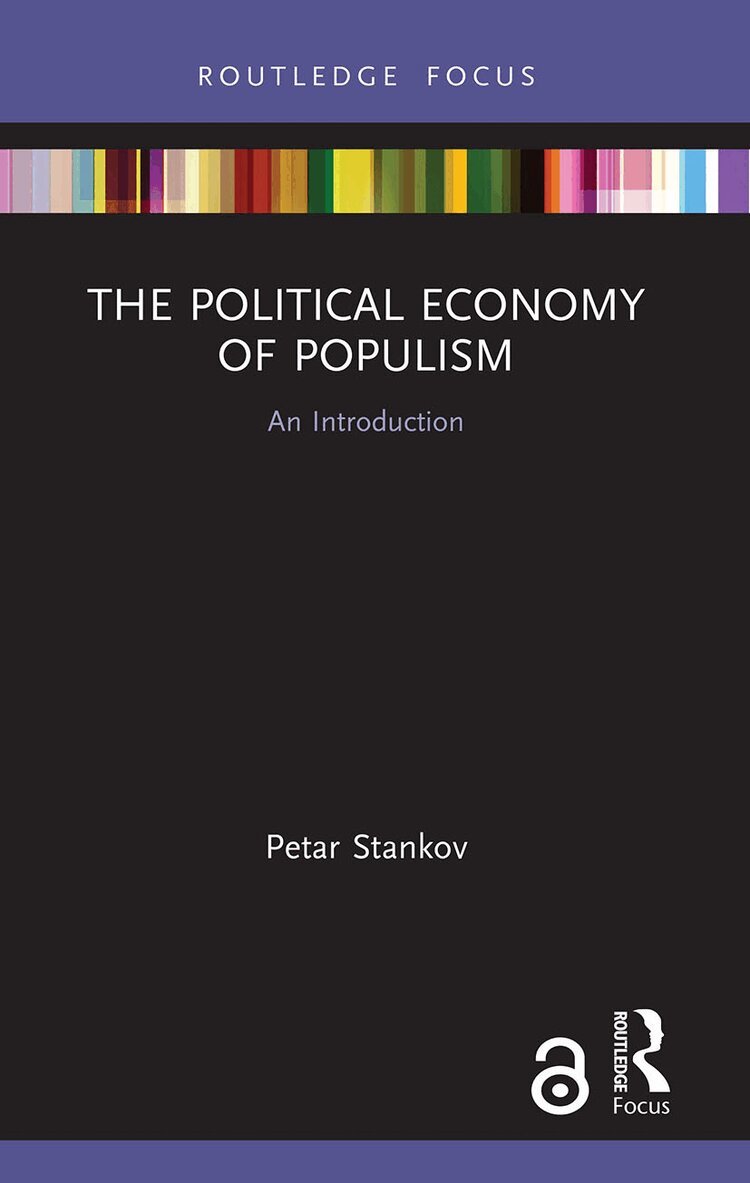
    Political Economy of Populism

    An Introduction

    AvPetar Stankov

    Inbunden, Engelska, 2020

    Del i serien Routledge Frontiers of Political Economy

    961 kr

    Beställningsvara. Skickas inom 10-15 vardagar. Fri frakt över 249 kr.

    Fler format och utgåvor

    Häftad

    358 kr

    Beskrivning

    The Political Economy of Populism explores the interplay between identity, the economy and inequality to explain the dynamics of populist votes since the beginning of the 20th century.The book discusses the political and economic implications of populist governance using data on populist incumbencies and linking it to historical data on the macro economy and democracy. Chapters draw from the most recent political science, economics and other social science literature, as well as historical data, to explain the long-term causes and consequences of populism. Populism emerges and gains traction when political entrepreneurs exploit underlying identity conflicts for political gains. As the distributional consequences of both economic distress and economic growth typically favor the elite over the poor and the lower middle class, economic shocks usually sharpen the underlying identity conflicts between the groups. The book provides evidence of significant differences in the ways fiscal and monetary policies are conducted by incumbent populists in Latin America, Europe and the OECD. The work concludes by suggesting avenues through which a 21st century social consensus can be built, so that our society can avoid repeating the mistakes that led to wars and failed economic experiments in the 20th century.The Political Economy of Populism marks a significant contribution to the study of populism and is suited to students and scholars across the social sciences, including economics, political science and sociology.
    Produktinformation

    • Utgivningsdatum:2020-07-22
    • Mått:138 x 216 x 13 mm
    • Vikt:760 g
    • Format:Inbunden
    • Språk:Engelska
    • Serie:Routledge Frontiers of Political Economy
    • Antal sidor:108
    • Förlag:Taylor & Francis Ltd
    • ISBN:9780367368029

    Utforska kategorier

    • Ekonomisk historia inom Ekonomi och Ledarskap
    • Politiska ideologier och rörelser inom Samhälle och politik
    • Ekonomisk politik inom Ekonomi och Ledarskap

    Mer om författaren

    Petar Stankov is a teaching fellow in the Department of Economics at Royal Holloway, University of London, UK, and a senior lecturer at the University of National and World Economy, Sofia, Bulgaria.

    Recensioner i media

    "Populism is the big topic in political science now. The study of the latest re-emergence of populist parties and leaders has managed to attract some of the most talented young scholars. In this rigorously researched book Petar Stankov offers an original theory of populist cycles, focusing on identity, economy and societal fairness. In addition, he offers empirical explanations of those cycles and valuable insights into the consequences of populist governance." - Ivan Krastev, Centre for Liberal Strategies, Sofia, Bulgaria, and Institute for Human Sciences, Vienna, Austria."Petar Stankov’s The Political Economy of Populism offers a clear and concise interpretation of how and why populist leaders and parties have emerged across many societies in recent decades. The book examines the consequences of the rise of populism, describing policies and results that typically follow populist ascendancies. Finally, the book explores self-correction mechanisms in mature democracies. Covering a wide range of cases and methods of analysis, the lucid prose and clear explanations will make this a "must read" for every student of our current political moment." - Michael Kevane, Department of Economics, Santa Clara University, USA."Despite the growing academic interest in populism, there is not much research about its relationship with the economy. This book addresses this research gap by offering a detailed analysis of the economic consequences of populism as well as a novel theory of populist cycles. This is a must-read for all those who want to understand the economic underpinnings of populism." - Cristóbal Rovira Kaltwasser, School of Political Science, Diego Portales University, Santiago, Chile.

    Innehållsförteckning

    • (1) What do we know about populism?  (2) A theory of populist cycles  (3) Populist cycles: an illustrated history  (4) The political and economic consequences of populism  (5) What can we do about populism?