• Fri frakt över 249 kr
  • •
  • Snabba leveranser
  • •
  • Billiga böcker
Kundservice

Du är på sajten för privatpersoner.

Företag, bibliotek eller offentlig verksamhet?

Du handlar på classic.bokus.com, där alla dina funktioner finns intakta.
Till classic.bokus.com
Bokus logotyp. Gå till startsidan.
  • Erbjudanden
  • Nyheter
  • Student
  • Topplistor
  • Barn & ungdom
  • Bokus Play
  • E-böcker
  • Pocketböcker
  • Spel & pussel

10% rabatt på allt med kod NYSTART10 →

Sidfot

Mina sidor

    Hjälp

    • Kundservice
    • Vanliga frågor och svar
    • Frakt och leverans
    • Retur vid ångerrätt
    • Reklamera vara
    • Betalning
    • Köpvillkor
    • Allmänna villkor
    • Information om webbplatsens tillgänglighet

    Om Bokus

    • Om oss
    • Pressrum
    • För studenter
    • För företag
    • För bibliotek och offentlig verksamhet
    • För leverantörer
    • Hållbarhet

    Populärt

    • Aktuella erbjudanden
    • Presentkort
    • Studentlitteratur
    • Nya böcker
    • Topplistor
    • Signerade böcker
    • Engelska böcker

    Inspiration

    • Boktips
    • BookTok
    • Populära bokserier
    • Barnbokskaraktärer
    • Populära författare
    Logotyp för Bokus
    Följ oss på Facebook (extern länk)Följ oss på Instagram (extern länk)Följ oss på YouTube (extern länk)Följ oss på TikTok (extern länk)
    bokus @ CookiesAnpassa cookiesIntegritetspolicyKöpvillkor
    Till Citymail hemsida (extern länk)Till Budbee hemsida (extern länk)Till Postnord hemsida (extern länk)Till Schenker hemsida (extern länk)Till Early Bird hemsida (extern länk)Till Walleys hemsida (extern länk)
    1. Samhälle och politik
    2. Politik och statsskick
    3. Statsskick och politiska processer

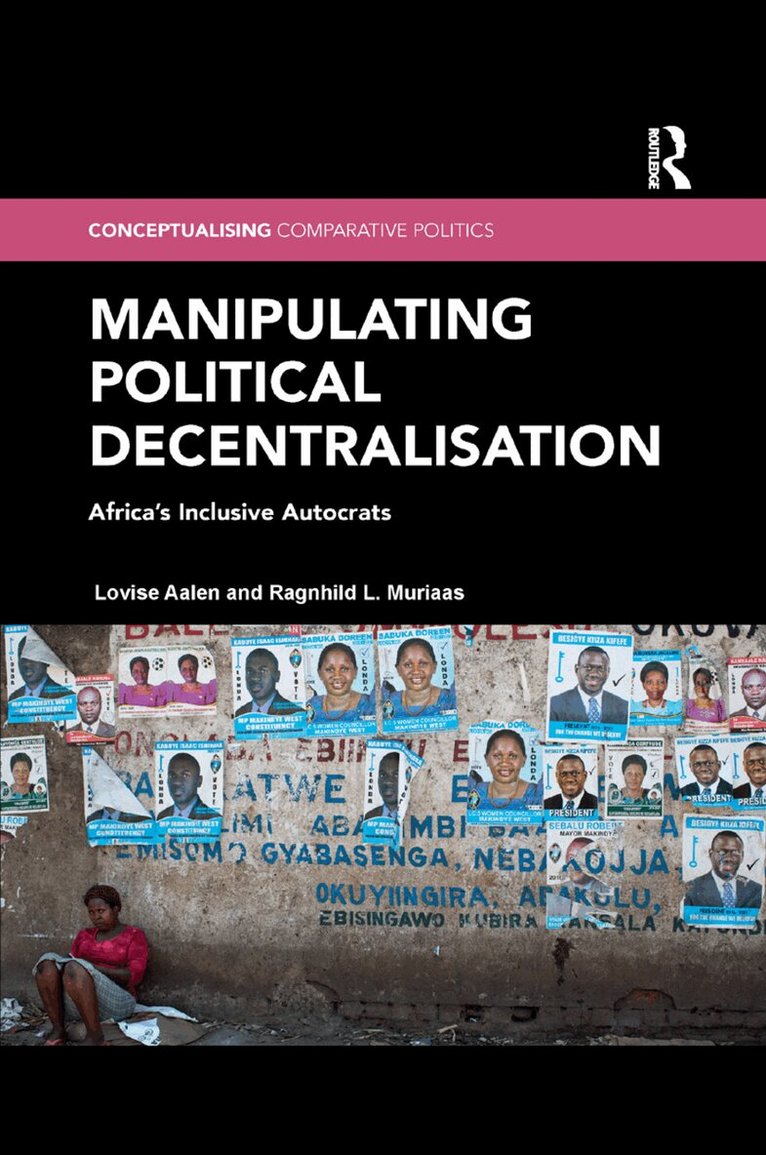
    Manipulating Political Decentralisation

    Africa's Inclusive Autocrats

    AvLovise Aalen,Ragnhild L. Muriaas

    Häftad, Engelska, 2019

    Del i serien Conceptualising Comparative Politics

    765 kr

    Beställningsvara. Skickas inom 10-15 vardagar. Fri frakt över 249 kr.

    Fler format och utgåvor

    Inbunden

    2 422 kr

    Beskrivning

    Can autocrats establish representative subnational governments? And which strategies of manipulation are available if they would like to reduce the uncertainty caused by introducing political decentralisation? In the wake of local government reforms, several states across the world have introduced legislation that provides for subnational elections. This does not mean that representative subnational governments in these countries are all of a certain standard. Political decentralisation should not be confused with democratisation, as the process is likely to be manipulated in ways that do not produce meaningful avenues for political participation and contestation locally. Using examples from Africa, Lovise Aalen and Ragnhild L. Muriaas propose five requirements for representative subnational governments and four strategies that national governments might use to manipulate the outcome of political decentralisation. The case studies of Ethiopia, Malawi, South Africa, and Uganda illustrate why autocrats sometimes are more open to competition at the subnational level than democrats. Manipulating Political Decentralisation provides a new conceptual tool to assess representative subnational governments' quality, aiding us in building theories on the consequences of political decentralisation on democratisation.

    Produktinformation

    • Utgivningsdatum:2019-07-12
    • Mått:152 x 229 x undefined mm
    • Vikt:360 g
    • Format:Häftad
    • Språk:Engelska
    • Serie:Conceptualising Comparative Politics
    • Antal sidor:178
    • Förlag:Taylor & Francis Ltd
    • ISBN:9780367372125

    Utforska kategorier

    • Statsskick och politiska processer inom Samhälle och politik
    • Referensverk och tvärvetenskap inom Samhälle och politik
    • Statsvetenskap och politisk teori inom Samhälle och politik

    Mer om författaren

    Lovise Aalen is a Political Scientist and Research Director at Chr. Michelsen Institute. Her research interests include institutional solutions in divided societies, including power sharing, federalism, and decentralisation. She has explored the impact of introducing ethnic federalism in Ethiopia, and has demonstrated how ethnic-based federalism was an important tool for the ruling party to gain legitimacy, control, and support across ethnic groups, thereby sustaining the national government rather than deepening democracy. Ragnhild L. Muriaas is Professor in Political Science at the University of Bergen and an Associated Senior Researcher at Chr. Michelsen Institute. Her key research interest is explaining variation in the inclusionary aspects of African regimes. She has led international research projects and published extensively on topics related to political decentralisation, traditional authorities, and women’s representation in Malawi, Uganda, South Africa, and Zambia.

    Recensioner i media

    'Lovise Aalen and Ragnhild Muriaas provide a timely and thorough analysis of how incumbent elites can employ strategies that undermine decentralisation. ... Well-written and carefully researched, this book provides important insights into the politics of decentralisation and a much-needed note of caution to those who expect decentralisation to limit political capture.' –Ellen Lust, Yale University'Although there is broad recognition that subnational elections need not generate the expected benefits of local democracy, Aalen and Muriaas provide an unusually thorough, systematic, and grounded analysis of the factors and dynamics that shape the relationship between decentralisation and democracy. This work is invaluable to scholars and practitioners interested in understanding the forms, roles, and potential effects of political decentralisation in Africa and beyond.' –Paul Smoke, New York University

    Innehållsförteckning

    • Series Editors’ Foreword 1. Introduction 1.1 Elections in authoritarian regimes 1.2 Extending elections to the subnational level 1.3 The argument of the book 1.4 Conceptualisation and methods 1.5 Outline of the book 2. Four Strategies of Manipulation 2.1 Advocating for decentralisation after the Cold War 2.2 How decentralisation failed to deliver 2.3 Why some governments decentralise 2.4 Strategies for Manipulating Political Decentralisation 2.5 Possibilities for contestation and participation 2.6 Conclusions 3. The Requirements of Political Decentralisation 3.1 Unpacking the relationship between regime type and decentralisation 3.2 Elections as hallmarks of political decentralisation 3.3 Requirements for representative subnational governments 3.4 The Four Ways of Manipulating Political Decentralisation 3.5 Case selection 3.6 Conclusions 4. Decentralisation through dominance in Ethiopia 4.1 Ethiopia under EPRDF: Decentralisation and autocratisation side by side 4.2 The requirements of representative subnational governments and their challenges 4.3 Manipulating political decentralisation through dominance 4.4 No contestation but mass-participation 4.5 Conclusions 5. Institutional interruption in Malawi 5.1 Regime and stalled political decentralisation 5.2 The requirements of representative subnational governments 5.3 Identifying Manipulation Strategies 5.4 Opportunities for Contestation and Participation 5.5 Conclusion 6. Overwhelming the opposition in Uganda 6.1 The decentralising autocrat 6.2 The requirements of representative subnational governments 6.3 Identifying Manipulation Strategies 6.4 Opportunities for Contestation and Participation 6.5 Conclusion 7. Regionalised opposition in South Africa 7.1 Democracy and the dominant position of ANC 7.2 The requirements for representative subnational governments 7.3 Manipulating Political Decentralisation 7.4 Consequences for contestation and participation 7.5 Conclusion 8. Conclusions 8.1 The five requirements of representative SNGs 8.2 Manipulation strategies and the space for contestation and participation 8.3 Extension to other cases 8.4 The challenges of measuring and comparing local government 8.5 Inclusive autocrats 8.6 The way forward