• Fri frakt över 249 kr
  • •
  • Snabba leveranser
  • •
  • Billiga böcker
Kundservice

Du är på sajten för privatpersoner.

Företag, bibliotek eller offentlig verksamhet?

Du handlar på classic.bokus.com, där alla dina funktioner finns intakta.
Till classic.bokus.com
Bokus logotyp. Gå till startsidan.
  • Erbjudanden
  • Nyheter
  • Student
  • Topplistor
  • Barn & ungdom
  • Bokus Play
  • E-böcker
  • Pocketböcker
  • Spel & pussel

Må bättre, för mindre! Upp till 50% rabatt på hälsoböcker

Sidfot

Mina sidor

    Hjälp

    • Kundservice
    • Vanliga frågor och svar
    • Frakt och leverans
    • Retur vid ångerrätt
    • Reklamera vara
    • Betalning
    • Köpvillkor
    • Allmänna villkor
    • Information om webbplatsens tillgänglighet

    Om Bokus

    • Om oss
    • Pressrum
    • För studenter
    • För företag
    • För bibliotek och offentlig verksamhet
    • För leverantörer
    • Hållbarhet

    Populärt

    • Aktuella erbjudanden
    • Presentkort
    • Studentlitteratur
    • Nya böcker
    • Topplistor
    • Signerade böcker
    • Engelska böcker

    Inspiration

    • Boktips
    • BookTok
    • Populära bokserier
    • Barnbokskaraktärer
    • Populära författare
    Logotyp för Bokus
    Följ oss på Facebook (extern länk)Följ oss på Instagram (extern länk)Följ oss på YouTube (extern länk)Följ oss på TikTok (extern länk)
    bokus @ CookiesAnpassa cookiesIntegritetspolicyKöpvillkor
    Till Citymail hemsida (extern länk)Till Budbee hemsida (extern länk)Till Postnord hemsida (extern länk)Till Schenker hemsida (extern länk)Till Early Bird hemsida (extern länk)Till Walleys hemsida (extern länk)
    1. Samhälle och politik
    2. Samhälle och kultur
    3. Kultur och medier
    4. Referensverk och tvärvetenskap

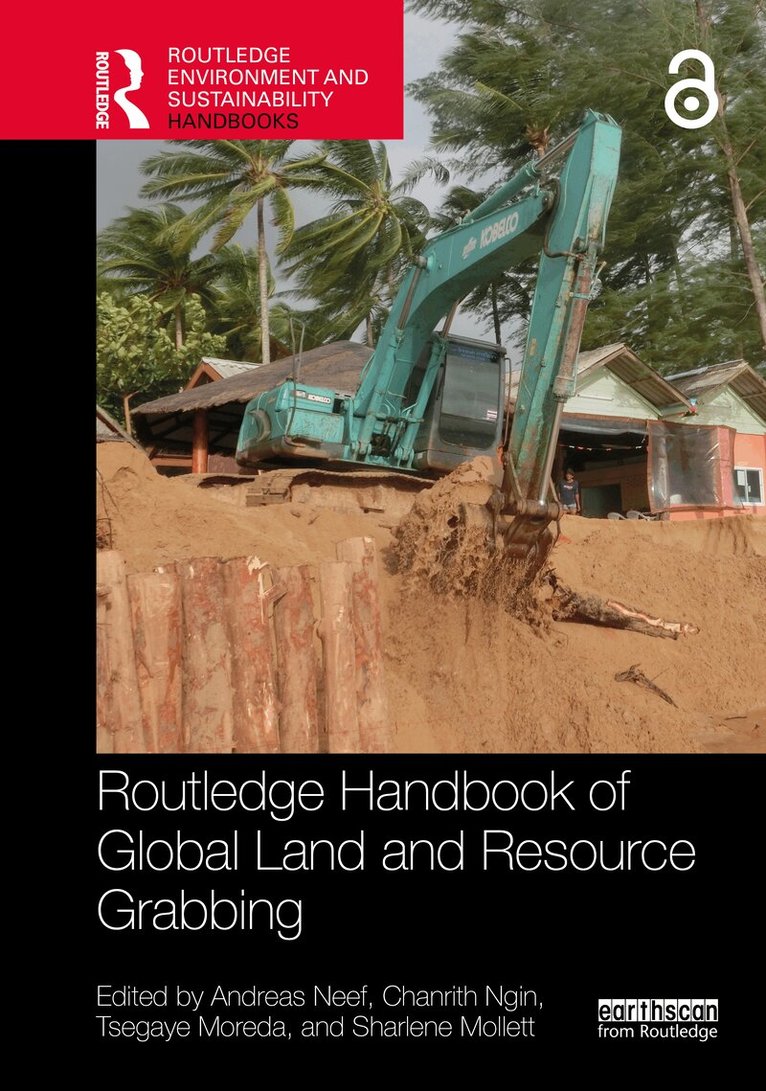
    Routledge Handbook of Global Land and Resource Grabbing

    AvAndreas Neef,Chanrith Ngin

    Häftad, Engelska, 2025

    Del i serien Routledge Environment and Sustainability Handbooks

    695 kr

    Beställningsvara. Skickas inom 10-15 vardagar. Fri frakt över 249 kr.

    Beskrivning

    This handbook provides a cutting-edge, comprehensive overview of global land and resource grabbing.Global land and resource grabbing has become an increasingly prominent topic in academic circles, among development practitioners, human rights advocates, and in policy arenas. The Routledge Handbook of Global Land and Resource Grabbing sustains this intellectual momentum by advancing methodological, theoretical and empirical insights. It presents and discusses resource grabbing research in a holistic manner by addressing how the rush for land and other natural resources, including water, forests and minerals, is intertwined with agriculture, mining, tourism, energy, biodiversity conservation, climate change, carbon markets, and conflict. The handbook is truly global and interdisciplinary, with case studies from the Global South and Global North, and chapter contributions from practitioners, activists and academics, with emerging and Indigenous authors featuring strongly across the chapters.The handbook will be essential reading for students and scholars interested in land and resource grabbing, agrarian studies, development studies, critical human geography, global studies and natural resource governance.The Open Access version of this book, available at www.taylorfrancis.com, has been made available under a Creative Commons Attribution-Non Commercial-No Derivatives 4.0 license.

    Produktinformation

    • Utgivningsdatum:2025-01-30
    • Mått:174 x 246 x 31 mm
    • Vikt:950 g
    • Format:Häftad
    • Språk:Engelska
    • Serie:Routledge Environment and Sustainability Handbooks
    • Antal sidor:482
    • Förlag:Taylor & Francis Ltd
    • ISBN:9780367532048

    Utforska kategorier

    • Referensverk och tvärvetenskap inom Samhälle och politik
    • Miljövetenskap och miljöpolitik inom Naturvetenskap och teknik
    • Etnicitet inom Samhälle och politik

    Mer om författaren

    Andreas Neef is Professor in Development Studies at the University of Auckland, New Zealand. He has researched and published in the areas of global land and resource grabbing, climate mobilities and mobility justice, climate change adaptation, post-disaster response and recovery, and community resilience. He is the author of Tourism, Land Grabs and Displacement: The Dark Side of the Feel-Good Industry (Routledge, 2021).Chanrith Ngin is Senior Research Fellow and Director of the Centre for Natural Resources and Environment at the Cambodia Development Resource Institute. He also serves as Honorary Academic at the University of Auckland, New Zealand. Earlier, he was a Senior Research Fellow and Professional Teaching Fellow at the University of Auckland, a Designated Professor at Nagoya University Cambodia Satellite Campus, and Dean of the Faculty of Development Studies at the Royal University of Phnom Penh, Cambodia.Tsegaye Moreda is Assistant Professor of Agrarian and Rural Studies at the International Institute of Social Studies (ISS) at Erasmus University Rotterdam, the Netherlands. His research interests are in the political economy of development, with a particular focus on agricultural, rural and environmental policies; land politics, rural-urban relations and synergies; natural resource politics and their implications for the environment, livelihoods, conflict and social justice.Sharlene Mollett is Associate Professor and Distinguished Professor in Feminist Cultural Geography, Nature and Society in the Departments of Human Geography and Global Development Studies at the University of Toronto, Canada. Her work interrogates Indigenous and Afro-descendant land struggles in Central America.

    Recensioner i media

    "Assembling a rich and diverse set of scholarly contributions, the handbook reviews what we know about land grabbing and identifies fresh lines of inquiry. It is an excellent resource for scholars and activists."Tania Murray Li, Professor of Anthropology, University of Toronto"An indispensable read, this handbook demonstrates that land and resource grabbing is much more than a sudden fever of corporate investment. It is a fundamental trait of contemporary capitalism."Jacobo Grajales, Professor of Political Science, Université de Lille, author of 'Agrarian Capitalism, War and Peace in Colombia. Beyond Dispossession'"The geographic scope – from the Arctic to sub-Saharan Africa, Brazil, Aotearoa New Zealand and a multitude of places in between – and the hugely diverse range of sectors, settings and actors mark this as the most comprehensive and nuanced examination of the 'global land grab' phenomena to date. The volume expands the temporal and sectoral boundaries of this ‘grabbing’ from colonial resource frontiers, into the ocean (‘blue-grabbing’) and urban environments and across arenas that include renewable energy, tourism and conservation (‘green-grabs’). Along with the important conceptual work here – from the emotional geographies of green grabs to the construction of governance processes that facilitate ‘grabbing’ – the volume represents a significant step-change in academic attention towards and understanding of land and resource grabs."Glenn Banks, Professor of Geography, School of People, Environment and Planning, Massey University, Aotearoa"While much has been written on the so-called 'global land grab' since the mid-2000s, there has to date been no authoritative resource on the issue. This volume admirable fills that gap, providing a comprehensive account that is both global in scope and replete with local case studies; that is historically informed and yet entirely contemporary in its coverage; and that is richly conceptualized and yet always grounded in real world examples. This will be a go-to resource for many years to come, not only for students and researchers but also for activists, policy makers and practitioners in the field of land and natural resource governance."Philip Hirsch, Emeritus Professor of Human Geography, University of Sydney"This impressive and clearly-written volume provides remarkably wide-ranging coverage of the objects, places, protagonists, narratives, technologies, causes, and institutions of 21st century land and resource grabbing. It illuminates the present while emphasizing the long histories of dispossession and resistance that shape, and are continued in, contemporary struggles. Recommended for beginners and experts alike."Derek Hall, Associate Professor, Political Science and Balsillie School of International Affairs, Wilfried Laurier University

    Innehållsförteckning

    • Chapter 1. Global Land and Resource Grabbing: An IntroductionAndreas Neef, Sharlene Mollett, Chanrith Ngin and Tsegaye MoredaPart 1: Historical Trajectories of Land and Resource GrabbingChapter 2. From the Colonial Doctrine of Discovery to Contemporary Land Grabs: "Dignity Taking" against the PoorThembela KepeChapter 3. Riro Whenua Atu, Hoki Whenua Mai: Land Grabbing in British Settler States and Contested Land Restitution to Māori in Aotearoa New ZealandMargaret MutuChapter 4. Ruptures and Continuities: How the Global Land "Rush" (Re)produces Slow Violence on Latin America’s Resource FrontiersJoel E. CorreiaPart 2: Enabling Mechanisms and Governance of Land and Resource GrabbingChapter 5. Capture Land: Anti-Squatting Policy as Processual Land Grab in JamaicaRachel GoffeChapter 6. The Rule of Technocrats? Historical Conditions for a Land Grab in Northern GuatemalaKevin GouldChapter 7. Governing Land Concessions in LaosMiles Kenney-Lazar, Oliver Schönweger, Peter Messerli, and Vong NanhthavongPart 3: Large-Scale Land Acquisitions for Food, Feed and BiofuelsChapter 8. Sugar Agro-Extractivism: Land Enclosures, Contract Farming and the Sugar Frontier in AfricaGiuliano MartinielloChapter 9. Conceptualizing Contract Farming in the Global Land Grabbing DebateMark Vicol and Helena Pérez NiñoChapter 10. GMOs, the Land Grab, and Epistemological EnclosuresLindsay NaylorPart 4: Taking Land for Conservation, Eco-Tourism, Renewable Energy and Carbon MarketsChapter 11. Green Territoriality and Resource Extraction in CambodiaSarah Milne, Tim Frewer, and Sango MahantyChapter 12. Towards Climate-Smart Land Policy: Land Grabbing under a Changing Political Landscape in MozambiqueNatacha Bruna and Aires A. MbanzeChapter 13. Renewables Grabbing: Land and Resource Appropriations in the Global Energy TransitionArnim Scheidel, Alevgul H. Sorman, Sofia Avila, Daniela Del Bene, and Jonas OttChapter 14. Geospatial Technologies in Tourism Land and Resource Grabs: Evidence from Guatemala’s Protected AreasLaura Aileen Sauls and Jennifer A. DevinePart 5: Land Grabbing by Extractive Industries – Fossil Fuels, Minerals and MetalsChapter 15. Arctic Resource Extraction in the Context of Climate Crises and Ecological CollapsesMarkus KrögerChapter 16. Territorial Control, Dispossession and Resistance: The Political Economy of Large-Scale Mining in AsiaPascale Hatcher and Etienne Roy GrégoireChapter 17. Phosphate Mining in Distant Places: The Dark Side of New Zealand’s Agricultural Economic SuccessCatherine Alexander, Katerina Teaiwa, and Andreas NeefPart 6: Blue Grabbing – The Global Rush for Freshwater and Marine ResourcesChapter 18. Cases of Water Grabbing in Waterscape Developments in IndiaMansee Bal BhargavaChapter 19. The Historical Assembly of Oceania’s Deep-Sea Mining FrontierOliver Lilford and Matthew G. AllenChapter 20. Resource Grabbing and the Blue Commons: The Evolution of Institutions in Scallop Production in Sechura Bay, PeruAchim Schlüter, Lotta Clara Kluger, María Garteizgogeascoa, and Gerardo DamonteChapter 21. Coastal Grabbing by Extractive Industries in the South Pacific: The Case of FijiGlenn Finau, Renata Varea, Rufino Varea, Sivendra Michael, and Andreas NeefPart 7: Land Grabs for Large Infrastructure ProjectsChapter 22. Corridors of Connectivity and Infrastructural Land Grabbing in LaosJessica DiCarlo and Kearrin SimsChapter 23. Large Infrastructure Projects and Cascading Land Grabs: The Case of Northern KenyaEvelyne Atieno Owino, Kennedy Mkutu, and Charis EnnsChapter 24. The Great ‘Anti-Politics’ Progress Machine: Mega-Infrastructure Projects, Disenchanted Institutional Change and Dramas of Grabbed CommonsTobias Haller and Samuel WeissmanPart 8: Urban Land Grabs and Special Economic ZonesChapter 25. Urban Land Grabs: An Overview of the IssuesKei Otsuki, Murtah Shannon, Griet Steel, and Femke van NoorloosChapter 26. History and Contemporary Displacement in Suva’s Informal SettlementsEberhard Weber, Camari Koto, Andreas Kopf, Maelin Bhagwan, Asenaca Nawaqalevu, Nicholas Halter, and Koini VamosiChapter 27. Transnational NGO Advocacy to Address Land Grabbing Injustices: The Case of the Thilawa Special Economic Zone in MyanmarSetsuko MatsuzawaPart 9: Land and Resource Grabbing: Resistance, Restitution and RemediesChapter 28. After the Rubber Boom: A Cautionary Tale from Southern Laos and Northeastern CambodiaIan G. BairdChapter 29. Gender and Dispossession in India: Dynamics of Women’s Participation in Anti-Land Grabbing StrugglesSaba JoshiChapter 30. The Role of Emotions in Resistance Movements against Land and Resource Grabs: New Evidence from CambodiaAlice Beban and Sochanny HakChapter 31. Filling Gaps in International Human Rights Law to Address Global Land and Resource Grabbing – Extraterritorial Human Rights Law Obligations of States and the Rights of Future GenerationsFons Coomans, Rolf Künnemann, and Andreas Neef