• Fri frakt över 249 kr
  • •
  • Snabba leveranser
  • •
  • Billiga böcker
Kundservice

Du är på sajten för privatpersoner.

Företag, bibliotek eller offentlig verksamhet?

Du handlar på classic.bokus.com, där alla dina funktioner finns intakta.
Till classic.bokus.com
Bokus logotyp. Gå till startsidan.
  • Erbjudanden
  • Nyheter
  • Student
  • Topplistor
  • Barn & ungdom
  • Bokus Play
  • E-böcker
  • Pocketböcker
  • Spel & pussel

10% rabatt på allt med kod: NYSTART10 →

Sidfot

Mina sidor

    Hjälp

    • Kundservice
    • Vanliga frågor och svar
    • Frakt och leverans
    • Retur vid ångerrätt
    • Reklamera vara
    • Betalning
    • Köpvillkor
    • Allmänna villkor
    • Information om webbplatsens tillgänglighet

    Om Bokus

    • Om oss
    • Pressrum
    • För studenter
    • För företag
    • För bibliotek och offentlig verksamhet
    • För leverantörer
    • Hållbarhet

    Populärt

    • Aktuella erbjudanden
    • Presentkort
    • Studentlitteratur
    • Nya böcker
    • Topplistor
    • Signerade böcker
    • Engelska böcker

    Inspiration

    • Boktips
    • BookTok
    • Populära bokserier
    • Barnbokskaraktärer
    • Populära författare
    Logotyp för Bokus
    Följ oss på Facebook (extern länk)Följ oss på Instagram (extern länk)Följ oss på YouTube (extern länk)Följ oss på TikTok (extern länk)
    bokus @ CookiesAnpassa cookiesIntegritetspolicyKöpvillkor
    Till Citymail hemsida (extern länk)Till Budbee hemsida (extern länk)Till Postnord hemsida (extern länk)Till Schenker hemsida (extern länk)Till Early Bird hemsida (extern länk)Till Walleys hemsida (extern länk)
    1. Kultur
    2. Arkitektur
    3. Arkitekturhistoria

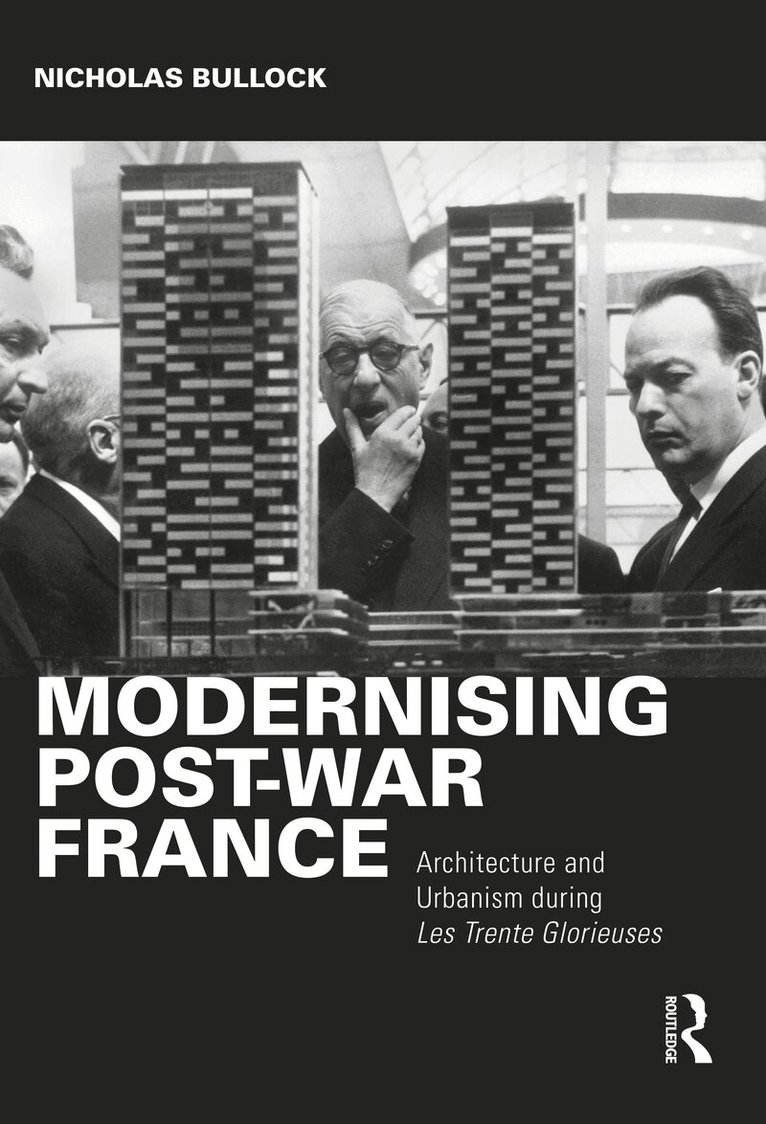
    Modernising Post-war France

    Architecture and Urbanism during Les Trente Glorieuses

    AvNicholas Bullock

    Inbunden, Engelska, 2022

    2 117 kr

    Beställningsvara. Skickas inom 10-15 vardagar. Fri frakt över 249 kr.

    Fler format och utgåvor

    Häftad

    600 kr

    E-bok

    708 kr

    E-bok

    708 kr

    Beskrivning

    This book is about the role played by architects, engineers and planners in transforming France during the three post-war decades of growing prosperity, a period when modernisation was a central priority of the state, promising a way forward from the shame of defeat in 1940 to a place at the centre of the new Europe.The first part of the book examines the scale of transformation, showing how architecture and urbanism both served the cause of modernisation and shaped the identity of the new France. Mainstream modernism was co-opted to the service of the state, from major public buildings to Gaullist plans for the transformation of Paris to establish the city as the ‘capital’ of Europe.By contrast, the second part of the book explores the critique of state-sponsored modernisation by radical architects from Le Corbusier to the young Turks of the 1960s such as Georges Candilis and the students who attacked the banality of mainstream modernism and its inability to address the growing problems of France’s cities. Following May 1968, the Beaux-Arts was closed, the Grand Prix de Rome, symbol of the old order, abolished – for a while the establishment might continue as before, but progressive architecture was set on a new course.Beautifully illustrated and written to be accessible to all, the book sets the discussion of architecture and urbanism in its social, political and economic contexts. As such, it will appeal both to students and scholars of the history of architecture and urbanism and to those with a wider interest in France’s post-war history.

    Produktinformation

    • Utgivningsdatum:2022-11-22
    • Mått:174 x 246 x undefined mm
    • Vikt:762 g
    • Format:Inbunden
    • Språk:Engelska
    • Antal sidor:304
    • Förlag:Taylor & Francis Ltd
    • ISBN:9780367556501

    Utforska kategorier

    • Arkitekturhistoria inom Kultur
    • Regional planering inom Naturvetenskap och teknik
    • Arkitektur inom Kultur

    Mer om författaren

    Nicholas Bullock, a Fellow of King’s College, was Professor of the History of Architecture and Urbanism of the 20th Century in the Department of Architecture, University of Cambridge, and lectured at the Architectural Association in London for over 40 years. Originally admitted for modern languages, he read architecture at Cambridge and completed his Ph.D. under the supervision of Sir Leslie Martin. He was a founder member of the Martin Centre for Architecture and Urban Studies, established in 1967. He has published widely on the architecture, housing and planning issues of the 20th century in Britain, Germany and France.

    Recensioner i media

    This is a fascinating story, very well told. It dives into great detail on some aspects, like the determined efforts to bring in modern construction methods, or the evolving shape of architects’ education, but not in a way that breaks up the narrative, and the treatment of housing and planning choices in Paris and its region is crystal-clear. It’s clearly based on a huge amount of reading and research…knocked into a compelling story of a state and a profession grappling with vital social issues, in ways that sometimes recall British struggles, and sometimes look culturally very different….this is a masterful review of a fascinating period in the development history of our endlessly-interesting neighbour, full of insights into the professions and culture that shaped an era.Martin Crookston, Built Environment Vol 49 No 2

    Innehållsförteckning

    • Preface Abbreviations Introduction: Architecture, Urbanism and the Trente Glorieuses Part 1: Modernisation Takes Command: From Austerity to Affluence 1. Reconstruction 1945–56: rebuilding or modernisation? 2. Industrialising the building industry 3. The grands ensembles and the modernisation of housing, 1953–62 4. Modern France at home: shaping the new domestic ideal, 1953–63 5. Public architecture of the 1950s: towards a new architecture for state and industry 6. ‘15,000 hectares to reconquer’: the struggle to modernise Paris, 1955–65 7. Modernising the Paris region: from the SDAU to the New Towns, 1965–75 Part 2: Opposing Modernisation: From Resistance to Revolt 8. Modernism versus modernisation: the Unité d’habitation at Marseille 9. Radicals and opposition to the modern city in the 1960s 10. Revolt and the search for new directions, 1968–73 Epilogue: 1975, France transformed Image Credits Index