• Fri frakt över 249 kr
  • •
  • Snabba leveranser
  • •
  • Billiga böcker
Kundservice

Du är på sajten för privatpersoner.

Företag, bibliotek eller offentlig verksamhet?

Du handlar på classic.bokus.com, där alla dina funktioner finns intakta.
Till classic.bokus.com
Bokus logotyp. Gå till startsidan.
  • Erbjudanden
  • Student
  • Topplistor
  • Barn & ungdom
  • Bokus Play
  • E-böcker
  • Ljudböcker
  • Pocketböcker
  • Spel och pussel

Pocketfynda! Hundratals böcker för 49 kr/st →

Sidfot

Mina sidor

    Hjälp

    • Kundservice
    • Vanliga frågor och svar
    • Frakt och leverans
    • Retur vid ångerrätt
    • Reklamera vara
    • Betalning
    • Köpvillkor
    • Allmänna villkor
    • Information om webbplatsens tillgänglighet

    Om Bokus

    • Om oss
    • Pressrum
    • För studenter
    • För företag
    • För bibliotek och offentlig verksamhet
    • För leverantörer
    • Hållbarhet

    Populärt

    • Aktuella erbjudanden
    • Presentkort
    • Studentlitteratur
    • Nya böcker
    • Topplistor
    • Signerade böcker
    • Engelska böcker

    Inspiration

    • Boktips
    • BookTok
    • Barnbokskaraktärer
    • Populära författare
    Logotyp för Bokus
    Följ oss på Facebook (extern länk)Följ oss på Instagram (extern länk)Följ oss på YouTube (extern länk)Följ oss på TikTok (extern länk)
    bokus @ CookiesAnpassa cookiesIntegritetspolicyKöpvillkor
    Till Citymail hemsida (extern länk)Till Budbee hemsida (extern länk)Till Postnord hemsida (extern länk)Till Schenker hemsida (extern länk)Till Early Bird hemsida (extern länk)Till Walleys hemsida (extern länk)
    1. Naturvetenskap och teknik
    2. Geovetenskap
    3. Miljövetenskap och miljöpolitik

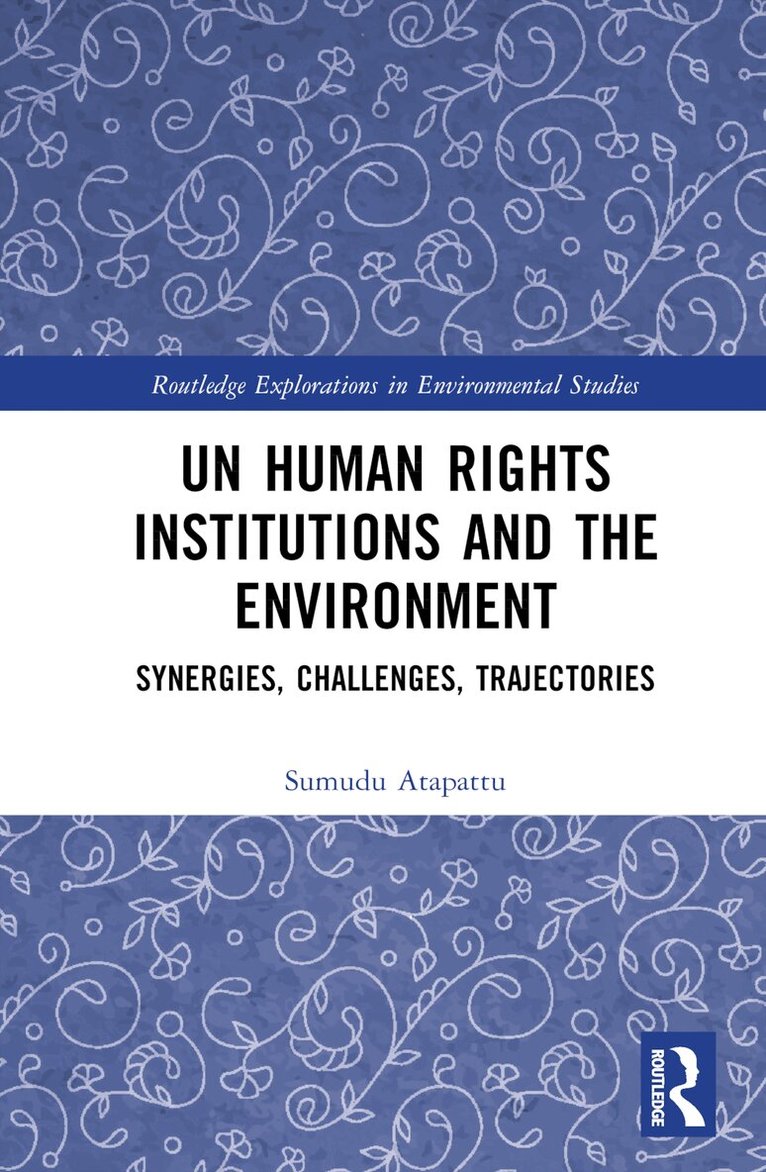
    UN Human Rights Institutions and the Environment

    Synergies, Challenges, Trajectories

    AvSumudu Atapattu

    Häftad, Engelska, 2024

    Del i serien Routledge Explorations in Environmental Studies

    572 kr

    Beställningsvara. Skickas inom 10-15 vardagar. Fri frakt över 249 kr.

    Fler format och utgåvor

    Inbunden

    2 218 kr

    Beskrivning

    This book presents an in-depth analysis of how UN human rights institutions and mechanisms have addressed environmental protection, sustainable development, and climate change. Despite the increasing involvement of UN human rights bodies in addressing environmental degradation and climate change, a systematic review of the convergence between human rights and the environment in these bodies has not been carried out. Filing this lacuna, this book surveys the resolutions, general comments, concluding observations, decisions on individual communications and press releases. It identifies principles that have emerged, explores the ways in which human rights charter-based and treaty-based institutions are interpreting environmental principles and examines how they contribute to the emerging field of human rights and the environment. Given the disproportionate effect that polluting activities have on marginalized and vulnerable groups, Atapattu also discusses how these human rights mechanisms have addressed the impact on women, children, indigenous peoples, people with disabilities, and racial minorities.Written by a world-renowned expert on human rights and the environment, this book will be of great interest to students and scholars researching and teaching in this important field of study.

    Produktinformation

    • Utgivningsdatum:2024-10-04
    • Mått:156 x 234 x 19 mm
    • Vikt:540 g
    • Format:Häftad
    • Språk:Engelska
    • Serie:Routledge Explorations in Environmental Studies
    • Antal sidor:320
    • Förlag:Taylor & Francis Ltd
    • ISBN:9780367653132

    Utforska kategorier

    • Miljövetenskap och miljöpolitik inom Naturvetenskap och teknik
    • Folkrätt inom Juridik

    Mer om författaren

    Sumudu Atapattu is Teaching Professor and Director of the Global Legal Studies Center at the University of Wisconsin Law School. She is also the Executive Director of the campus-wide interdisciplinary Human Rights Program. She serves as the Lead Counsel for Human Rights at the Center for International Sustainable Development Law based in Montreal, Canada, is on the advisory board of the McGill International Journal of Sustainable Development Law and Policy, and is affiliated faculty at the Raoul Wallenberg Institute for Human Rights and Humanitarian Law, Sweden. She has published widely in the fields of international environmental law, climate change and human rights, environmental rights, and sustainable development.

    Recensioner i media

    "This latest work of Sumudu Atapattu is a much-needed contribution to the field of study of climate change and human rights.The devastating impacts of climate change are worsening as actors around the world engage to safeguard human life and protect the rights of all, including those most vulnerable and exposed.Professor Atapattu helps the academic as well as the policy and activist communities better understand how a human rights framing helps victims of environmental degradation. In whatever environmental arena one finds oneself, this book is a required tool and an important asset." Ambassador Dessima Williams, Formerly, Special Advisor on Sustainable Development Goals and Director, Office of the President of the UN General Assembly, Ambassador and Permanent Representative of Grenada to the UN & Chair, Alliance of Small Island Developing States"UN Human rights institutions are increasingly addressing the human rights impact of environmental degradation including climate change and unsustainable development, despite their mandates’ silence on these issues.In this volume, Sumudu Atapattu lends her expertise to this emerging field and provides a comprehensive overview of how these human rights bodies have addressed these interlinkages. This volume fills a gap in the scholarly literature and should be of interest to scholars, students, activists, government officials, think tanks, and practicing lawyers."Professor Carmen G. Gonzalez and Morris I. Leibman, Professor of Law, Loyola University Chicago School of Law"This brilliant survey by Sri Lankan international lawyer Sumudu Atapattu comes at a propitious moment -- viz., the adoption by the UN General Assembly of Resolution on "the human right to a clean, healthy and sustainable environment", preceded by a UN Human Rights Council Resolution. As explained by the author, it is not the intention of this study to engage in a discussion of scholarly writing or a literature review of the multiple global and regional human rights institutions so surveyed, but to examine the practice of these institutions in relation to environmental issues and whether there are any principles, standards and consistencies, giving birth to a new interdisciplinary area, and concluding with a critical analysis of the potential fragmentation and cross-fertilization in this emerging field."Professor Peter H. Sand, Institute of International Law, University of Munich, Formerly Legal Adviser for Environmental Affairs, World Bank, Commissioner for environmental damage, UN Compensation Commission, Geneva

    Innehållsförteckning

    • ContentsForewordAcknowledgementsAbout the authorAbbreviationsTable of casesTable of treaties and other instrumentsPart IIntroduction and overview of international human rights law1 UN Human Rights Institutions and the Environment: Framing the Issues1.1 Introduction1.2 Environmental issues covered1.2.1 Environmental pollution, environmental degradation and environmental protection1.2.2 Climate change1.2.3 Sustainable development and Sustainable Development Goals 1.2.4 Other issues covered1.3 Methodology1.4 Outline of the book and overview of chapters2 An Overview of International Human Rights Law and the Emergence of Environmental Rights2.1 Introduction2.2 An overview of International Human Rights Law2.2.1 International Bill of Rights2.2.2 Typology of rights2.3 An overview of human rights institutions2.3.1 Treaty-based mechanisms2.3.2 Charter-based mechanisms2.3.3 Office of the High Commissioner for Human Rights2.4 Rights affected by environmental degradation2.4.1 Right to life2.4.2 Right to health2.4.3 Rights to food, water and sanitation2.4.4 Right of self-determination2.5 Specialized treaties on vulnerable groups2.6. Emergence of environmental rights and the right to a healthy environment2.6.1 Articulation of environmental rights2.6.2 Developments at the UN: The creation of special mandates2.7 Other global efforts to recognize environmental rights 2.7.1 Draft International Covenant on the Human Right to the Environment2.7.2 Global Pact for the Environment2.8 Regional developments2.9 Developments at the national level2.10 ConclusionPart IICharter-based mechanisms3 UN Human Rights Council and the Office of the High Commissioner for Human Rights3.1 Human Rights Council 3.1.1 Introduction and mandate3.1.2 Universal Periodic Review and working group recommendations3.1.2.1 Environmental protection3.1.2.2 Climate change3.1.2.3 Sustainable development and SDGs3.1.2.4 Indigenous rights3.1.2.5 Business enterprises and transnational corporations3.1.3 Resolutions of the HRC 3.1.3.1 Environmental protection/degradation3.1.3.2 Climate change3.1.3.3 Sustainable development and SDGs3.2 Office of the High Commissioner for Human Rights 3.2.1 Environmental protection/degradation3.2.2 Climate change3.2.3 Sustainable development and SDGs3.3 Conclusion4 Special Procedures Mandate Holders4.1 Introduction4.2 Appointment of a Special Rapporteur on Human Rights and the Environment4.3 Special Rapporteur on the Implications for Human Rights of the Environmentally Sound Management and Disposal of Hazardous Substances and Wastes4.4 Independent Expert on Human Rights and the Environment4.5 Special Rapporteur on Human Rights and Environment4.5.1 Framework Principles on Human Rights and Environment4.5.2 David Boyd as Special Rapporteur4.6 Special Rapporteur on Cultural Rights4.7 Special Rapporteur on the Right to Food4.8 Special Rapporteur on Extreme Poverty and Human Rights4.9 The Working Group on Human Rights and Transnational Corporations and other Business Enterprises4.10 Special Rapporteur on Contemporary Forms of Racism, Racial Discrimination, Xenophobia and Related Intolerance4.11 Special Rapporteur on Indigenous Peoples4.12 Special Rapporteur on Climate Change and Human Rights4.13 Complaint submitted to special mandate holders on Rights of Indigenous Peoples in addressing climate-forced displacement4.14 Conclusion Part IIITreaty-based mechanisms5 UN Human Rights Committee5.1 Introduction and mandate5.2 General comments5.3 Concluding observations5.3.1 Environmental pollution, environmental management and natural resource management5.3.2 Climate change5.3.3 Indigenous peoples5.4 Individual communications5.5 Conclusion6 Committee on Economic, Social, and Cultural Rights6.1 Introduction6.2 General comments6.3 Concluding observations6.3.1 Climate change6.3.2 Environmental pollution, environmental degradation, and environmental impact of mining operations and extractive industries6.3.3 Sustainable Development and Sustainable Development Goals6.3.4 Indigenous rights6.3.5 Human rights defenders6.4 Resolutions, statements and press releases6.5 Conclusion7 Committee on the Elimination of Discrimination Against Women 7.1. Introduction and mandate7.2. General recommendations7.2.1 Sustainable development and SDGs7.2.2 Environmental impact assessments and free, prior and informed consent7.2.3 Climate change7.3. Concluding observations7.3.1 Climate change7.3.2 Sustainable Development Goals (SDGs)7.3.3 Environmental pollution7.3.4 Renewable energy7.3.5 Women human rights defenders7.4 Conclusion8 Committee on the Rights of the Child8.1 Introduction and mandate8.2 General Comments8.2.1 Proposed General Comment on Environment and Climate Change8.3 Concluding observations8.3.1 Climate change8.3.2 Environmental health/pollution/degradation8.3.3 Children’s rights and the business sector8.3.4 Sustainable Development/SDGs8.3.5 Other issues discussed/recommendations made8.4 Individual complaints8.4.1 Amici curiae brief of Special Rapporteurs8.4.2 CRC Committee decision8.5 Conclusion9 Other Treaty Bodies9.1 The Committee on the Rights of Persons with Disabilities9.1.1 General comments9.1.2 Concluding observations9.1.3 Disaster risk reduction and climate change9.1.4 Other relevant provisions9.2 Committee on the Protection of Rights of All Migrant Workers and Members of their Families9.2.1 General comments9.2.2 Concluding observations9.3 Committee on the Elimination of Racial Discrimination9.3.1 General recommendations9.3.2 Concluding observations9.4 Conclusion10 UN Human Rights Institutions and the Environment: Reflections, Challenges, Trajectories10.1 Introduction10.2 Principles, guidelines and standards10.3 General comments10.4 Individual communications10.5 Critiques10.6 Challenges 10.7 Fragmentation, cohesion, or cross-fertilization? 10.8 A research agenda for the futureIndex