• Fri frakt över 249 kr
  • •
  • Snabba leveranser
  • •
  • Billiga böcker
Kundservice

Du är på sajten för privatpersoner.

Företag, bibliotek eller offentlig verksamhet?

Du handlar på classic.bokus.com, där alla dina funktioner finns intakta.
Till classic.bokus.com
Bokus logotyp. Gå till startsidan.
  • Erbjudanden
  • Nyheter
  • Student
  • Topplistor
  • Barn & ungdom
  • Bokus Play
  • E-böcker
  • Pocketböcker
  • Spel & pussel

10% rabatt på allt med kod: NYSTART10 →

Sidfot

Mina sidor

    Hjälp

    • Kundservice
    • Vanliga frågor och svar
    • Frakt och leverans
    • Retur vid ångerrätt
    • Reklamera vara
    • Betalning
    • Köpvillkor
    • Allmänna villkor
    • Information om webbplatsens tillgänglighet

    Om Bokus

    • Om oss
    • Pressrum
    • För studenter
    • För företag
    • För bibliotek och offentlig verksamhet
    • För leverantörer
    • Hållbarhet

    Populärt

    • Aktuella erbjudanden
    • Presentkort
    • Studentlitteratur
    • Nya böcker
    • Topplistor
    • Signerade böcker
    • Engelska böcker

    Inspiration

    • Boktips
    • BookTok
    • Populära bokserier
    • Barnbokskaraktärer
    • Populära författare
    Logotyp för Bokus
    Följ oss på Facebook (extern länk)Följ oss på Instagram (extern länk)Följ oss på YouTube (extern länk)Följ oss på TikTok (extern länk)
    bokus @ CookiesAnpassa cookiesIntegritetspolicyKöpvillkor
    Till Citymail hemsida (extern länk)Till Budbee hemsida (extern länk)Till Postnord hemsida (extern länk)Till Schenker hemsida (extern länk)Till Early Bird hemsida (extern länk)Till Walleys hemsida (extern länk)
    1. Naturvetenskap och teknik
    2. Teknik och industri
    3. Energiteknik

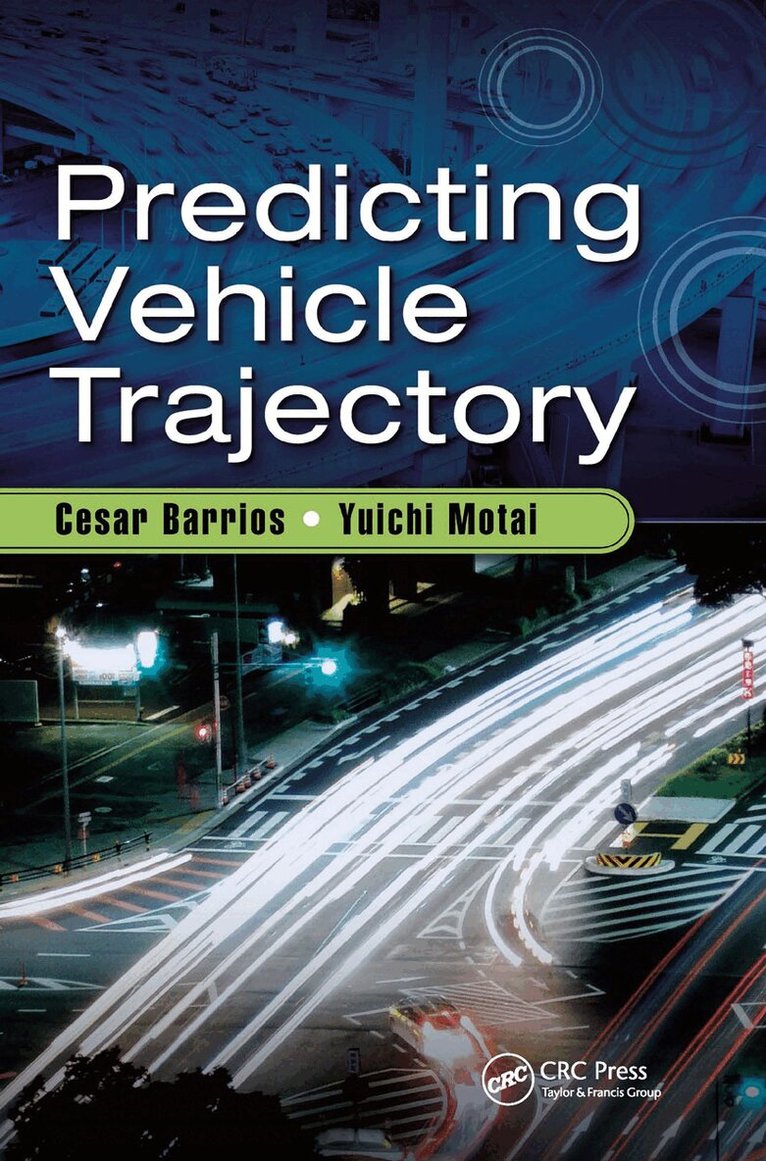
    Predicting Vehicle Trajectory

    AvCesar Barrios,Yuichi Motai

    Häftad, Engelska, 2020

    892 kr

    Beställningsvara. Skickas inom 10-15 vardagar. Fri frakt över 249 kr.

    Fler format och utgåvor

    Inbunden

    Tillf. slut

    Beskrivning

    This book concentrates on improving the prediction of a vehicle’s future trajectory, particularly on non-straight paths. Having an accurate prediction of where a vehicle is heading is crucial for the system to reliably determine possible path intersections of more than one vehicle at the same time. The US DOT will be mandating that all vehicle manufacturers begin implementing V2V and V2I systems, so very soon collision avoidance systems will no longer rely on line of sight sensors, but instead will be able to take into account another vehicle’s spatial movements to determine if the future trajectories of the vehicles will intersect at the same time. Furthermore, the book introduces the reader to some improvements when predicting the future trajectory of a vehicle and presents a novel temporary solution on how to speed up the implementation of such V2V collision avoidance systems. Additionally, it evaluates whether smartphones can be used for trajectory predictions, in an attempt to populate a V2V collision avoidance system faster than a vehicle manufacturer can.

    Produktinformation

    • Utgivningsdatum:2020-09-30
    • Mått:156 x 234 x 13 mm
    • Vikt:380 g
    • Format:Häftad
    • Språk:Engelska
    • Antal sidor:190
    • Förlag:Taylor & Francis Ltd
    • ISBN:9780367656348

    Utforska kategorier

    • Energiteknik inom Naturvetenskap och teknik
    • Teknik: allmänt inom Naturvetenskap och teknik
    • Motorfordon inom Naturvetenskap och teknik

    Mer om författaren

    Cesar Barrios received a B.S. (1999) and an M.S. (2001) in electrical engineering from the New Jersey Institute of Technology, and a Ph.D. degree (2014) in electrical engineering from the University of Vermont. He worked for IBM after graduating with his B.S. degree in 1999, and since 2015 he has been working for GLOBALFOUNDRIES. He began in the Information Technology field and has since moved into Semiconductor Research and Development.Yuichi Motai received his B.Eng. degree in instrumentation engineering from Keio University, Tokyo, Japan, in 1991, his M.Eng. degree in applied systems science from Kyoto University, Kyoto, Japan, in 1993, and his Ph.D. degree in electrical and computer engineering from Purdue University, West Lafayette, IN, U.S.A., in 2002. He is currently an Associate Professor of Electrical and Computer Engineering at Virginia Commonwealth University, Richmond, VA, USA. His research interests include the broad area of sensory intelligence (particularly in intelligent vehicle), pattern recognition, computer vision, and sensory-based robotics.

    Recensioner i media

    "I found specifically very important in this book the research conducted by the authors to properly handle error accumulation from missing data from offline sensors, and running the system at the fastest rate possible greatly reducing the prediction errors in non-straight paths (which are the harder task to predict). Moreover, I found very interesting the idea of using every-day equipment (smartphones) as a temporary (yet effective) solution to enable older vehicles to V2V and V2I technologies. It is also very important that the evaluation revealed that, in some cases, the smartphone prediction errors are similar to more expensive sensors in V2I. This book addresses solutions specifically for improved trajectory prediction in traffic networks. There is no question that this short book may be a valuable handbook for engineers, especially those who work on the specific problem trying to engage as much as possible users/vehicles in the V2V or V2I ecosystem."—IEEE Intelligent Transportation Systems Magazine, Fall 2017

    Innehållsförteckning

    • Preface. Improving Estimation of Vehicle’s Trajectory Using Latest Global Positioning System with Kalman Filtering. Intelligent Forecasting Using Dead Reckoning with Dynamic Errors. Trajectory Estimations Using Smartphones. Summary of Vehicle Trajectories’ Prediction Methods Evaluated. Conclusions. Appendix.