• Fri frakt över 249 kr
  • •
  • Snabba leveranser
  • •
  • Billiga böcker
Kundservice

Du är på sajten för privatpersoner.

Företag, bibliotek eller offentlig verksamhet?

Du handlar på classic.bokus.com, där alla dina funktioner finns intakta.
Till classic.bokus.com
Bokus logotyp. Gå till startsidan.
  • Erbjudanden
  • Nyheter
  • Student
  • Topplistor
  • Barn & ungdom
  • Bokus Play
  • E-böcker
  • Pocketböcker
  • Spel & pussel

10% rabatt på allt med kod: NYSTART10 →

Sidfot

Mina sidor

    Hjälp

    • Kundservice
    • Vanliga frågor och svar
    • Frakt och leverans
    • Retur vid ångerrätt
    • Reklamera vara
    • Betalning
    • Köpvillkor
    • Allmänna villkor
    • Information om webbplatsens tillgänglighet

    Om Bokus

    • Om oss
    • Pressrum
    • För studenter
    • För företag
    • För bibliotek och offentlig verksamhet
    • För leverantörer
    • Hållbarhet

    Populärt

    • Aktuella erbjudanden
    • Presentkort
    • Studentlitteratur
    • Nya böcker
    • Topplistor
    • Signerade böcker
    • Engelska böcker

    Inspiration

    • Boktips
    • BookTok
    • Populära bokserier
    • Barnbokskaraktärer
    • Populära författare
    Logotyp för Bokus
    Följ oss på Facebook (extern länk)Följ oss på Instagram (extern länk)Följ oss på YouTube (extern länk)Följ oss på TikTok (extern länk)
    bokus @ CookiesAnpassa cookiesIntegritetspolicyKöpvillkor
    Till Citymail hemsida (extern länk)Till Budbee hemsida (extern länk)Till Postnord hemsida (extern länk)Till Schenker hemsida (extern länk)Till Early Bird hemsida (extern länk)Till Walleys hemsida (extern länk)
    1. Samhälle och politik
    2. Samhälle och kultur
    3. Sociala och etiska frågor

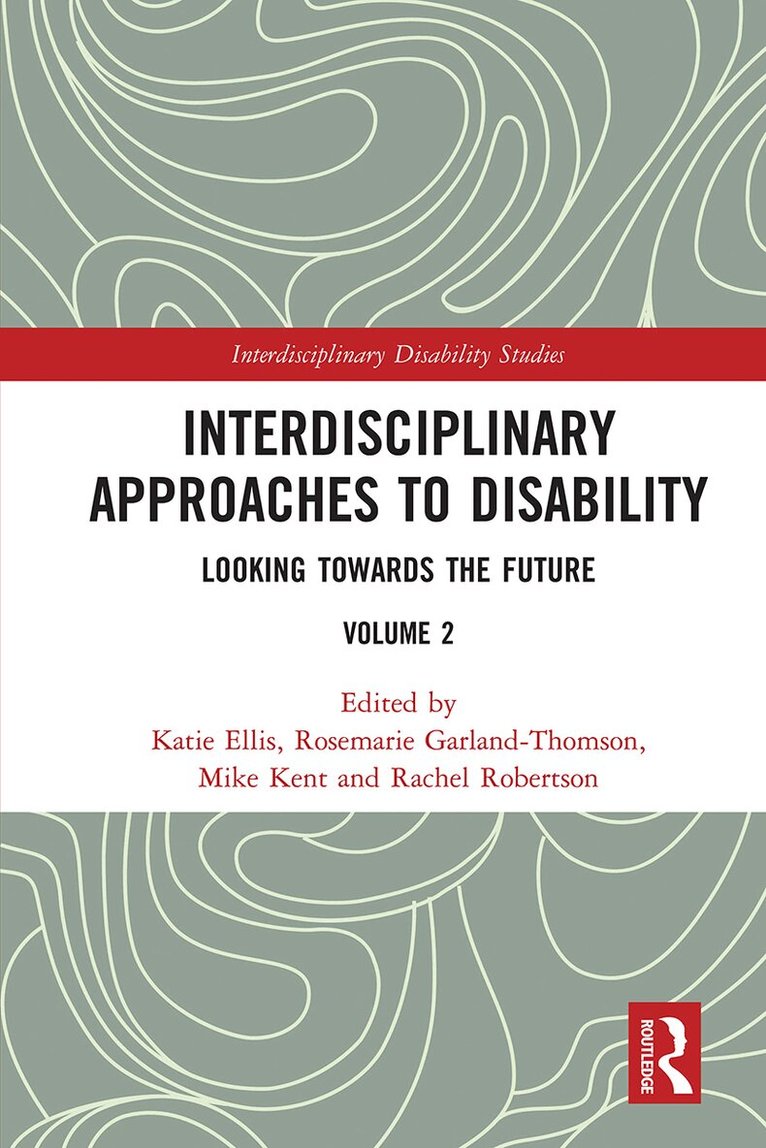
    Interdisciplinary Approaches to Disability

    Looking Towards the Future: Volume 2

    AvKatie Ellis,Rosemarie Garland-Thomson

    Häftad, Engelska, 2020

    Del i serien Interdisciplinary Disability Studies

    667 kr

    Beställningsvara. Skickas inom 10-15 vardagar. Fri frakt över 249 kr.

    Beskrivning

    How can a deep engagement with disability studies change our understanding of sociology, literary studies, gender studies, aesthetics, bioethics, social work, law, education, or history? Interdisciplinary Approaches to Disability (the companion volume to Manifestos for the Future of Critical Disability Studies) identifies both the practical and theoretical implications of such an interdisciplinary dialogue and challenges people in disability studies as well as other disciplinary fields to critically reflect on their professional praxis in terms of theory, practice, and methods.Topics covered include interdisciplinary outlooks ranging from media studies, games studies, education, performance, history and curation through to theology and immunology. Perspectives are drawn from different regions from the European Union to the Global South with chapters that draw on a range of different national backgrounds. Our contributors who write as either disabled people or allies do not proceed from a singular approach to disability, often reflecting different or even opposing positions. The collection features contributions from both established and new voices in international disability studies outlining their own visions for the future of the field. Interdisciplinary Approaches to Disability will be of interest to all scholars and students working within the fields of disability studies, cultural studies, sociology, law history and education. The concerns raised here are further in Manifestos for the Future of Critical Disability Studies.

    Produktinformation

    • Utgivningsdatum:2020-09-30
    • Mått:156 x 234 x 22 mm
    • Vikt:600 g
    • Format:Häftad
    • Språk:Engelska
    • Serie:Interdisciplinary Disability Studies
    • Antal sidor:326
    • Förlag:Taylor & Francis Ltd
    • ISBN:9780367663278

    Utforska kategorier

    • Sociala och etiska frågor inom Samhälle och politik
    • Sociologi inom Samhälle och politik
    • Socialt arbete och välfärd inom Samhälle och politik

    Mer om författaren

    Katie Ellis is associate professor and senior research fellow in Internet Studies at Curtin University. She holds an Australian Research Council Discovery Early Career Research award for a project on disability and digital televisions and is series editor of Routledge Research in Disability and Media Studies. Rosemarie Garland-Thomson is professor of English and bioethics at Emory University, where her fields of study are disability studies, American literature and culture, and feminist theory. Her work develops the field of critical disability studies in the health humanities, broadly understood, to bring forward disability access, inclusion and identity to communities inside and outside of the academy.Mike Kent is an associate professor and head of the School of Media, Creative Arts and Social Inquiry at Curtin University, Western Australia. Mike’s research focus is on people with disabilities and their use of, and access to, information technology and the Internet. Rachel Robertson is a senior lecturer at Curtin University with research interests in critical disability studies, literary and cultural studies, feminist maternal studies and life writing. She is the author of Reaching One Thousand: A Story of Love, Motherhood and Autism. Her articles on disability and motherhood have been published in journals such as Hecate, Studies in the Maternal and the Australasian Journal of Popular Culture.

    Innehållsförteckning

    • List of contributors; Acknowledgements; Chapter 1: Looking to the Future for Critical Disability Studies: Disciplines, Perspectives and Manifestos (Mike Kent, Katie Ellis, Rachel Robertson and Rosemarie Garland Thomson); Part One, Disciplines of Media and Communication; Chapter 2: Teaching disability studies and building a community of pedagogy through Facebook (Beth A. Haller and Matthew Wangeman); Chapter 3: Disability, Higher Education and E-learning: Moving beyond accessible web design (Mike Kent, Katie Ellis, Tim Pitman, Leanne McRae and Nathalie Latter); Chapter 4: On dis/ability within game studies: The discursive construction of ludic bodies (Simon Ledder); Chapter 5: Disability studies, big data and algorithmic culture (Olivia Banner); Part Two, Disciplines of Culture and Arts; Chapter 6: Sharing and shaping space: Notes toward an aesthetic ecology (Gretchen E. Henderson); Chapter 7: Why critical disability studies needs a cultural model of dis/ability (Anne Waldschmidt); Chapter 8: Celebrating the able body in contemporary disAbility performance (Suzanne Ingelbrecht); Chapter 9: Re-thinking care: Disability and narratives of care in Dinah Mulock Craik’s A noble life (1866) (Theresa Miller); Chapter 10: The politics of creative access: Guidelines for a critical dis/ability curatorial practice (Amanda Cachia); Chapter 11: Towards a critical disability studies model of teacher education (Saili S. Kulkarni); Part Three, Disciplines of Complexity and Innovation; Chapter 12: Complexity and disability: drawing from a complexity approach to think through disability at the intersections (Louisa Smith and Leanne Dowse); Chapter 13: Towards a crip methodology for critical disability studies (Louise Hickman and David Serlin); Chapter 14: Inserting disability pedagogies in mutable configurations of space and interaction (Brian Goldfarb and Suzanne Stolz); Chapter 15: Mobilising historical knowledge: Locating the disability archive (Natalie Spagnuolo); Chapter 16: Cripping immunity: Disability and the immune self (Travis Chi Wing Lau); Chapter 17: Theologising disability: Intersections of critique and collaboration (Sarah Jean Barton); Part Four, Perspectives of Place; Chapter 18: Hello from the other side: Why Iran remains excluded from global disability studies (Negin Hosseini Goodrich); Chapter 19: Misrecognising persons with disabilities in the Global South: The need for a comparative disability studies framework (Stephen Meyers); Chapter 20: An investigation into the social integration of people with disabilities in the European Union using a novel approach to cultural consonance analysis (Mirjam Holleman); Chapter 21: Different, not less: Communicating autism via the internet in Indonesia (Hersinta); Chapter 22: Making the irrelevant relevant: The case of the invisibles with disabilities in the Middle East (Najma Al Zidjaly); Part Five, Perspectives of Experience; Chapter 23: Human doing to human being: Western versus Indigenous views on differences in ability (Jillian Pearsall-Jones, Caris Jalla and George Hayden); Chapter 24: Strange beauty: Aesthetic possibilities for desiring disability into the future (Eliza Chandler and Esther Ignagni); Chapter 25: The Brazilian way: Media coverage of the London 2012 Paralympic Games (Tatiane Hilgemberg); Chapter 26: I could see the future: An ethnographic study of Deaf children’s transition from an oral school to a signing school (Pamela G Macias); Glossary; Index