• Fri frakt över 249 kr
  • •
  • Snabba leveranser
  • •
  • Billiga böcker
Kundservice

Du är på sajten för privatpersoner.

Företag, bibliotek eller offentlig verksamhet?

Du handlar på classic.bokus.com, där alla dina funktioner finns intakta.
Till classic.bokus.com
Bokus logotyp. Gå till startsidan.
  • Erbjudanden
  • Nyheter
  • Student
  • Topplistor
  • Barn & ungdom
  • Bokus Play
  • E-böcker
  • Pocketböcker
  • Spel & pussel

Må bättre, för mindre! Upp till 50% rabatt på hälsoböcker

Sidfot

Mina sidor

    Hjälp

    • Kundservice
    • Vanliga frågor och svar
    • Frakt och leverans
    • Retur vid ångerrätt
    • Reklamera vara
    • Betalning
    • Köpvillkor
    • Allmänna villkor
    • Information om webbplatsens tillgänglighet

    Om Bokus

    • Om oss
    • Pressrum
    • För studenter
    • För företag
    • För bibliotek och offentlig verksamhet
    • För leverantörer
    • Hållbarhet

    Populärt

    • Aktuella erbjudanden
    • Presentkort
    • Studentlitteratur
    • Nya böcker
    • Topplistor
    • Signerade böcker
    • Engelska böcker

    Inspiration

    • Boktips
    • BookTok
    • Populära bokserier
    • Barnbokskaraktärer
    • Populära författare
    Logotyp för Bokus
    Följ oss på Facebook (extern länk)Följ oss på Instagram (extern länk)Följ oss på YouTube (extern länk)Följ oss på TikTok (extern länk)
    bokus @ CookiesAnpassa cookiesIntegritetspolicyKöpvillkor
    Till Citymail hemsida (extern länk)Till Budbee hemsida (extern länk)Till Postnord hemsida (extern länk)Till Schenker hemsida (extern länk)Till Early Bird hemsida (extern länk)Till Walleys hemsida (extern länk)
    1. Psykologi och pedagogik
    2. Pedagogik
    3. Högskola och universitet

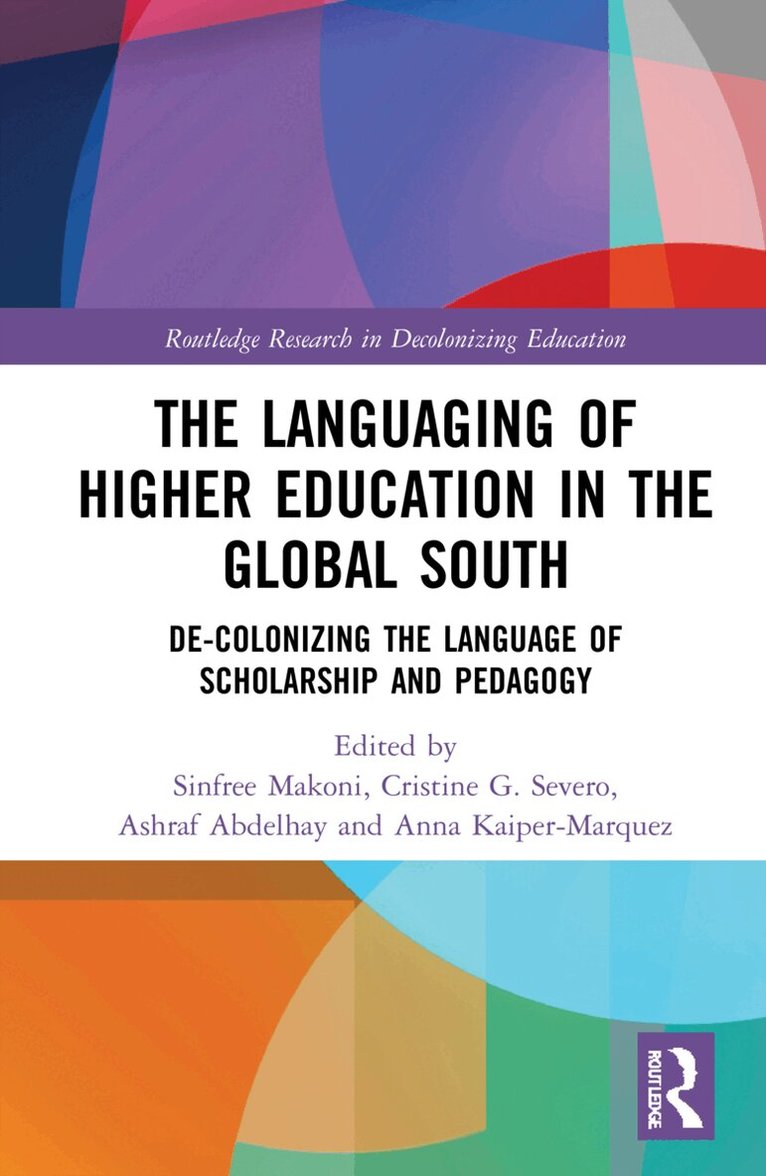
    Languaging of Higher Education in the Global South

    De-Colonizing the Language of Scholarship and Pedagogy

    AvSinfree Makoni,Cristine G. Severo

    Inbunden, Engelska, 2022

    Del i serien Routledge Research in Decolonizing Education

    2 352 kr

    Beställningsvara. Skickas inom 10-15 vardagar. Fri frakt över 249 kr.

    Beskrivning

    By foregrounding language practices in educational settings, this timely volume offers a postcolonial critique of the languaging of higher education and considers how Southern epistemologies can be used to further the decolonization of post-secondary education in the Global South.Offering a range of contributions from diverse and minoritized scholars based in countries including South Africa, Rwanda, Sudan, Qatar, Turkey, Portugal, Sweden, India, and Brazil, The Languaging of Higher Education in the Global South problematizes the use of language in various areas of higher education. Chapters demonstrate both subtle and explicit ways in which the language of pedagogy, scholarship, policy, and partcipiation endorse and privelege Western constructs and knowledge production, and utilize Southern theories and epistemologies to offer an alternative way forward – practice and research which applies and promotes Southern epistemologies and local knowledges. The volume confronts issues including integrationism, epistemic solidarity, language policy and ideology, multilingualism, and the increasing use of technology in institutions of higher education. This innovative book will be of interest to researchers, scholars, and postgraduate students in the fields of higher education, applied linguistics, and multicultural education. Those with an interest in the decolonization of education and language will find the book of particular use.

    Produktinformation

    • Utgivningsdatum:2022-01-07
    • Mått:152 x 229 x 18 mm
    • Vikt:453 g
    • Format:Inbunden
    • Språk:Engelska
    • Serie:Routledge Research in Decolonizing Education
    • Antal sidor:238
    • Förlag:Taylor & Francis Ltd
    • ISBN:9780367686536

    Utforska kategorier

    • Högskola och universitet inom Psykologi och pedagogik
    • Språkundervisning och språkinlärning inom Språk och ordböcker
    • Utbildningsstrategier och utbildningspolitik inom Psykologi och pedagogik

    Mer om författaren

    Sinfree Makoni is Professor of Applied Linguistics at the Pennsylvania State University, US. Cristine G. Severo is Associate Professor of Language Policy and Linguistics at the Federal University of Santa Catarina, Brazil. Ashraf Abdelhay is Associate Professor of Sociolinguistics at the Doha Institute for Graduate Studies, Qatar. Anna Kaiper-Marquez is Associate Director and Assistant Teaching Professor of the Institute for the Study of Adult Literacy and the Goodling Institute for Research in Family Literacy at Pennsylvania State University, US.

    Innehållsförteckning

    • Introduction Part 1: Confronting Epistemological Language Issues 1. Global North Technocratic Discourse in Arab Higher Education: The Case of a North American Technical College in an Arab State 2. Reflections on the Global North and Global South Engagement Initiative in Kinigi, Rwanda 3. Polycentric or Pluricentric? Epistemic Traps in Sociolinguistic Approaches to Multilingual Portuguese 4. RE-. Vocabularies we live by in the Language and Educational Sciences Part 2: Language Policy in Postcolonial Academic Contexts 5. Decolonizing Epistemology in Sudanese Linguistics: Integrationist and Political Perspectives 6. Multilingualism at South African Universities: A Eeflection from an Integrationist Perspective 7. ‘Everyone was Happy When Talking’: Revisiting the Use of Mother Tongues in Kenyan Universities 8. Existential Sociolinguistics: The Fundamentals of the Political Legitimacy of Linguistic Minority Rights Part 3: Languaging Pedagogy in Post-Secondary Contexts 9. Teaching Gender Awareness in Teacher Education through a Curriculum which De-links from Abyssal Thinking 10. Recontextualization of the Author’s and Reader’s Positions in Simone De Beauvoir’s Le Deuxième Sexe in the Turkish Cultural Environment Through Translation Part 4: Technology and Decolonial Practices 11. Languaging in Computer-Mediated Communication: Heteroglossia and Stylization in Online Education 12. (How) Can Critical Posthumanism Help to Decolonize Tertiary Education in the South in the Age of Cognitive Capitalism? 13. Concluding Commentary